Xi makes country's voice heard







President's visits to a dozen countries during year bolster diplomatic efforts
Under the leadership of President Xi Jinping, China remained committed to multilateralism and championed justice worldwide this year as it strove to push forward major-country diplomacy with Chinese characteristics, according to officials and analysts.
Over the year, Xi traveled to 12 countries in Asia, Europe and South America during seven overseas trips.
The president has taken a lead in safeguarding multilateralism, promoting equality around the world and firmly opposing unilateralism and hegemony.
Xi also presided over four major events hosted by China during the year: the second Belt and Road Forum for International Cooperation, the Conference on Dialogue of Asian Civilizations, the 2019 Beijing International Horticultural Exhibition and the second China International Import Expo.
State Councilor and Foreign Minister Wang Yi said: "Wherever he traveled in 2019, President Xi Jinping made China's voice heard. It is a voice of justice that rejects unilateralism, hegemony and power politics in favor of multilateralism, the authority of the United Nations and the norms of international relations."
As a responsible member of the international community, China has been a strong champion of multilateralism, Wang said late this month while summing up the country's diplomatic efforts over the year.
Economic globalization
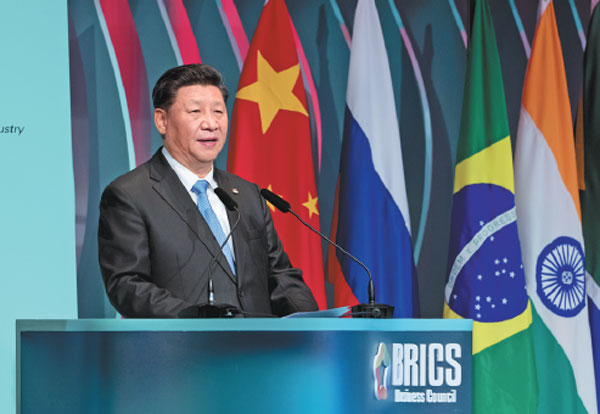
In his speech at the closing ceremony of the BRICS business forum in November in Brasilia, the Brazilian capital, Xi called for active participation by businesses in BRICS cooperation to promote economic growth and job creation amid a global economic slowdown arising from growing protectionism.
The BRICS nations are Brazil, Russia, India, China and South Africa.
Xi said a new round of the technological and industrial revolution is driving socioeconomic development amid mounting protectionism and economic tensions, which are eroding global trade and investment and weighing down the world economy.
"At present, economic globalization is encountering setbacks," Xi warned, adding that the BRICS countries need to stand firm against protectionism, uphold the WTO-centered multilateral trading system and increase the voice and influence of developing countries in international affairs.
The president's stance on safeguarding multilateralism and promoting economic globalization was evident in his key speeches delivered on a number of other important occasions.
At the opening ceremony for the second China International Import Expo in Shanghai early last month, Xi pledged that China would continue to deepen multilateral cooperation amid the country's efforts to achieve opening-up at a higher level.
"China is a champion for international cooperation and a supporter of multilateralism," Xi said.
Trips: Promoting BRI a key task
The Shanghai expo attracted an impressive gathering of 181 countries, regions and international organizations, more than 3,800 exhibitors and over 500,000 buyers worldwide. Business deals worth more than $71 billion were concluded, a rise of 23 percent year-on-year.
Ruan Zongze, executive vice-president of the China Institute of International Studies, said the world is undergoing profound changes unseen for a century, and some countries have resorted to unilateralism and protectionism to deal with the situation. This has had a grave impact on the international order.
China, as an important developing country, has proactively engaged itself in the tide of economic globalization and worldwide efforts to move in the direction of multi-polarization, he said.
Belt and Road
Promoting the Belt and Road Initiative remained one of the most important tasks on the president's diplomatic agenda for the past year. Xi has made continuous and sincere efforts to promote this ambitious proposal that aims to bring China and the rest of the world closer.
In April, China successfully hosted the second Belt and Road Forum for International Cooperation, which was attended by 40 national leaders and heads of international organizations, and nearly 6,000 representatives from 150 countries and 92 international organizations.
This year, China has signed documents on Belt and Road cooperation with 16 countries and international organizations, taking the number of such documents to 199.
Flagship projects such as the China-Pakistan Economic Corridor, the China-Laos Railway, the Jakarta-Bandung High-Speed Railway in Indonesia and the China-Europe Railway Express have created substantial development opportunities for participating countries.
In November, Xi and his wife, Peng Liyuan, accompanied by Greek Prime Minister Kyriakos Mitsotakis and his wife Mareva Grabowski-Mitsotakis, visited the Port of Piraeus.
In 2009, a subsidiary of China Ocean Shipping Company started managing the port's container terminals. In 2016, the Chinese company acquired a majority stake in the port and formally took over its management and operation.
To date, the project has created jobs for more than 10,000 local people directly and indirectly, and has built the port into the largest in the Mediterranean region and one of the fastest-growing container terminals in the world.
Xi said at the port that the Belt and Road Initiative is not an empty slogan, but a successful practice and a brilliant reality.
During his first overseas visit of the year in March to three European countries -Italy, Monaco and France - Xi also promoted the initiative, making substantial progress.
Witnessed by Xi and Italian Prime Minister Giuseppe Conte, the two countries signed a memorandum of understanding on jointly developing the BRI. Italy was the first G7 country to sign such an agreement with China.
Wang Yiwei, a professor of international relations at Renmin University of China in Beijing, said the BRI has brought numerous opportunities for the economic development of Europe.
Some European Union countries, including France, Germany, Italy and Switzerland, became founding members of the Asian Infrastructure Investment Bank, showcasing their pragmatic efforts to seize the opportunities offered by the initiative to pursue greater influence for their currencies, Wang said.
During his State visit to Russia in early June, Xi said the two countries should proactively push forward the connection between the Belt and Road and the Eurasian Economic Union and dedicate themselves to promoting integration of the regional economy.
In talks Xi held in June with Kyrgyzstan President Sooronbay Jeenbekov and Tajikistan's President Emomali Rahmon, in Bishkek and Dushanbe, the leaders agreed to implement the outcomes of the second Belt and Road Forum for International Cooperation and bring high quality to the Belt and Road.
Relations improved
In the past year, China has also seen improved relations with many neighboring countries.
During Xi's visit to Russia in June, he and Russian President Vladimir Putin signed two joint declarations — one on upgrading bilateral relations to a comprehensive strategic partnership of coordination for a new era and the other on strengthening global strategic stability.
According to a joint statement on the strategic partnership, the China-Russian relationship has entered a new era and is facing new opportunities for greater development.
The two countries have made smooth progress on synergizing the Belt and Road Initiative and the Eurasian Economic Union and also on implementing major strategic projects in areas such as energy, aviation, space and connectivity.
Early this month, Xi and Putin witnessed via video link the launch of the east route natural gas pipeline between the two countries, marking the start of a new era in energy cooperation
In October, Xi flew to the Indian coastal city of Chennai to attend the second India-China Informal Summit, following the first, which was staged in Wuhan, capital of Hubei province, a year ago.
During an informal meeting, Xi and Indian Prime Minister Narendra Modi agreed that a rules-based multilateral trading system should be supported and strengthened, and that China and India would continue to work for open and inclusive trade arrangements that benefit all nations.
On his trip to South Asia, Xi also traveled to Nepal for the first State visit to the country by a Chinese leader in 23 years. The two countries upgraded their relations to a strategic partnership of cooperation featuring everlasting friendship for development and prosperity.
On Dec 23, Xi held talks with Japanese Prime Minister Shinzo Abe at the Great Hall of the People in Beijing. It was the Japanese leader's second trip to Beijing in 14 months, following his official visit to the country in October last year.
Xi said China is willing to maintain close communications with Japan and strengthen political guidance to push the two countries' relations to a new level and better benefit the two peoples.
In late June, Xi met with Abe on the sidelines of the G20 summit in Osaka, Japan, where the two leaders reached a 10-point consensus on improving and expanding bilateral ties. Xi also agreed in principle to accept Abe's invitation to make a State visit to Japan in the spring.
Xi also paid a historic visit to the Democratic People's Republic of Korea in June, marking the 70th anniversary of China-DPRK diplomatic relations. The visit gave a new boost to the traditional friendship between the two countries.
Jin Yong, a professor of international relations studies at the Communication University of China, said Xi's efforts to promote "neighborhood diplomacy" have helped China to achieve a stable and favorable environment for development with its neighbors.
"Facing global challenges, including unilateralism and protectionism, it is necessary for China to build up good relations with neighboring countries," he said.


- Death toll rises to 156 in Hong Kong residential fire: HKSAR govt
- Protecting pristine NW China plateau lake from waste
- Chinese universities set to launch embodied intelligence majors to fill talent gap
- 10 foreign domestic helpers killed, 3 injured in Hong Kong residential fire: HKSAR govt
- Chinese scholars lead formulation of intl organoid standards
- Paleontologists uncover ancient elephant relative in Ningxia