Tech guru turns spotlight on accessibility







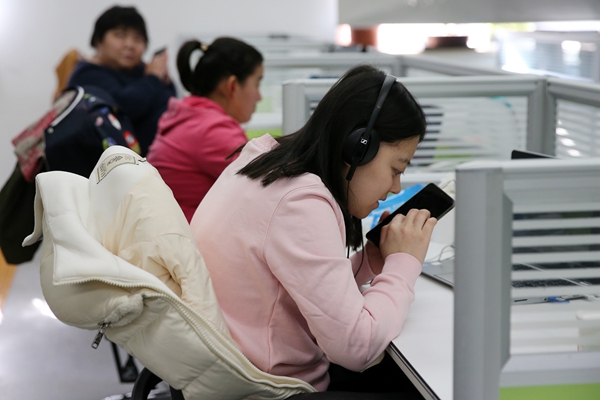
Data from the China Association of the Blind shows that the country has 17.31 million people who are visually impaired.
These people, and those with cognitive impairment, are very likely to meet obstacles in accessing information. In fact, an earlier report from news site jiemian.com points out that anyone could benefit from building an information environment through accessibility.
"The versatility and convenience of products will be enhanced when tech companies optimize them with fully-accessible functions. It will also broaden their user groups," says Zhang Kun, a leading expert at the Shenzhen-based Accessibility Research Association, in a video promoting the concept of web accessibility on the group's website.
"Many people think information accessibility is a public welfare issue, but for us, it's all about equality-everyone has the same right to acquire information," he says.
A large part of Cao's work over the past decade has been aimed at convincing technology companies like Tencent, Alibaba, Baidu and Didi to optimize their code and settings, to provide an interface-or adopt the latest image recognition technology-to assist visually impaired users to gain access to more non-visual information.
In 2019, the association signed up to a tie-in with Huawei, where newly released smartphones produced by the tech giant come with their screen-reading application already installed.
However, the rapid turnover of employees and product offerings of tech companies adds to the uncertainty of the process, Cao says.
In 2007, when smartphone maker Motorola launched a program to develop a type of phone made especially for blind people in China, Cao contributed to the design.
As one of them, he knows very well how blind people operate smartphones, understanding their needs and the logic behind their gestures as they use the device. He later played the role as an agent and sold around 20,000 phones.
It was during this period that he sniffed a fresh opportunity in the field of related technology, which finally led to him setting up his current business.
The enterprise has, however, been hit by controversy because their screen-reading app for smartphones is not being offered for free-people often take it for granted that things related to the disabled are simply for public welfare and should therefore be noncommercial.
"The problem is, we need to pay for our programmers' salaries and the marketing costs. We also need staff to teach our customers-especially those living in rural areas-how to use the app, as well as providing customized after-sale services. All these things cost money," Cao explains, acknowledging that it might be difficult for his customers to initially accept a product that costs over 200 yuan ($29).
A survey conducted by the company suggests visually impaired people in Beijing earn less than 3,000 yuan a month on average, according to Cao.
In the grand scheme of things, it's hard to accomplish an undertaking for the disabled without sustainable, self-perpetuating organizations. Cao has witnessed the failure of his peers and the disappearance of other social enterprises along the way.
"As long as you are providing services that are able to change the lifestyles of a certain disadvantaged group, and create job opportunities for them, it's entirely rational to have a sustainable revenue stream," Cao says.
As an enterprise that is supported by the Beijing Disabled Persons' Federation, Cao's company-Baoyi Interactive Technology Development Co-enjoys rent exemption and reduced tax.
He says their annual profits have grown at a rate of about 20 percent since 2013. The majority of their revenue is driven by the efforts of the government and charity groups. Only 35 percent of their income is driven by retail sales.
The company is now putting a lot of effort into software that supports smart home appliances, mainly based on the products developed by electronics giant Xiaomi.
More than 25 of the company's 43 employees are visually impaired or completely blind, including the programmers and testers. They mainly write in JavaScript and devote their time to developing mini programs on WeChat and other support tools like audio clocks.
However, it can take the visually impaired more than a week to finish a workload that sighted programmers-by far the majority in the coding industry-would normally complete in a day.