Tianjin project one of many for veteran Australian architect







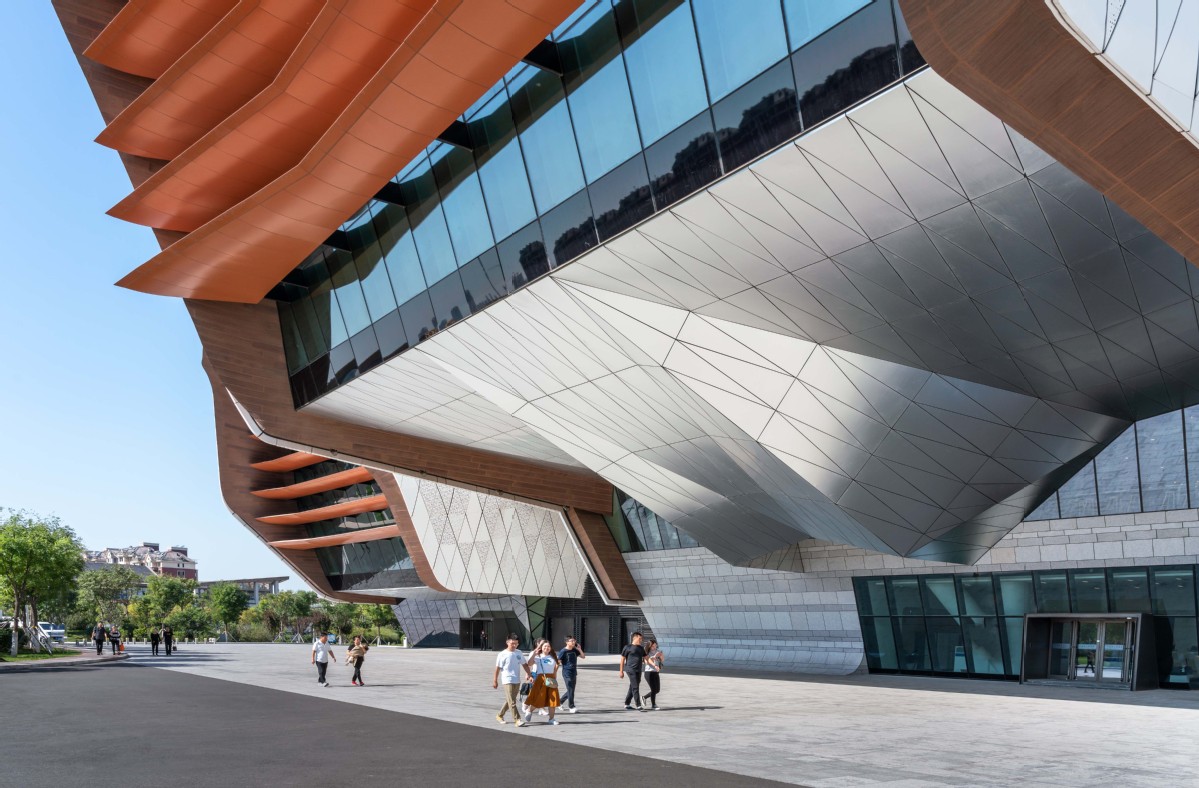
Philip Cox, whose company won the international design competition for the National Maritime Museum of China, may not be a household name in Australia, but among architects he ranks with the best.
Despite turning 80 this year, Cox is still highly active at his practice. He started work with architect Ian McKay in 1963 and the following year formed his own company, Philip Cox and Associates, now known as Cox Architecture.
Cox has strong views on architecture and its place in society. "In the 19th century, it was mainly stone and brick," he said, sitting in his open plan studio in Sydney. Cox Architecture also has other studios in Brisbane, Perth, Adelaide and Canberra.
"Today, it's all steel. They (buildings) are quick to put up and can be deconstructed very quickly. Nothing is sacred anymore," Cox said.
"Some of the buildings they are putting up now are destroying the fabric of our cities, but that's life."
In 1962, Cox graduated from Sydney University with honours in architecture, defying his father's wish to do "something better" with his life.
"I suppose (architecture) was something I had always wanted to do, despite dad's advice," he said.
Asked for his father's occupation, Cox started to laugh, before stating: "He was in newspapers. He said that he had gone through the depression and architects were selling oranges on the street-they had no work."
He said his father advised him to pursue a career in dentistry.
"He told me I needed a good, solid profession, but looking down people's throats all day was not my idea of a great career."
Cox said his father eventually conceded defeat and approved of his son's career choice.
"Architecture combined everything I enjoyed. I liked the combination of art, architecture and engineering. It was, and still is, a great intellectual mix," he said.
"At school, I didn't wander around looking at buildings. I liked good architecture, but it was not until I got to university that it became a lifestyle for me. I found it fascinating and wonderful."
His work combines the principles of structure, craft, art and nature, and he has delivered many iconic projects in Australia and overseas, including the National Maritime Museum of China and the Marina Bay redevelopment in Singapore.
Cox has also received numerous awards in recognition of his contribution to architecture, including the Royal Australian Institute of Architects Gold Medal in 1984 and a Life Fellowship of the RAIA and an Honorary Fellowship of the American Institute of Architects in 1987.
In 1988, he was awarded the Order of Australia for services to architecture, and five years later received the inaugural award for Sport and Architecture from the International Olympic Committee.
Despite stepping back from the day-to-day operations of his company some time ago, he is still actively involved in many of its design concepts.
Cox grew up in Australia at a time when there was a swing away from the European influence in architecture. In the 1960s, he and many of his contemporaries used distinctly Australian elements in their work, such as wraparound verandas and simple materials such as local brick, timber beams and clay-tile roofs.
"We're trying to develop an architecture that is distinctively Australian, responding to the landscape, to the country's past, and to Australians' various attitudes, and to produce an architecture that is different from elsewhere," he said.
Cox was one of the first in Australia to recognize the country's Aboriginal heritage. Being commissioned to design the Yulara tourist resort at Uluru, also known as Ayers Rock, was his first real test in determining an Australian identity.
The work for many of the sports centers he designed around Australia proved more difficult, but Cox said he matched not only the aesthetic and cultural aspects, but took political factors into consideration.
As examples, he cited such centers in Sydney and Perth that entailed a "minimalist use" of steel.





- 'Trend' voted word of 2025 across Taiwan Strait
- China looks to strengthen LAC relations with release of policy paper
- Share your views on 2026 China's Government Work Report
- HKSAR's 8th LegCo tasked with fostering Hong Kong's development: LegCo president
- Symposium on study, research of Xi Jinping Thought on Diplomacy held in Beijing
- China announces two mandatory national standards for civil drones