Innovations catch attention of both industry experts and lay people alike







Ever since the novel coronavirus outbreak, high-tech companies in China have been working overtime to make themselves central to the fight against time.
They have tweaked, customized, or innovated their gadgets, appliances, machines, systems and technologies in a variety of ways, to adapt them to the specific needs of the virus fight scenarios.
The following five systems or applications have caught the attention of both industry experts and lay people alike.
AI-powered medical imaging evaluation system
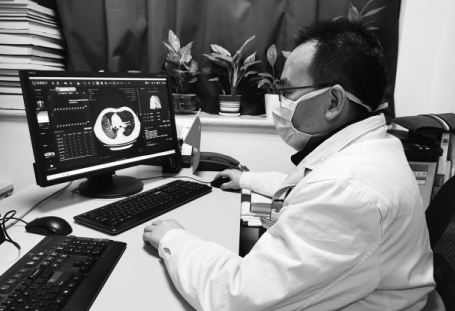
The intelligent imaging evaluation system, developed by Shanghai-based Yitu Technology, has been operating at the Shanghai Public Health Clinical Center since Jan 28 to help with the diagnosis of novel coronavirus pneumonia.
The system uses innovative AI quantitative analysis technology to provide clinical experts with new coronavirus lesion analysis and curative effect evaluation services based on CT images. It provides more efficient and accurate decision-making basis for clinicians and helps in infection prevention and control.
Traditional quantitative analysis performed by humans would require five to six hours. The new AI-enabled system is able to perform the same task in just three seconds or less.
Moreover, the system has been adopted by Union Hospital affiliated to Tongji Medical College of the Huazhong University of Science and Technology, Renmin Hospital of Wuhan University, Zhongnan Hospital of Wuhan University and the First Affiliated Hospital of Wenzhou Medical University.
Another AI pioneer SenseTime has developed a SenseCare smart health platform, which has already been widely adopted by a number of hospitals.
Using image processing technology, the platform assists doctors to analyze images of suspected pneumonia cases and assess the level of lung abnormalities, which improves the efficiency of diagnostic procedures.
It is expected that the application of AI-powered technology in the field of image-aided diagnosis will become a trend in the future.
Drone as disinfectant sprayer, temperature monitor
Farm drones have been converted into autonomous precision-spraying tools. They can be highly effective alternatives to clunky machines to accurately release disinfectants over public places.
DJI, the world's largest commercial drone manufacturer by market share, has pledged almost $1.5 million in aid to help contain the epidemic.
It has also deployed its agricultural drones in certain areas to spray disinfectants. Target areas include factories, residential areas, hospitals, and waste treatment plants.
The aircraft have sprayed disinfectants over 600 million square meters across the country so far. With this solution, spraying efficiency can be 50 times faster than traditional methods.
Moreover, DJI drones have been used for remote temperature detection in many communities and at road checkpoints.
Sticking a cotton swab on the DJI's Mavic 2 Enterprise drones improves the accuracy of measuring a person's temperature by acting as a reference for reducing the thermal imaging camera error margin to 0.5 degree Celsius.
China's largest agricultural drone maker XAG has also provided its drone users with technical support to properly carry out aerial disinfectant sprays, especially in rural villages with weaker health systems and poorer sanitation.
Operations will target densely populated outdoor areas like public places, and communities that have confirmed or suspected cases of coronavirus infections.
Non-contact remote temperature screening
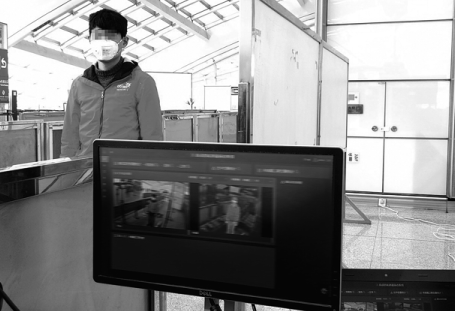
As body temperature measurement is the key to containing the further spread of the novel coronavirus, Chinese artificial intelligence or AI companies have come up with cutting-edge solutions that can rapidly detect people with fever in a crowd.
Both SenseTime and Megvii have developed their own facial recognition algorithms and thermal imaging temperature measurement technologies to launch their AI-enabled intelligent epidemic prevention solutions.
The AI-powered thermal cameras have now been deployed at airports, railway stations, subway stations and bus terminals, as well as office buildings, to help detect in a crowd those people whose body temperature exceeds 37.3 C.
Liu Ruiwei, a senior product manager of Megvii, said the system it developed supports non-contact remote temperature screening from a distance of 3 meters.
The system's margin of error is within 0.3 degree Celsius, Liu said.
It can send fever alerts for up to 15 people per second. Even at crowded subway stations, only one employee is required to work on-site, further reducing the risk of infection, he said.
"In light of the large group of returnees to major cities after the extended Spring Festival holiday, we built a team of about 100 people before the Chinese Lunar New Year started, to develop the system. With the help of AI technology, we can track the whereabouts of people with fever as well as their close contacts," said Liu.
Remote work and smart community management
Chinese tech powerhouses have added new functionalities to their popular mobile apps to both facilitate remote work and neighborhood management from afar.
Tencent Holdings Ltd and Alibaba Group Holding Ltd have seen that the usage of remote work apps skyrocketed as people use these apps for long-distance, real time communications.
Tens of millions of white-collar workers work from home these days to dodge the potential bullet of the novel coronavirus epidemic in public areas.
These apps support conference calls, file transfers and data-sharing, notice distribution, as well as collection of information on employees' health status.
Targeting the online education industry, Tencent's WeChat Work also enable notifications to parents so that they receive messages from teachers in a prompt and timely manner.
More than 12 million students from around 20,000 schools across China are now taking online courses on the Alibaba's DingTalk app.
For its part, Tencent introduced an electronic exit and entry system at residential compounds by using Tencent Haina, a smart community management system.
Operations started this month. The service allows property management teams to keep precise track of people entering and leaving the neighborhood, including the time, frequency and their health conditions.
A suite of similar mini-programs embedded in digital wallet Alipay was launched earlier this month.
The mini-programs assist residential property management teams with a range of issues, such as the reservation of masks, outbreak notifications, as well as exit and entry logging.
Both WeChat and Alipay have also unveiled a health recording system that can be activated by simply scanning a quick-response or QR code.
This helps the government to have a better overview of people's health condition for the purpose of containing the spread of the novel coronavirus.
Cloud computing for R&D of new drugs, vaccines
Chinese internet search giant Baidu Inc is mobilizing its genome research capabilities to fight the novel coronavirus epidemic.
The company announced that it is making its gene sequencing algorithm available to scientists, as the secret to stop the spread of the novel coronavirus is hidden in its genome.
Baidu Research has offered the LinearFold algorithm for free, along with a dedicated computing website, to gene-testing agencies, epidemic control centers, and research institutions not just in China but around the world.
Baidu says this algorithm can significantly speed up RNA structure prediction. Baidu Research's AI scientists have used LinearFold to analyze the secondary structure of the novel coronavirus' RNA sequence in only 27 seconds, compared to 55 minutes required if you use conventional algorithms.
Chinese AI pioneer SenseTime is using its supercomputing power to assist scientists researching the novel coronavirus. After receiving a request from the National Supercomputing Center in Shenzhen, Guangdong province, for more computing power, SenseTime has allocated 20 GPU server nodes for free to help Luo Haibin, a professor at the School of Pharmaceutical Sciences, which is part of Sun Yat-sen University.
The professor is conducting research into large-scale screening of drugs against the novel coronaviruses and the prediction of virus mutations.


Today's Top News
- China-Cambodia-Thailand foreign ministers' meeting held, press communique issued
- Drills demonstrate China's resolve to defend sovereignty against external interference
- Trump says 'a lot closer' to Ukraine peace deal following talks with Zelensky
- China pilots L3 vehicles on roads
- PLA conducts 'Justice Mission 2025' drills around Taiwan
- Partnership becomes pressure for Europe