The gains from China's measures outweigh costs







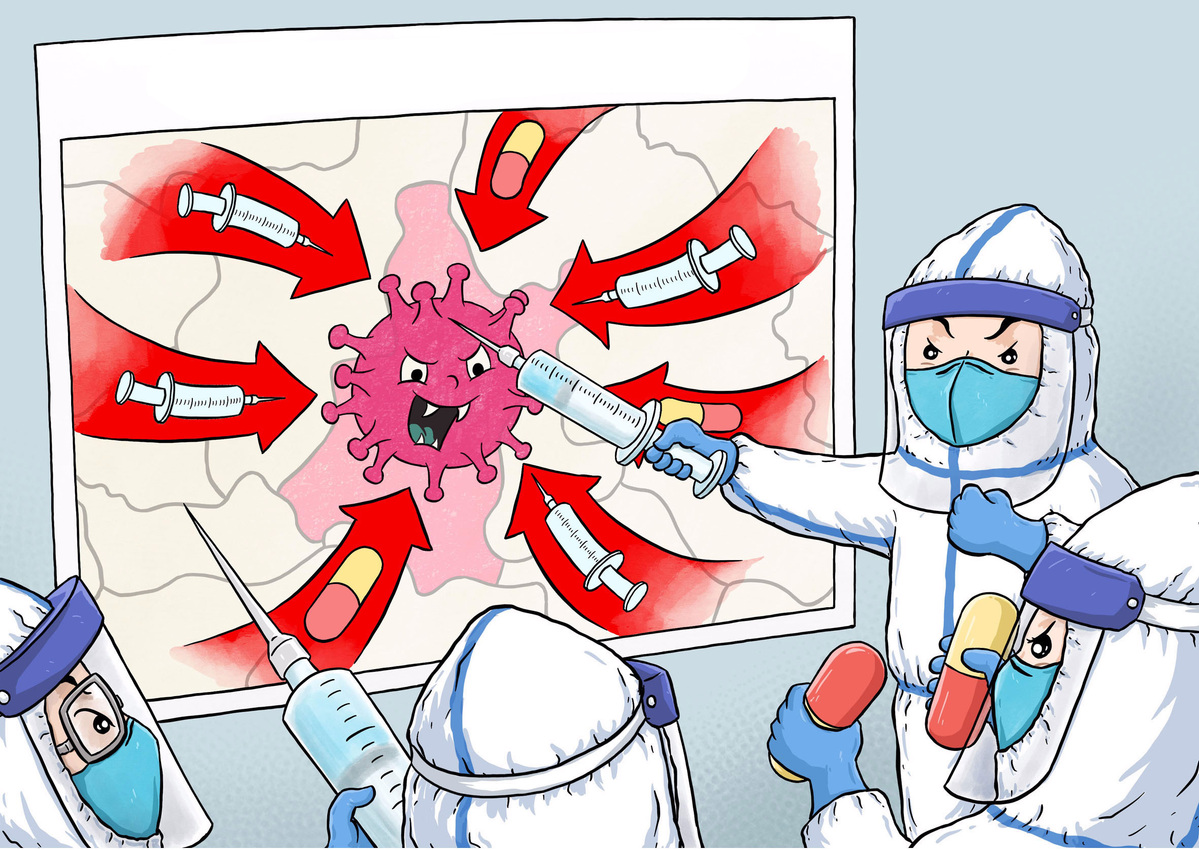
An editorial in the magazine Economist claimed in February that it was still too early to tell if the gains from the containment policy adopted in China in response to the new coronavirus epidemic were worth the price paid in economic and individual terms.
In the preceding paragraph, however, the same editorial said that, without these containment measures, China would have "registered many millions of cases and tens of thousands of deaths".
Curiously, the editorial did not seem to notice that it had answered its own query before it was raised: The gains from China's remarkable use of containment measures have clearly, to date, outweighed the price.
The assessments of infections avoided and lives saved set out in the editorial are supported by a medical modeling estimate from Hong Kong University published in the Lancet, a medical journal, in January. According to that, the numbers infected in China could have risen to over 2 million (without effective containment) by early March.
As China put in place the most extensive contact tracing and quarantine the world has seen, critics said the measures were draconian, a violation of human rights and ineffective.
There is now widespread agreement that China's decision to employ an old-style quarantine (and trace) approach on an unprecedented scale has slowed the spread of COVID-19 infections greatly, not just within China but around the world. This has since been verified by the World Health Organization.
At the least, very valuable time has been bought for countries everywhere to make better response preparations. Today, without these quarantine measures, we would likely be witnessing a far greater increase in the caseload on health systems globally, straining some to the breaking point.
It's also generally acknowledged that most countries, including the United States and other wealthy economies, are comparatively unprepared for an outbreak.
The vital window of opportunity may not, however, have been entirely well used. A leading US epidemiologist from Harvard University, Marc Lipsitch, recently observed in an interview with New Yorker magazine that the Chinese methods were more thorough than those being deployed in the US.
Lamenting the lack of testing capacity in the US to find out what was really occurring, he said: "Our government's response was something like 1 percent or less than what China did."
Suppose, though, the Western critics had been heeded and the massive quarantine had not gone ahead, based on the HKU modeling estimates. By this time, China might have had over 2 million cases and up to 40,000 deaths-instead of more than 80,000 cases and over 3,000 deaths.
Had matters unfolded in this way, the mainstream media narrative would have been governed by observations about China not knowing what to do, Beijing's incompetence and doing too little too late.
A second wave of infections in China remains possible, of course. But already, thousands of lives have been saved and millions of likely infections have been avoided. Moreover, China is now better placed to deal with any second wave, having learned much from the initial wave.
It is also in a stronger position to assist other jurisdictions fighting the spread of COVID-19 infections.
Apart from the huge economic cost, the human cost within China, of coping with the COVID-19 epidemic, has been colossal. There is the death toll itself, and disturbing numbers of doctors and nurses have died and more than 3,000 medical personnel have been infected fighting the virus.
Then there is the immense sacrifice the people of Wuhan (and Hubei) have been called upon to make as a result of the lockdown.
Without the exceptional fortitude of the general population and the remarkable bravery and skills of those staffing the medical front lines, this level of containment could not have been achieved.
Bruce Aylward, assistant director-general of the WHO, said China's bold approach "has changed the course of a rapidly escalating and deadly epidemic".
China and the world owe a great debt to Wuhan-and Hubei. It should not be forgotten.
The author is a visiting professor on the law faculty at Hong Kong University. The views do not necessarily reflect those of China Daily.