Fighting the virus with blood, sweat and tears







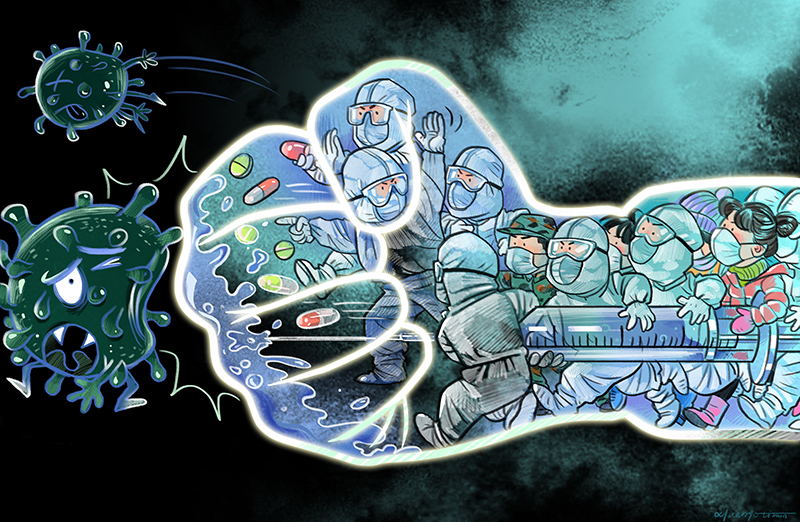
British Prime Minister Winston Churchill made the expression "blood, toil, tears and sweat" famous in 1940. In a speech he delivered in parliament, Churchill offered his "blood, toil, tears and sweat" so that Britain would win victory in World War II. Today, eight decades later, the phrase could well apply to what people in China have been doing to win the war against the novel coronavirus outbreak. The virus is still spreading, but China is now in a position to share with the international community the many lessons it has learned at the cost of "blood, toil, tears and sweat" in the fight against the novel coronavirus.
Medical measures, including quarantine, to contain the epidemic in China have been well documented and standardized. But the less-mentioned innovations in psychological intervention and the use of the internet and social media to spread information, and prevent misinformation, also deserve to be shared and highlighted.
True, medical professionals, patients and their families have been under tremendous pressure. But the fact is, even those who have not contracted the virus are stressed out. Many suffer from "cabin fever" from being cooped up for weeks, while some suffer from depression, anxiety, even post traumatic stress disorder. No wonder a recent survey by the Chinese Psychology Society found that 42.6 percent of respondents showed signs of anxiety related to the virus.
Many people keep comparing the novel coronavirus epidemic to the SARS outbreak in 2002-03. But we live in a different world today. While the treatment of infectious diseases has marginally advanced in the past 17 years, the big difference between then and now is that in 2003 internet and mobile technologies were in their adolescence and social media was in its infancy. The flow of information then was more like a trickle, which now is a torrent driven by new innovative technologies, many of them developed in China.
Today, thanks to popular Chinese apps, such as WeChat, Weibo and Douyin, medical and healthcare professionals can share critical information with the government and public in a jiffy. In addition to providing helpful and life-saving information, companies such as Tencent and Douyin are fighting against what the World Health Organization calls the "infodemic" or fake information epidemic. For example, many in China erroneously believe that eating garlic will kill the novel coronavirus, just as people in the Middle Ages thought garlic was an antidote to the Black Plague. These companies are using technology to scotch rumors during the first major health crisis in the age of social media.
The real game changer this time and a model for other countries is the abundance of online psychological counseling services on apps such as WeChat. Person-to-person consultations have been widely established by mental health professionals in medical institutions, universities and academic societies throughout China, which provide 24x7 services without charge. The services include psychological self-help intervention and online cognitive behavioral therapy for depression, anxiety and insomnia. In Shenzhen, for instance, the local government has launched a service using artificial intelligence (AI) to provide counseling for patients.
A number of other AI programs have also been introduced as interventions for psychological crises, with the most remarkable one using AI to help identify people on Weibo who show suicidal tendencies. The NGO doing this is called Tree Hollow Rescue Movement and it was founded by AI professor Huang Zhisheng. Although it predates the current crisis, it uses web crawler software to find messages from users who AI determines are highly likely to attempt suicide. Since its inception, hundreds of people have been saved by Huang's AI programming and his volunteers.
As an American, contrasting the situation in China with that in the United States causes me significant anxiety about my relatives and friends there. While the US administration downplays the seriousness of the coronavirus outbreak in the US and expends its energy playing politics, President Xi Jinping is leading the fight against the virus from the front, and the trending statistics confirm the correctness of his actions.
Every cloud has a silver lining. If the outbreak does have an upside, it is that instead of being paralyzed by fear, China has moved full-speed ahead to conquer the virus, and has much to share with the world on how to tame not only this virus, but also the ones that may follow it in the future.
The author is a senior fellow at the Center for China and Globalization. The views don't necessarily represent those of China Daily.