Indexes indicate business picking up







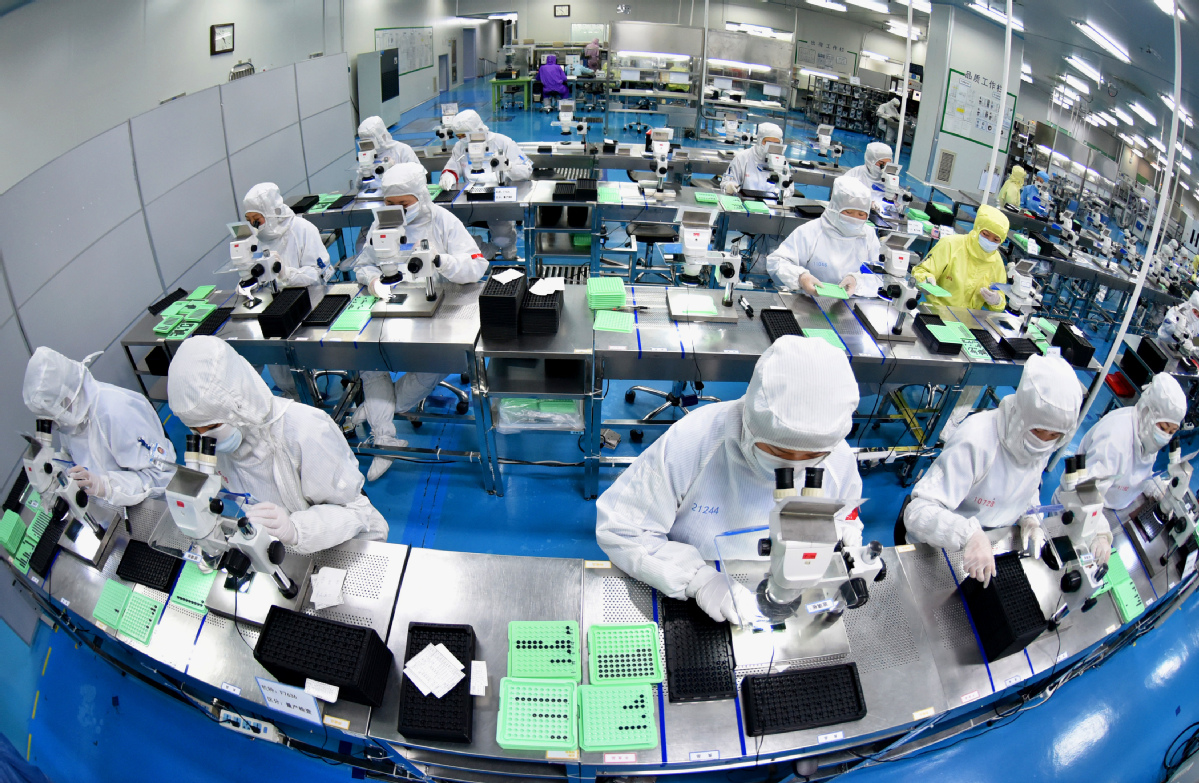
China's manufacturing purchasing managers index stood at 52 in March, up from 35.7 in February, showing a significant, positive change in production and business operations from the previous month.
The nonmanufacturing business activities index was 52.3, compared with 29.6 last month. The comprehensive PMI output index rose to 53 from 28.9, the National Bureau of Statistics said on Tuesday.
"The month-over-month PMI rebound in March reflected the improvement in production and business operations from the previous month, as the majority of enterprises are steadily pushing ahead with the resumption of work and production. But it does not mean that the actual status of production has returned to the level before the novel coronavirus outbreak," said the head of the service survey center at the NBS.
Observation needed
"We cannot draw a conclusion that China's economy has completely returned to normal simply because PMI rose above the neutral 50 mark dividing expansion from contraction for a single month. We still need to continuously observe changes in the economy to see whether there is a trend of getting better," the official said in the transcript of an interview with China Information News posted on the NBS website on Tuesday.
As of March 25, 96.6 percent of the large and medium-sized enterprises surveyed by purchasing managers in China had resumed work, 17.7 percentage points higher than on Feb 25.
The production index, one of the five subindexes comprising the manufacturing PMI, rose to 54.1 from 27.8, indicating that manufacturing production activity had picked up. The new orders subindex rose to 52 from 29.3, indicating that market demand had recovered, said Wen Bin, chief analyst at China Minsheng Banking Corp.
"Both manufacturing and nonmanufacturing PMIs climbed above the 50 mark, showing improvement in economic activities. But analysts still have to follow economic trends afterward to tell whether the economy has recovered," Wen said.
"Next, China should further step up countercyclical regulation, coordinate its financial, fiscal and employment policies, overcome obstacles for the resumption of production, increase the provision of funds, lower financing costs for the real economy and ensure that the economy continues to show signs of improvement," he said.
Looking ahead, PMI may fluctuate in the second quarter due to the rapid spread of the pandemic worldwide, said Lian Ping, chief economist at Zhixin Investment.
"We should watch the global spread of the disease closely, which may lead to a contraction of external demand and force business activities to halt. As a result, the manufacturing PMI may drop again in April, but the degree of decline will be lower than that of the first two months of this year," Lian said.
External changes will also affect exports, employment, incomes, consumption and market expectations, he said.
Slowdown projected
The World Bank forecast slower economic growth in the East Asia and Pacific region, which has been hit by the novel coronavirus, in the face of the prospect of a global financial shock and recession.
China's economic growth is projected to decline to 2.3 percent in the baseline or most likely scenario and to 0.1 percent in a worse-case scenario in 2020, down from 6.1 percent in 2019, the World Bank said in the updated economic report for the East Asia and Pacific region issued on Tuesday.
Ma Jun, a member of the central bank's monetary policy committee, said at a recent online seminar that it would be difficult for China's GDP growth to reach 6 percent this year. Given the uncertainties, Ma suggested that a GDP growth target should not be set for 2020, the Economic Daily reported on Tuesday.
An unrealistic target would push local governments to take aggressive stimulus measures, especially by promoting infrastructure investment. That could lead to a "flood" of monetary easing, and capital-intensive infrastructure investments would not be helpful for reducing unemployment in the short run, he said.