Envoy rebuts claims China hid cases







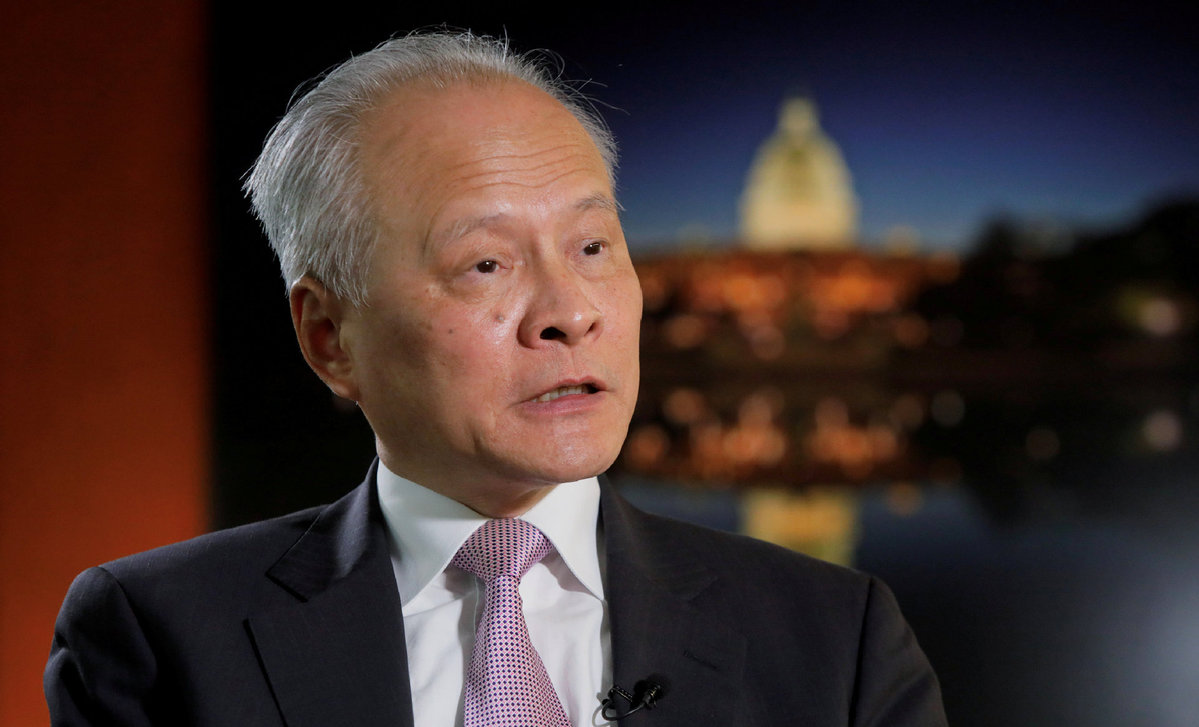
China's top diplomat in the United States rebutted claims that his country underreported the number of COVID-19 cases and related deaths, suggesting instead that the accusers usually have something hidden under their "dirty carpet".
Ambassador Cui Tiankai, in an interview with Ian Bremmer at the weekly digital and broadcast show Gzero World, also said the majority of the several million people believed to have left Wuhan before the capital of Hubei province was locked down on Jan 23 to combat the novel coronavirus had actually remained in China, instead of traveling elsewhere and spreading the virus.
The program began airing nationally over the weekend on US public television.
"For the accusations that China is hiding the numbers, just think about it. We have such a huge population, such a big country, you cannot hide the cases with such a very vicious virus," Cui said in the interview on April 3.
"Because if you have patients, they are just patients. If people are infected, they're just infected. How can you hide them?" Cui told Bremmer, president and founder of Gzero Media and Eurasia Group.
As for those people and some institutions accusing China of concealing data, Cui suggested that if they look at their own history, they usually are the people and institutions who are "always hiding and concealing" something from the public.
He was not asked to elaborate on who the accusers are.
"I don't know what is under their dirty carpet. Maybe you could have a look," he said.
Cui offered a brief timeline of reporting of what later was categorized as COVID-19 in Wuhan, saying that before Li Wenliang, an eye doctor who sounded the alarm about the infection, another doctor, also in the city, had reported suspicious cases of people running a fever for unknown reasons.
Three days after that doctor made that report, the local CDC sent an alert to all local hospitals to say that there were suspicious cases of an unknown cause, according to the ambassador.
"The first reporting was on Dec 27 last year. Then on Jan 3, we informed the World Health Organization of this particular situation," Cui said. "Then a day after that, the CDCs of our two countries had their first communication."
Then when people came to realize the virus could be transmitted between humans-even before that-the central government sent experts to Wuhan to look at the suspicious cases, Cui noted.
"When they came to realize that this is transmittable between humans, we locked down the whole city of Wuhan with 10 million people," he said. The lockdown was then expanded to the whole of Hubei with a population of 60 million.
Two days after the lockdown of Wuhan, the United States evacuated its consulate in the city, along with its citizens. Then in early February, the US stopped all foreign travelers from the Chinese mainland or who had been in China within the past 14 days.
No new confirmed cases of COVID-19 were reported in Hubei on Saturday, the local health authority said on Sunday. No new deaths were reported in the province, where the number of COVID-19 patients in severe and critical condition, most of whom were in Wuhan, dropped to 93 on Saturday from a peak of more than 10,000 in February.
The overall recovery rate for COVID-19 in Wuhan has improved to 94 percent, with that of patients above 80 years old nearing 70 percent, according to the latest official figures.
Cui said Chinese people are working very hard to restart the economy and restore economic and social activities, with many companies operating and shops and schools in many provinces open again.
"So you cannot do all these things if you have no confidence that you are able to contain the virus," Cui said. "And the number of infected people is coming down; this is quite clear."
Cui said that even if a large number of people had left Wuhan before the lockdown, he thought the "overwhelming majority" of them didn't have visas to go to any other country.
"So I don't think people could put the blame on us for the increasing number in countries far, far away from China," he said. "Maybe they are from elsewhere."