



Catering industry upgrades to seek long-term development







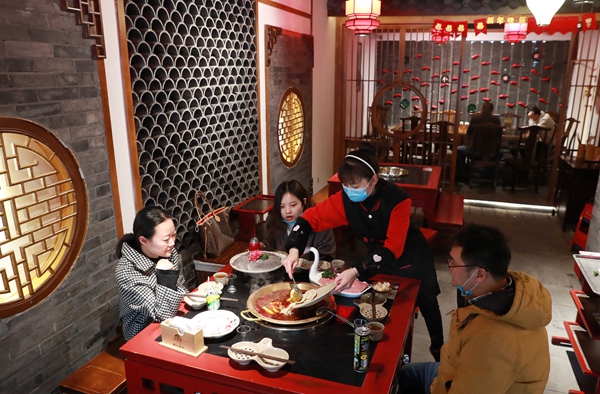
CHENGDU -- When in southwestern China's Sichuan province, a typical day usually ends with the famous local cuisine of spicy hotpot, the dining experience at such restaurants has become very different from what it was before the outbreak of COVID-19.
To maintain social distancing between diners and servers, QR codes that contain the restaurant's menu are attached to the tables in lieu of paper menus. Customers scan the code to place orders and complete payment directly on their phones.
"The mobile application helps cut 5 percent of our labor costs to offset financial losses," said Su Xiaoqiang, brand manager of the Chengdu hotpot chain Xiaolongkan, pointing out that the adjustment saves the heavy workload of servers to place and check orders and reduces the number of staff behind the counters.
The coronavirus outbreak is reshaping China's catering industry. More and more restaurant owners are finding their way through cost control, takeout service and digital marketing, and the coping strategies will sustain even after the epidemic wanes.
"In the medium and long term, restaurants will face an industry-wide reshuffle," said Hu Han, an analyst with the Euromonitor Consulting. One of the future priorities of catering service providers is to strengthen online operation and balance dine-in and take-out services, Hu added.
The industry may become more standardized and franchise-oriented to minimize unexpected risks, Hu said, adding that capital and investment will accelerate the process by favoring brands that are highly standardized.
China's restaurant market is recovering, but business owners are still under pressure. According to a report issued by the China Hospitality Association, nearly 80 percent of the restaurants have returned to business in March, and the percentage of dine-in services has risen sharply.
However, the report indicates that the turnover of the surveyed catering companies in March was only 17 percent of that of the same period last year, and they are under the stress of rising labor, rent and raw material costs.
The prices of chili and beef, two of the most-consumed ingredients for Sichuan cuisines, are higher than they were before the outbreak, "mostly due to the unavailability of imported materials," said Bo Lin, head of the Chengdu Catering Enterprises Association.
Li Yun, the owner of a Japanese restaurant, told Xinhua that prices of imported fresh seafood have surged due to reduced flights.
In the wake of social distancing amid COVID-19, take-out orders contribute most to the income of restaurants. The Xiaolongkan hotpot restaurants, for example, have seen up to 2,000 takeaway orders per day in Chengdu alone.
Many time-honored brands also develop their classic dishes into semi-finished products to boost sales.
The epidemic has also prompted the catering industry to go digital. Many industry players use live streaming and social media groups to attract customers. Some companies have developed their own online payment applications to reduce customers' reliance on third-party platforms, whose higher commissions have sparked complaints in the industry in some regions.
Su said that more restaurant owners have realized the importance of keeping in touch with their guests due to the epidemic, so they innovate their online market strategies to sustain interests.
"We set up a WeChat group with our customers and share our dishes in the group every day," said Liu Yan, manager of a restaurant specializing in signature Sichuan dishes. "Our intention is to update our status with the regulars of our restaurant, or they might think that we are closed."
"The epidemic forces us to upgrade and consider the long-term development," said Bo.



















