Vice-minister sits for NBC interview







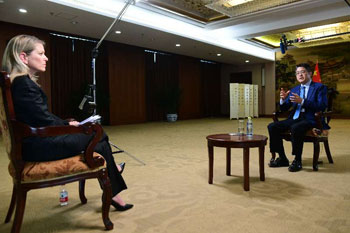
Janis Frayer: With an increasingly negative view of China in the United States given this extraordinary situation, with it now appearing as though President Trump is molding part of his re-election campaign along an "Anti- or Blame China" strategy, what is your outlook for US-China relations, particularly in an election year?
Le Yucheng: Inside the United States, there are some negative views or comments with regard to China. But I also know that many Americans with fair judgment are calling for more cooperation with China. They oppose decoupling and a new Cold War. The China-US relationship, being such an important relationship between two major countries, should not be defined or handled in a way that serves only the purpose of one election. Nor should election be used as an excuse to shift groundless blame to China, undermine China-US cooperation, or pit the two peoples against each other. That is simply shortsighted and irresponsible. Whatever differences or disagreements between China and the US, they look pale when we consider the well-being of the Chinese and American peoples and their shared aspiration for a better future.
Our two countries, China and the United States, can and should engage in cooperation. The United States is making America great again, and China is pursuing national rejuvenation. These are two historical processes that could run hand in hand without conflicting each other. China and the US are actually in a good position to help each other succeed and achieve greatness together. We must not let this relationship be led astray or brought to a wrong course by a small bunch of extreme forces. At stake is the future of our two peoples.
Looking ahead, I think the two countries must first of all work together to advance a relationship based on coordination, cooperation and stability, which is an important common understanding reached between the two presidents. Specifically, the two sides should move forward in three areas and reject three ill-tendencies. We need to step forward to: first, maintain frequent communication between our leaders as well as dialogue and coordination between the relevant departments on both sides; second, advance practical cooperation in all areas; and third, promote international cooperation on COVID-19 at multilateral platforms. At the same time, we must reject: No.1, stigmatizing China and politicizing the virus issue; No.2, disruptions or damage to bilateral cooperation; and No.3, a zero-sum game in the context of COVID-19.
Janis Frayer: The US has, or President Trump, has said that he's going to withdraw funding to the World Health Organization in large part because what is seen as the organization's deference to China, that the WHO is too pro-Beijing. How will China respond to those accusations.
Le Yucheng: The WHO has done a great job in living up to its duties and responsibilities. It is very professional, very responsible and highly efficient. It does not center around any particular country. It is devoted to protecting lives and health of mankind. Its performance has been widely applauded by the international community. Besides the United States, I have not heard any leaders and any international organizations criticizing WHO's performance. The US decision to halt financial contribution to the WHO is not a wise one. At this critical moment, what the US needs to do is to focus on combating the virus, instead of opening fire at the WHO which is coordinating the international efforts in fighting the virus. By so doing, the United States actually has chosen to pit itself against the whole world. Such moves will only undermine WHO's efforts to coordinate the international response and save lives, especially the response in developing countries, African countries in particular. I don't understand what logic the US is following.
Janis Frayer: I have two more questions if that's okay. I realize that we are nearing our time. Being at this point in the time line of the epidemic here in China over the past several months. Are you satisfied, is China satisfied with its response to the outbreak here, to the epidemic in China and to the pandemic that's spread around the world?
Le Yucheng: China has gone through a lot in the past months, and has finally stemmed the spread. Along the way, considerable experience has been accumulated. Let me mention the following:
First, we have put people's lives front and center. We have adopted a people-centered approach. We spared no efforts and no resources in saving lives, without worrying too much about economic cost. If lives are lost, what's the point of money? We have always taken saving lives our utmost priority. In Wuhan, for instance, more than 10 COVID-19 patients over 100 years old were cured.
Second, as a nation we looked out for each other. Nationwide, more than 40,000 health workers were rallied and sent to support the battle against COVID-19 in Wuhan, which was hit the hardest. From my home province Jiangsu alone, over 2,800 medical workers went to Wuhan and Hubei to join the fight.
Let me share with you a touching story. There is a young nurse who works in Wuhan. Her name is Gan Ruyi. During the Chinese New Year holiday, she was in her hometown 300 kilometers away from Wuhan. When she saw the news about the lack of health workers in Wuhan due to the lockdown, this young lady in her 20s, did not hesitate a minute to travel 300 kilometers back to Wuhan. Since there was no public transportation, she biked and walked for four days and three nights. She just wanted to play her part in this fight. This story is deeply touching for me.
Third, we actively engaged in international cooperation. Receiving help from other countries, we have also managed to help others. China has provided to the world an astronomical number of protective equipment, including over 20 billion masks, and billions of protective suits and protective goggles.
We also gained much experience in the fight against COVID-19. We adopted proven practices such as early detection, early reporting, early quarantine, and early treatment. We pulled together the best medical and technological resources and health professionals to improve treatment. We combined traditional Chinese medicine with western medicine in therapeutics. We mobilized nationwide joint containment and control efforts. These measures have proved effective and enabled us to control the situation, save lives, achieve a cure rate of 93.5%, and now restore economic activities.
Of course, COVID-19 has also exposed the areas where we need to improve. For example, this unprecedented situation reveals to us that we need to ramp up our medical teams and medical supplies reserve. Our community-level medical agencies shall be better equipped. Our R&D capacity for the therapeutics for some major diseases must be further enhanced. We also need to improve public education on hygiene, disease preparedness, etc. All in all, we will improve our work, build up the institutions and mechanisms for infectious disease containment and enhance public health emergency response.
Mankind has emerged stronger from the battles against the scourge of diseases, from smallpox, to the Black Death, to Ebola, to H1N1 flu. Each of these diseases has left mankind with valuable experiences.
Janis Frayer: Given the criticism coming from many quarters of the world that there was a slow response in the beginning, that there was information from whistle-blowers that was ignored or suppressed, that there was a slower response to what was recognized as potential for a pandemic, how do you then go about reassuring the international community that there have been lessons learned from this epidemic?
Le Yucheng: I think in comparison with some countries, China was fairly fast in responding to COVID-19, especially given the fact that China was among the countries hit by the first wave of COVID-19. Let me give you an example. On 23 January when Wuhan went under lockdown, the United States reported only one case. But on 13 March when a national emergency was announced, the United States reported over 1,600 confirmed cases. There are quite a number of US experts working in the WHO, and the US government was fully aware of the situation. And there are as many as 50 days of interval. How could anyone blame China? Where have those 50 days gone?
Janis Frayer: Lastly on a slightly different topic. There is a lot of speculation on media about the health of Chairman Kim Jong-un of the Workers' Party of Korea of the Democratic People's Republic of Korea (DPRK). Given the close relations between China and the DPRK, what can you tell us about his health?
Le Yucheng: I don't have information for you, and I don't know the source of the speculation that you mentioned. One thing I would say is that for things related to the top leadership of a country, media reporting needs to be based on a serious and prudent approach.