Innovative financing bolsters small enterprises







China has launched several financial assistance measures during the COVID-19 outbreak, requiring banks to increase lending to micro, small and medium-sized enterprises (MSMEs) and lower lending rates and various expenses.
However, as the intensity of policy implementation decreases progressively, small businesses and individual-owned businesses may find it hard to access financial assistance.
In general, only large enterprises and quality MSMEs could benefit from the current financial policies.
China has a small number of large enterprises that maintain comprehensive tax and credit records. The government found it easy to reach such large enterprises while launching support policies such as reducing rents or providing hiring subsidies.
MSMEs, on the other hand, are large in number and their scope of activities is vast. But their tax and credit records are not easily available or incomplete, making it difficult for the regulators to have full understanding of their financial health and an accurate view of their requirements.
The central bank's relending and rediscount program, as well as the regulatory policy allowing eligible small businesses to delay loan or interest payments until the end of June, are both targeting companies that have already received loans. But MSMEs have difficulty in obtaining loans from banks, for they cannot offer fixed assets as collateral.
It is also tough to implement some policies properly, including those encouraging banks to lend to small businesses that have never received bank loans or requiring government-backed firms that offer financing guarantees to halve their fees for MSMEs.
After the central government required banks to step up support for small businesses, it became common for large banks to use their size and policy advantages to snatch high-quality clients from regional small and medium banks, for large banks could offer loans at lower rates and have more resources for supplementary services, creating potential imbalances in credit allocation, some banking practitioners said.
The All-China Federation of Industry and Commerce, a non-governmental chamber of commerce, launched a special service during the pandemic through partnership with several banks, including Bank of Communications Co Ltd, which provided 6.15 billion yuan ($867.6 million) in loans to 134 enterprises. The average loan per company was 45.9 million yuan.
These companies are obviously non-typical MSMEs. At some regional banks, MSMEs' demand for loans is usually below 2 million yuan. For some city commercial lenders like Bank of Taizhou Co Ltd, which specializes in serving MSMEs, the average small loan per company is only 60,000 yuan to 70,000 yuan. Financial institutions should make further efforts to help small businesses get through hard times and grow smoothly.
Currently, banks are shouldering major risks associated with the implementation of bailout policies. This is the root cause of inadequate implementation of such policies.
Helping pandemic-troubled companies to navigate the difficult time, protect livelihoods and secure employment has been at the heart of government measures to protect public interest. The government launched some of the bailouts disregarding costs and risks. But, this type of risk should not be undertaken by banks because they are also companies.
In the wake of the pandemic fallout, risks will intensify increasingly at banks amid the economic downturn. Banking crises, once they occur, may lead to systemic financial risks, and the cost of bailouts will be inestimable. So, banks need even more protection compared to enterprises.
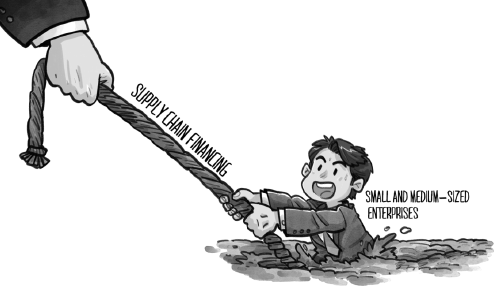
The government should lead the design of special supply chain finance whose risks it can cover along with banks and enterprises. But, the government, not banks, ought to shoulder the responsibility of implementing bailouts.
Supply chain finance refers to systematic financing arrangements for the benefit of all members of a supply chain. Backed by government guarantees, special supply chain finance is carried out by key enterprises in supply chains that boast key resources, information or data.
On the one hand, key enterprises will offer financial support to their suppliers by settling accounts payable in advance or making payments in advance.
On the other hand, their customers will receive services from key enterprises with the help of consumer loans or buyer's credit, a short-term loan facility extended to an importer by an overseas lender to finance the purchase of goods and services, or by using contracts as collateral.
Key enterprises, banks and the government could jointly form project teams. The enterprises will provide authentic information about their suppliers and clients, while banks will design and offer financial services after conducting risk assessments, and the government will provide guarantees for possible losses.
In this way, banks will find the will to pump money into enterprises in upstream and downstream supply chains, especially MSMEs, without worrying about hidden risks.
In times of crisis, if key enterprises receive sufficient liquidity support from the government and banks, which will allow them to obtain financing more easily, they should share the benefit with the upstream and downstream enterprises by taking measures such as settling their accounts payable as soon as possible. Suppliers can also apply for advance payments through the mechanism of special supply chain finance, if they need help.
Based on available tax, business and customs records, as well as transaction data provided by key enterprises, banks could grant liquidity loans to qualified suppliers by allowing them to use orders as collateral and step up financing for distributors by allowing them to use warehouse receipts as collateral.
China has about 80 million individual-owned businesses that employ 160 million people, accounting for nearly 20 percent of the employed population in the country.
Most of such businesses are family-run, and each of them employs very few employees. They are the weakest economic entities amid the pandemic.
As some preferential policies, including tax cuts and temporary reduction and exemption of social insurance contributions, are not very helpful for them, I hope the government will issue vouchers to boost consumption at individual-owned businesses by taking advantage of supply chain finance. For instance, the issuance of vouchers with the aim of helping individual-owned businesses could be combined with sales promotions at large supermarkets.
It is also worth noting that internet-based platforms have collected a vast amount of data while providing supply chain services. Using these platforms to provide more convenient payment options to the downstream enterprises is another effective way to help small businesses navigate through pandemic-related challenges.
The writer is director of research with the Saiyi Enterprise Institute and a visiting research fellow at Wuhan University's Center of Finance and Law.




Today's Top News
- Confidence, resolve mark China's New Year outlook: China Daily editorial
- Key quotes from President Xi's 2026 New Year Address
- Full text: Chinese President Xi Jinping's 2026 New Year message
- Poll findings indicate Taiwan people's 'strong dissatisfaction' with DPP authorities
- Xi emphasizes strong start for 15th Five-Year Plan period
- PLA drills a stern warning to 'Taiwan independence' separatist forces, external interference: spokesperson