Two sessions herald rebound of economy







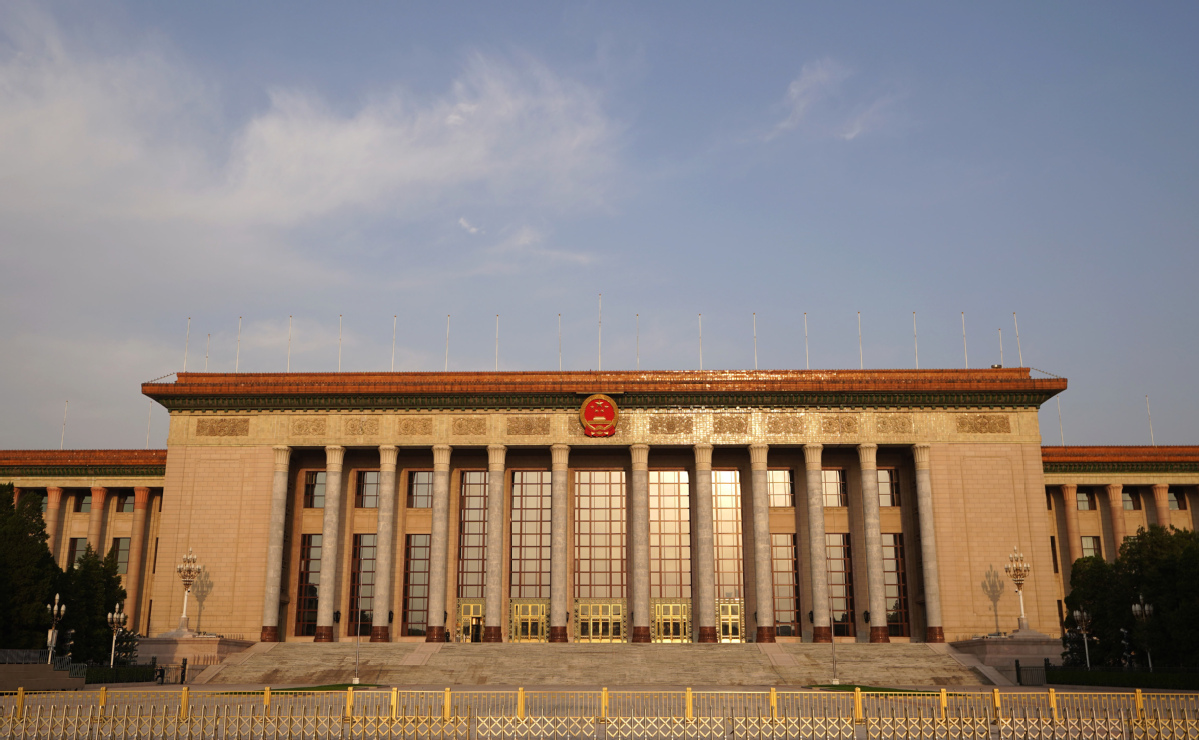
International interest in the annual sessions of China's top legislative and political advisory bodies (National People's Congress and Chinese People's Political Consultative Conference National Committee), which start on Thursday, is exceptionally high.
Due to the novel coronavirus pandemic, the two sessions will be held under strict anti-epidemic measures, including social distancing, and will be significantly shorter and rely more on videoconferences. Such measures are in line with science-based health policies, which the central government adopted in January.
Apart from their sociopolitical significance, the two sessions also herald the rebounding of the Chinese economy, even amid the pandemic.
From virus containment to economic rebound
In China, big businesses, in general, have been operating with near full capacity since mid-April. Factories and power plants are humming. Stores are reopening. And although there's no immediate return to the pre-pandemic world, China's new normal differs dramatically from that of the United States and the eurozone due to proactive governance and science-based public-health policies to contain the coronavirus outbreak.
In China, the rebound of the economy began in March-April. In the US and the European Union, it could ensue more broadly only after the second quarter. But even those hopes could be undermined by premature exits from the lockdown, new infection waves and residual clusters.
In the first quarter, China's growth shrank 6.8 percent. However, the rebound could raise the second quarter data close to 4 percent, while growth in the third and fourth quarters could be close to 5 and 6 percent, respectively. That would take growth for the entire year to 2 percent, as the International Monetary Fund has predicted.
If international conditions are peaceful, faster rebound could improve the outcome, however. Despite the dire international horizon, China's economy has potential for an upside surprise, thanks to its more proactive mobilization against the COVID-19.
More fiscal expansion and quicker response to crises
This year marks the last one of the 13th Five-Year Plan (2016-20) period. But, even if China sees a V-shaped recovery, can it deliver on its promises of greatly improving living standards, eradicating abject poverty and sustaining the environment?
The short answer is: It's a precarious balancing act. More fiscal expansion is needed to support the economy, while improved reporting systems are likely to be implemented to prevent future public health emergencies.
Long-term objectives-improving living standards, eradicating poverty and reducing pollutants-will prevail but they can be effectively executed only after the pandemic is fully contained worldwide. Ironically, the past months' economic slump has translated into a dramatic, though temporary, fall in emissions.
The greatest challenge in the coming months will be to overcome the current misalignment between supply and demand. During the second quarter, the supply-side performance has rapidly improved as economic capacity is almost back to normal and industrial production is up. Last month, even the export sector's performance was strong. The broad improvements suggest the government's strong back-to-work push is paying off.
The demand side will take more time, though. In the months of strict quarantine measures, e-commerce sales took off dramatically as more and more people resorted to online shopping. But retail and shopping malls, clothing and cosmetics and consumption-led sectors will take longer to normalize.
In the West, the demand-side story will prove even more challenging, due to greater impact of the outbreak and thus longer delays in the return to full employment. In the eurozone, social support has eased the crisis in the short-term, but will add to debt burden over time. In the US, inadequate support will aggravate the contraction and unemployment, and still increase the debt burden.
As long as a vaccine against the virus and effective therapies are not available, uncertainty will constrain private investment, which fortunately has been offset by government-led infrastructure investment and is likely to remain a key growth driver until full stabilization.
Stronger fiscal policy may be on the way
Fiscal policies are likely to be strengthened, with expected measures such as raising the fiscal deficit rate to 5 percent of GDP and issuance of more than $420 billion in special treasury bonds to boost fiscal funding. In turn, fiscal accommodation is likely to be supported with easing of monetary and credit policy. In the past four months, newly increased social financing and loans have seen new highs, while the demand for financing is recovering as production has resumed. That's vital to increasing employment during these challenging times.
For China, the worst economic damage may be behind, while for the US and the eurozone, it's still ahead. Despite the challenging first quarter, this damage is unlikely to penalize China's strong long-term economic fundamentals. In contrast, in the West, the fallout of the outbreak is likely to prove more protracted.
In the first quarter, US GDP growth fell to minus 4.8 percent, but in the second quarter, it could plunge close to a whopping minus 40 percent, according to recent US reports. In the eurozone, growth fell to minus 3.8 percent in the first quarter but that's only a prelude to the expected double-digit plunge in the second quarter.
West should brace for political tsunamis
Since such economic outcomes can be attributed to the mishandling of COVID-19 risks, they are likely to result in political tsunamis in the West in the coming months. In light of the global economic outlook, the key question is whether the coronavirus lessons will foster global cooperation, which is the only way out, or result in a global conflict scenario, which would further weaken external demand.
Responsive and responsible governments would delay and prolong the current trade truce schedules. Yet the US administration is neither. The White House's misguided trade war and COVID-19 mishandling has already caused US debt to soar record-fast to $25.3 trillion.
As US federal debt to GDP ratio is now close to 120 percent-at par with that of Italy during its debt crisis in 2011-12-such leverage, which the White House and the Federal Reserve will have to further increase, could prove costly to global economy.
The author is the founder of Difference Group. He has served at the India, China and America Institute (USA), Shanghai Institutes for International Studies (China) and the EU Centre (Singapore).
The views don't necessarily reflect those of China Daily.