Houston consulate closure a desperate, boneheaded move







Yet again, my hometown finds itself at the center of controversy. Houston just can't catch a break.
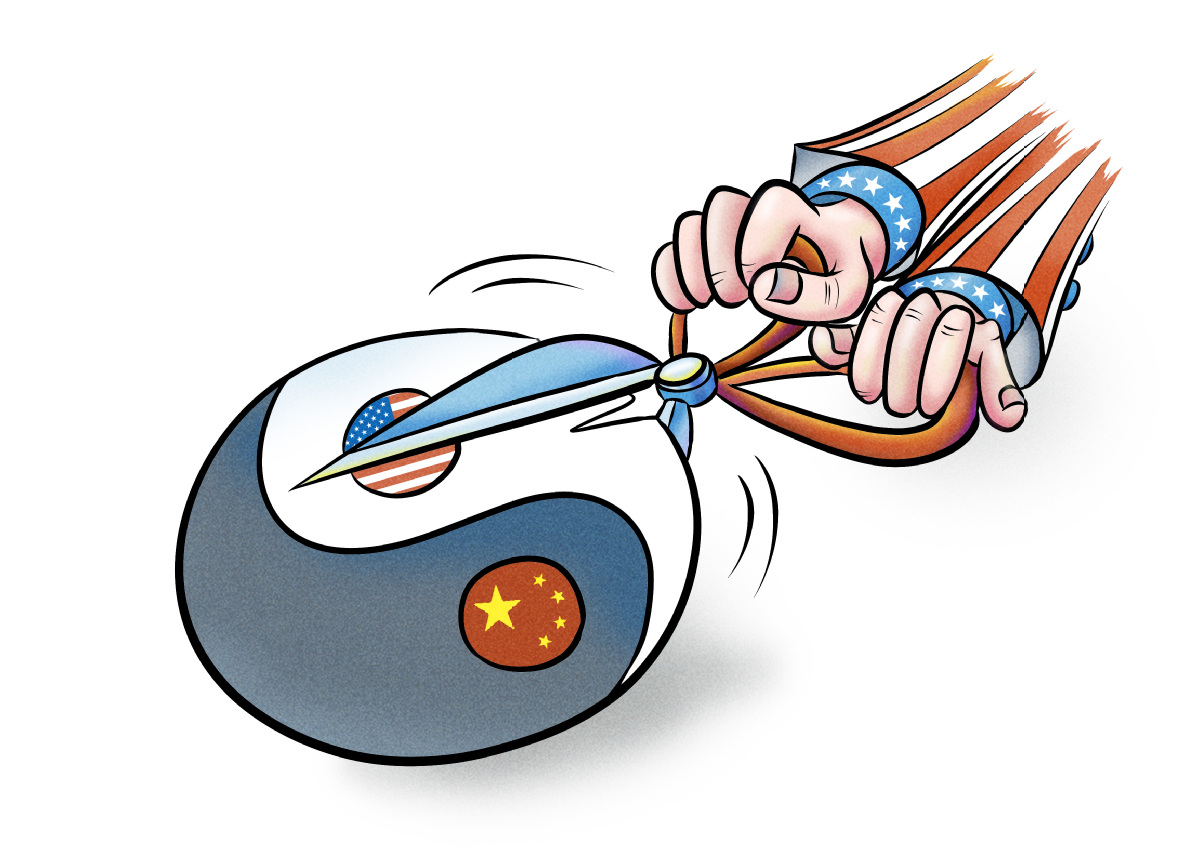
In a shocking, perplexing move, the Chinese Consulate-General there has been informed by the US State Department it must close in a matter of days, with no warning and no reason given aside from a specious list of evidence-free accusations.
This bizarre attack hits close to home, and I mean that quite literally. Houston is only an hour's drive from the Texas county where I was raised, and having a consulate a stone's throw away was especially useful for my move to Beijing.
Without the Houston facility I would have had to either travel across the country to get visa approval or pay for a proxy service, both of which were well outside my price range. An error on my part necessitated repeat trips — don't remove staples on certified documents, folks! —and it was the convenience of the Houston location that made it feasible for me to get my paperwork done while between jobs, living at home and collecting unemployment.
So when I heard the news I thought of the many people who counted on that consulate, particularly Houston's sizable Chinese population. Where will they go? What financial and logistical hurdles will they have to leap to access basic consular services?
It's clear the State Department and the Trump administration don't care. In fact, I'd wager they consider it a bonus. It's not as though his government has done anything for the poor and working-class people of the United States, least of all immigrants; they've been hit hardest by the COVID-19 pandemic, and the jaw-droppingly bad job the US has done in fighting the virus has only made things worse.
With millions of cases, over a hundred thousand dead, tens of millions out of work and countless evictions looming, Trump's approval ratings are at a near-historic low. An election in only four months demands a new plan to prop up those plummeting poll numbers, and it appears Trump and his team are relying on an old favorite: "Blame China."
It's the spaghetti strategy, so named for the technique chefs use to check if pasta is ready: "throw it at the wall and see what sticks." First, they tried to claim COVID-19 was cooked up in a Chinese lab. Then, they pushed a theory of an accidental leak.
Neither instance of finger-pointing caught on, as people who actually know what they're doing — the virologists, epidemiologists and medical doctors whose advice is routinely ignored by the Trump administration — dismissed those fever-dream delusions as impossible, or so close to impossible it wasn't worth consideration.
When outright blaming China for the pandemic proved to be a dud, the US government decided to ratchet up tensions in other ways; booting out Chinese journalists through arbitrary quotas, restricting visas for Chinese researchers, heightening its attacks on Chinese tech companies and applying broad, punitive sanctions over bogus "human rights" concerns. The hope was with enough distractions the people would forget all about the appalling mismanagement of a deadly pandemic.
But the case count kept rising, and few took the bait. Public anger only intensified after the brutal murder of George Floyd and a second wave of infections brought the economy to another screeching halt. So further escalation was in order, naturally — because when you've dug yourself deep into a hole, the only sane solution is to dig your way out.
Hence the closure of the consulate in Houston. The purpose here is twofold; continue antagonizing China for all the aforementioned reasons, but also to trigger a response in kind. This is another well-worn page from the US playbook. Make a nakedly aggressive move, then when the targeted country does something in return — which it must — accuse them of the very thing you did in the first place.
The ever-compliant media sells this narrative well, reporting the initial provocation dispassionately, if at all, and saving the alarmist rhetoric for the "enemy" country's reciprocal act. We've seen it happen with the US' withdrawal from the Iran nuclear agreement, the moving of its embassy in Israel to Jerusalem, its military activity on the Korean Peninsula and countless other incidents.
Which means now that China's Foreign Ministry has announced it has instructed the US consulate in Chengdu to close, we can expect the usual theatrics from Western politicians and media. A cursory mention of the inciting incident will, at best, be included a few paragraphs down in stories about China's decision, long after most people have stopped reading.
But we shouldn't fall for such a transparent ploy. Ordering the closure of the US consulate in Chengdu is not an act of an aggression, it's a reaction to one. What's more, it isn't even proportional.
The Chinese consulate in Houston served the entire American South, including Texas and Florida — two of the most populous states in the country. Chengdu, though an important location and the site of the westernmost US consulate, serves a relatively small group of people.
And let's be frank: Your average American citizen in China is, to put it mildly, in a privileged position. I doubt whatever inconveniences they'll face getting to the Guangzhou consulate will be anything close to the difficulties their Chinese counterparts are experiencing. In any event, it's hard to imagine there's a terrible rush to enter the US right now.
If those Americans want to complain, though, they shouldn't be knocking on China's door. This situation is entirely the US' doing, and we need to shout this indisputable fact from the rooftops. That's what it'll take to beat back the waves of misinformation coming from Trump's State Department. Contrary to popular belief, China has stayed committed to a peaceful resolution of its differences with the US — and all it's gotten for its trouble is one provocation after another.
I'm reminded of the old Tom and Jerry cartoons, where Tom the cat would torment Spike the dog over and over, taunting and harassing him just past the end of Spike's leash. For a while, it was great fun for Tom — until the leash came off.
You can guess what happened next.
The author is a US writer with China Daily.
The opinions expressed here are those of the writer and do not represent the views of China Daily and China Daily website.