Delivery robots to give a fillip to services sector
New technologies bringing meals, medicines, other orders to customers over barriers without cross-infection hazards







In an industrial park in Beijing, workers were surprised to find the food they ordered online being delivered by a robot, which can take elevators and navigate all the way from a restaurant in an underground floor to an office on the 15th floor.
The robot, named S2, was developed by Segway-Ninebot, a rising star in the smart travel industry. The company has been piloting robots to deliver food and parcels in several industrial parks and hotels for more than a year. But amid the COVID-19 outbreak, its robots are playing a bigger role by partnering with more restaurants to deliver food within industrial parks.
Sun Chunyang, who is in charge of the robotics business at Segway-Ninebot, said S2 can deliver up to 300 real-time orders a day, with each delivery completed in eight minutes on average."Our robots are autonomous and contact-free, which can block the human-to-human transmission chain of the virus and reduce infection risks," Sun said.
The Segway delivery robot S2 is one of a growing list of robots that have been used amid the COVID-19 pandemic to help people better resume work while ensuring health.
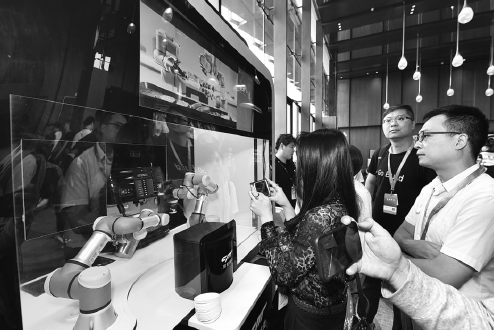
Robots are becoming increasingly popular in China as they check body temperature, deliver food and drugs, help disinfect offices and wards and accompany children and patients via voice interaction and body movements.
They can be seen at airports, hotels, hospitals, shopping malls, schools, industrial parks, government institutions, office buildings and elsewhere to help reduce workloads and boost efficiency.
Bi Yalei, secretary-general of the Shenzhen Robotics Association, said robots have played a positive role in helping fight the pandemic and people are getting more comfortable with these new technologies.
The virus has led people to consider more scenarios for using robots and keeping people healthier and safer, Bi said.
The wider use of robotics is also the result of Chinese companies' constant efforts to experiment with the latest technologies to empower work and daily lives. For instance, Sun said S2 can now move between buildings after the company's progress in research and development.
"S2 can move outdoors in-between buildings in pedestrian areas, and enter buildings through automatic doors, meaning it can handle far more complicated geographical information," Sun said.
S2 has also been used to send food to Shenzhen hotels where people are quarantining themselves amid the contagion. The cargo box on the robot has an automatic cabin door, which can flexibly change from two to four slots, according to the size of goods the robot is transporting. As a result, the box can also contain sterilizing lamps to carry out disinfection work.
"After making steady progress in research and development, we have managed to beef up the robots' functions and bring down their cost so that the value they create can now match prices and make clients more willing to buy the robots. We are poised to pounce at the opportunity to seek wider applications of our robots in the future," Sun said, adding that S2 can cross obstacles as high as 2 centimeters.
More importantly, Segway-Ninebot has developed a cloud-based multi-robot coordination system which can dispatch an order to the nearest robot based on its real-time location.
"When one robot comes across another robot in an elevator, the system can also automatically determine which robot should get on or get off first, based on the priorities of the orders they are delivering, Sun added.
The robot uses multi-data integration technology that lets it deal with precise locations in different environments, as well as an advanced path planning algorithm and dynamic obstacle avoidance algorithm to achieve smooth movement, said Segway-Ninebot, which was created in 2015 after Beijingbased Ninebot acquired US-based Segway.
The company said the next two years will be crucial for the deployment of delivery robots in closed industrial parks. By the end of 2022, China will have some 50,000 high-quality office buildings in the market, and 30 to 40 percent of them are likely to have delivery robots in operation, the company added.
In addition to delivery robots, smart machines that can interact with patients are also being used during the pandemic. At the Shanghai Sixth People's Hospital affiliated to Shanghai Jiao Tong University, a 5G-enabled robot instructed a group of patients on how to properly wear masks.
"Before touching a clean mask, wash your hands thoroughly with both soap and water. Then orient the top of the mask properly and make sure that the mask's bendable side is facing upward," the robot said.
In provinces including Hubei and Zhejiang-and municipalities such as Shanghai-these robots, donated by China Mobile and Cloudminds, have offered a variety of automated medical services to help reduce pressure on front-line health workers when the outbreak was at its peak in China from February to March.
Standing at over a meter high, the robots are equipped with arms or hands that can swing freely, with display screens on the front. China Mobile said these robots can offer medical advice, deliver drugs, provide navigation and conduct disinfection work at hospitals. They can also check people's temperatures and perform other repetitive work.
"Using the robots to do such work in isolation wards can effectively reduce cross-infection, and enhance efficiency in taking care of patients," said Huang Xiaoqing, CEO and founder of Cloudminds, a company specializing in operating robots.
Chinese tech company Cheetah Mobile Inc is also working to popularize robotics technologies, with more than 10,000 of its robots being deployed in multiple industries.
The company said its robots have been deployed in shopping malls, exhibition areas, KTVs, libraries, office buildings, medical institutions, hotels, government buildings and other places.
But unlike Segway-Ninebot's delivery robots that can move about, the company's robots are mostly stationary and chiefly serve as marketing tools.
Fu Sheng, chairman of Cheetah Mobile, said when robots are deployed in large numbers, they can help people spend less time on repetitive jobs and give them more chances to engage in creative work.
The human-machine collaboration model can help companies reduce costs and increase efficiency, and the model uses robotics' big data to improve the efficiency of offline economies, Fu said.
Cheetah Mobile said its robots deployed at shopping malls are equipped with big screens and can recognize consumers via facial recognition, attract consumers to retail stores via voice-interaction, collect consumer feedback and distribute coupons.
Such functions can help shopping malls and retail stores better target consumers and improve marketing efficiency, the company added.
But experts also sounded a note of caution for a sudden rise in demand for robots amid the contagion. They cannot guarantee long-term growth. Efforts are needed to exploit emerging opportunities in a way to ensure sustainable development, they said.
Sun said demand may have increased amid the outbreak, but the contagion is not a thing that will profoundly reshape the service robot industry. "What we can do is to better hone our expertise and wait for the upcoming large-scale application of delivery robots," Sun added.






Today's Top News
- China rebuffs criticism over drills around Taiwan
- Mainland pledges deeper cross-Strait integration in 2026
- Lai's 'separatist fallacy' speech rightly slammed
- Xi's message for New Year widely lauded
- Swiss bar fire kills around 40, injures more than 110
- New Year's address inspiring for all