Medical AI applications gaining ground
Hospitals bank on technology to ease staffing concerns







Training to be a physician normally takes years of grueling work in medical school and hospitals. Out of the 800,000 medical graduates each year in China, only 22,000 become specialists, according to the National Children's Medical Center.
Things look even more jarring for those studying pediatrics, with just 300 of 22,000 candidates choosing to professionally attend to younger patients. This group has on average 2.4 times more of a workload compared with conventional physicians, and handles 2.6 times more inpatients.
Industry experts are brainstorming to find alternative solutions to make the sector more sustainable, such as creating artificial intelligence "doctors" that could be a cinch to "teach".
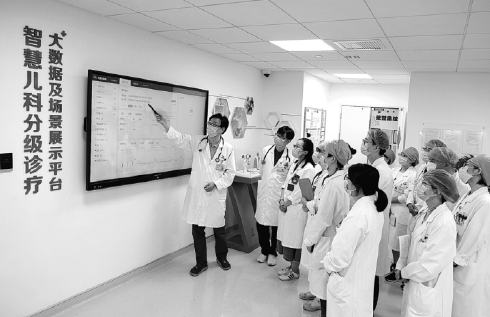
Zhao Liebin, deputy chairman of the Shanghai Children's Medical Center, is pioneering the use of artificial intelligence to make children's wards smarter and smoother by sharpening diagnostic skills and halving workloads.
At the heart of Zhao's transformative plan is to develop an intelligent identification system based on digital stethoscopes to classify cardiopulmonary sounds in children.
"Congenital heart disease remains a common birth defect in China," said Zhao. "But its timely detection has been difficult for many county-level doctors, who lack proficient training in this area."
Some 30,000 children suffering from CHD last year generated an expansive amount of acoustic data. This propelled Zhao and his team to adopt machine-learning algorithms to identify vital sign alerts and classify them as either threatening or not.
"Pediatric medicine requires paying the utmost attention to even the tiniest details, details that can be missed by even the most skilled physicians when exhaustion comes into play," said Zhou Xiang, co-chair of Shanghai United Image Medicine, a technology partner at the center.
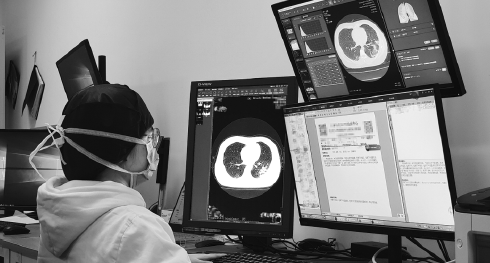
Zhou said well-trained AI "doctors" now have the ability to diagnose diseases on images at a level comparable to skilled physicians. In the area of radiology, for instance, AI can handle tasks in the automated detection of diseases, segmentation of lesions and dosage determination.
To make things more seamless, the center has also devised a hand-held smart stethoscope that helps doctors in remote regions detect sound abnormalities among patients with heart problems.
"They are designed specifically according to varying body sizes, with a smaller version dedicated to newborns for better diagnostic precision," said Zhao, adding that the second generation of the device has been adopted in eight provinces including Yunnan and Hainan, where medical resources are less developed.
Chinese hospital spending on AI-related IT expanded 88 percent in 2019 from a year earlier to 1.7 billion yuan ($240 million), according to a report by consultancy IDC-Worldwide Artificial Intelligence Spending Guide.
Main AI applications at hospitals can be categorized as follows: doctor-patient interactions, diagnostic imaging and treatment, clinical decision support systems and AI-based human-computer interfaces.
Apart from empowering diagnosis modalities, Zhao is also looking to make the doctor's visit less of a headache for patients.
Some improvements might include shortened waiting periods which would avoid the boredom of long waits in settings which typically do not allow for adequate social distancing.
YITU Healthcare, a Shanghai-based AI firm, has devised a smart medical guidance system featuring a suite of auxiliary diagnosis functionalities that serves to save trouble for both patients and doctors.
"Through a dedicated app, we allow parents of young patients to reach out to doctors, even prior to their arrival at the hospital," said Fang Cong, vice-president of YITU Healthcare."Doctors can raise common questions virtually as they do in clinical consulting rooms, such as whether the child has a fever or diarrhea, so that they know what tests need to be done or what prescriptions are needed once the patient arrives."
The efficient one-stop solution essentially encompasses a suite of AI technologies, Fang added. For instance, communicating with AI robots via phone requires voice recognition technology to translate sounds into accurate words.
In addition, effective diagnosis should require turning random words into structured text decipherable to machines, such as key parameters including body temperature and gastrointestinal symptoms. This requires natural language processing and medical knowledge mapping to help with diagnoses.
Fang said the system developed by the company has on average shortened time spent in hospitals from 180 minutes to 80 minutes, and 70 percent of all medical test paperwork is automatically prescribed by AI and rechecked by nurses.
"AI is most helpful for pediatricians, because younger patients have more difficulty (compared with adult patients) accurately describing their symptoms. So more is expected from AI," she said.
Inpatient management is key for patients with critical conditions, and that's also when AI is of greater importance.
A centrally controlled panel is installed in the ward of the center's pediatric respiratory department where key parameters are automatically displayed at the touch of the screen.
The monitor serves to help nurses familiarize themselves with patients' conditions, such as new arrivals or those whose conditions have experienced drastic changes overnight.
"AI's application in the medical realm should go beyond medical imaging," said Ma Handong, vice-president of Shanghai Synyi Medical Technology Co, which co-develops the system with the center.
"We see huge potential in developing a clinical decision support system, clinical quality management and smart schedule arrangement system," Ma said.
Wearable technologies are making waves in several medical procedures including the collection of heart rate data and monitoring respiration.
"Information is thus transferred to a mobile robot, which then analyzes data and offers prescription suggestions. It also follows up on patient discharge issues," Zhao said.
The government's push to promote medical AI applications is gradually assuaging hospital concerns about the safety and compliance of such applications, said Leon Xiao, senior research manager of health insights at IDC China.
For example, in January, the National Medical Products Administration approved DEEPVESSEL FFR, a noninvasive CT FFR technique developed with AI by Beijing Kunlun Technology Co Ltd, as a Class III medical device-those having life support and sustenance functions that can be implanted into the human body.
The NMPA's Center for Drug Reevaluation in May issued its "Key Points for Review of Coronary CT Angiography Triage and Evaluation Software"-a move seen as helping provide a powerful impetus for the promotion of AI-assisted diagnostic systems.
What's also unique to China is that hospital managers and medical experts like Zhao have played a crucial role in driving the development and application of medical AI systems, the IDC report said.
For example, hospitals at the vanguard of scaling up AI solutions include Zhongshan Hospital, First Affiliated Hospital of the University of Science and Technology of China, Huashan Hospital and Fudan University Shanghai Cancer Center, where hospital administrators show strong leadership in the AI healthcare push.
"Chinese hospitals are building a unique model to launch and improve their AI capabilities led by hospital administrators, clinical departments and medical technicians, within their respective functions and duties," Xiao said.
He is optimistic about AI's development in China's medical sector due to the healthcare digital transformation platforms informed by specialized AI development platforms and rich computing and cloud-based algorithmic resources.
"They are working together to determine their hospitals' needs for medical AI systems and are building relevant capabilities step by step."




Today's Top News
- Mainland pledges deeper cross-Strait integration in 2026 message
- Lai's 'separatist fallacy' speech rightly slammed
- Xi's message for New Year widely lauded
- Swiss bar fire kills around 40, injures more than 110
- New Year's address inspiring for all
- Xi congratulates Science and Technology Daily on its 40th anniversary