


Words of encouragement
Music star Gong Linna helps teachers find their voice as they learn uplifting songs based on classic Chinese poems to pass down to their students, Chen Nan reports.








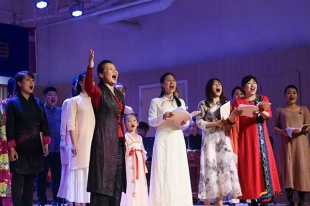
When a chorus consisting of 31 music teachers performs the song, Tan Te, or Disturbed, Gong Linna, who originally performed the song 10 years ago, laughs and joins them onstage.
The song means a lot to Gong. Written by her German husband, songwriter Robert Zollitsch, who is also known as Lao Luo in China, the song brought Gong into the limelight when it was released online in 2010. Her powerful voice, wide vocal range and solid singing technique made Gong a sensation on the internet.
However, this is the first time that Tan Te has been turned into a choral song, which was adapted by Zollitsch himself just for the music teachers' chorus. He replaced the traditional Chinese musical instruments, such as sheng (Chinese wind instrument), bamboo flute and yangqin (Chinese dulcimer), with human voices singing different parts.
The performance, staged in Beijing on Oct 9, marks the end of a five-day music education program initiated by Gong, which seeks to inspire joy and love for singing Chinese songs based on classic poems.
The 31 music teachers were trained by Gong, alongside other musical experts, including professor Wang Anguo from Capital Normal University, musicologist Zhao Zhongming, sheng player Nie Yunlei, who works with the Jingju Theatre Company of Beijing, as well as authorities in the field of traditional Chinese poetry, such as Gu Qian, a PhD in ancient Chinese literature.
Gong says: "I've been keen on popularizing Chinese songs adapted from traditional Chinese poems, and promoting singing techniques I've learned from Chinese ethnic groups. These music teachers can now pass on the knowledge to their students, mostly teenagers, who will form our future audiences."
The program, which is supported by the Beijing Cultural and Arts Fund, was scheduled to start earlier this year, but was postponed to April due to the coronavirus pandemic. In April, Gong launched an online course to teach the first song, a oneminute piece titled Happy Song, which was written by Zollitsch and released in 2013.
"It was not a song adapted from Chinese poems, but I decided to have it open the online course as a warmup to start the program in an uplifting way," Gong recalls. "We all shared similar emotions, such as anxiety, depression and fear, when the viral outbreak began earlier this year. I wanted to cheer people up with Happy Song."
She didn't expect the response to be so unanimously positive. The music teachers not only learned to sing the song but also shared the song with their own students.
Zhu Jinxiang, a music teacher from Beijing No 101 High School, recalls that when he learned to sing Happy Song, he felt relaxed and joyful. He also taught his students to sing the song, during the period when all of his classes were taking place online.
"We ended up spending around eight months working from home. The sudden change made me anxious. However, thanks to music, I gradually calmed down and found my own tempo," says Zhu.
With the musical training program, Gong taught more songs that were adapted from traditional Chinese poems by her husband, many of which have cheerful and encouraging lyrics.
One of the songs, Spring Dawn, is based on a Tang Dynasty (618-907) poem of the same title by Meng Haoran. The poem describes the observations and thoughts of the poet upon waking up on a pleasant spring morning.
When this spring came, people stayed at home due to the COVID-19 outbreak, Gong says. "Even though we couldn't go outside to enjoy the beautiful spring weather, we sang the song to relieve some of our negative emotions."
One of those attending Gong's music education program is Lin Jing, who has been teaching music at Yongfeng School affiliated to Tsinghua University High School for 20 years. Lin teaches the students-mostly under 12 years old-not only how to sing, but also how to play guqin (Chinese zither), a seven-stringed traditional Chinese instrument with a history stretching back more than 3,000 years.
"Combining music with traditional Chinese poems is a great way to introduce traditional Chinese culture to the young students," says Lin.
"I cannot wait to apply what I've learned with Gong during the past few months to my classes and just to see what the response would be like," says Lin, who adds that she has been drawn to traditional Chinese culture since childhood.