Factory output rises in Sept







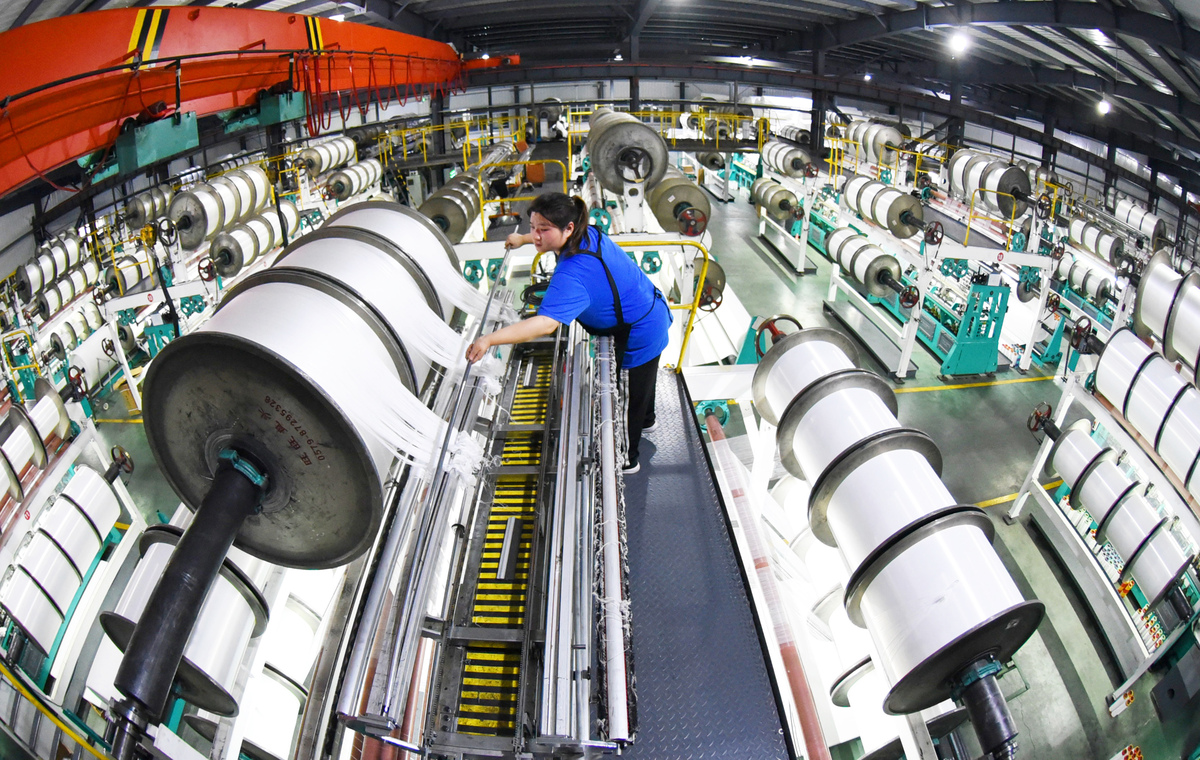
Manufacturing of equipment and high-tech gear increases during first nine months
Industrial output rose by 6.9 percent on a yearly basis in September in China, the sixth consecutive month of growth, data from the National Bureau of Statistics showed on Monday.
During the first three quarters of the year, industrial output rose by 1.2 percent on a yearly basis, reversing the decline of 1.3 percent seen in the first six months. Industrial output in September rose by 1.3 percentage points from the level seen in August, the NBS said.
High-tech and equipment manufacturing output rose by 5.9 percent and 4.7 percent respectively on a yearly basis during the first nine months of the year. Private sector output rose by 2.1 percent during the same period, while that of State-controlled enterprises went up by 0.9 percent.
Profits of China's industrial firms, or designated large enterprises with an annual business turnover of at least 20 million yuan ($2.98 million), reached 3.72 trillion yuan in the first eight months. Although the figure fell by 4.4 percent from a year earlier, the decline was 3.7 percentage points less than that seen in the first seven months.
Experts said the strong data are an indication of the remarkable resilience of the Chinese economy and its upward trajectory on the back of the effective COVID-19 control and other policy measures to offset the economic impact of the epidemic.
The measures included the focus on six key fronts for ensuring stability and "six priorities", they said. The six fronts refer to employment, the financial sector, foreign trade, foreign investment, domestic investment, and expectations, while the "six priorities" refer to job security, basic living needs, operations of market entities, food and energy security, stable industrial and supply chains, and the normal functioning of primary-level governments.
"It is obvious that by September the COVID-19 had a limited effect on the Chinese economy, considering the growth in business and production; and people are less panicky thanks to the effective epidemic control measures," said Zhang Yansheng, chief research fellow at the China Center for International Economic Exchanges.
The government has rolled out a series of policies to help market entities cope with the challenges caused by the disease outbreak. With the removal of social distancing restrictions, normal operations of production supply chains and logistics facilities have resumed, and so has consumption. Chinese firms, especially small and medium-sized enterprises that account for a huge chunk of the national economic activity, are able to operate and resume production at normal levels, he said.
Zhang Jianping, director general of the China Center for Regional Economic Cooperation, which is under Chinese Academy of International Trade and Economic Cooperation, said effective disease control and a strong domestic market have spurred industrial output, while the easing of the pandemic in foreign countries and Chinese companies' readiness to serve the reviving overseas markets also contributed to the growth.
Both experts said industrial output growth, especially in sectors like equipment and high-tech manufacturing, also demonstrated the Chinese economy's transition toward high-quality development, including advances in smart manufacturing, and growing application of internet and other smart technologies in industrial sectors.
Zhang Yansheng from the Center for International Economic Exchanges said it is important to cultivate new development momentum, new business forms, and new economic structure, and promote upgrading in manufacturing, services and new type of urbanization, to inject strong and sustainable growth impetus to the Chinese economy.
Zhang Jianping from the Center for Regional Economic Cooperation said Chinese companies must further tap domestic market through deepening supply-side reforms, because uncertainties remain in overseas markets, in the wake of the second wave of the pandemic in many foreign countries, and also because of rising protectionism.