Pony.ai eyes bigger robotaxi fleet for edge in self-driving
Firm banks on stronger efforts in R&D, ties with ride-hailing firms for growth







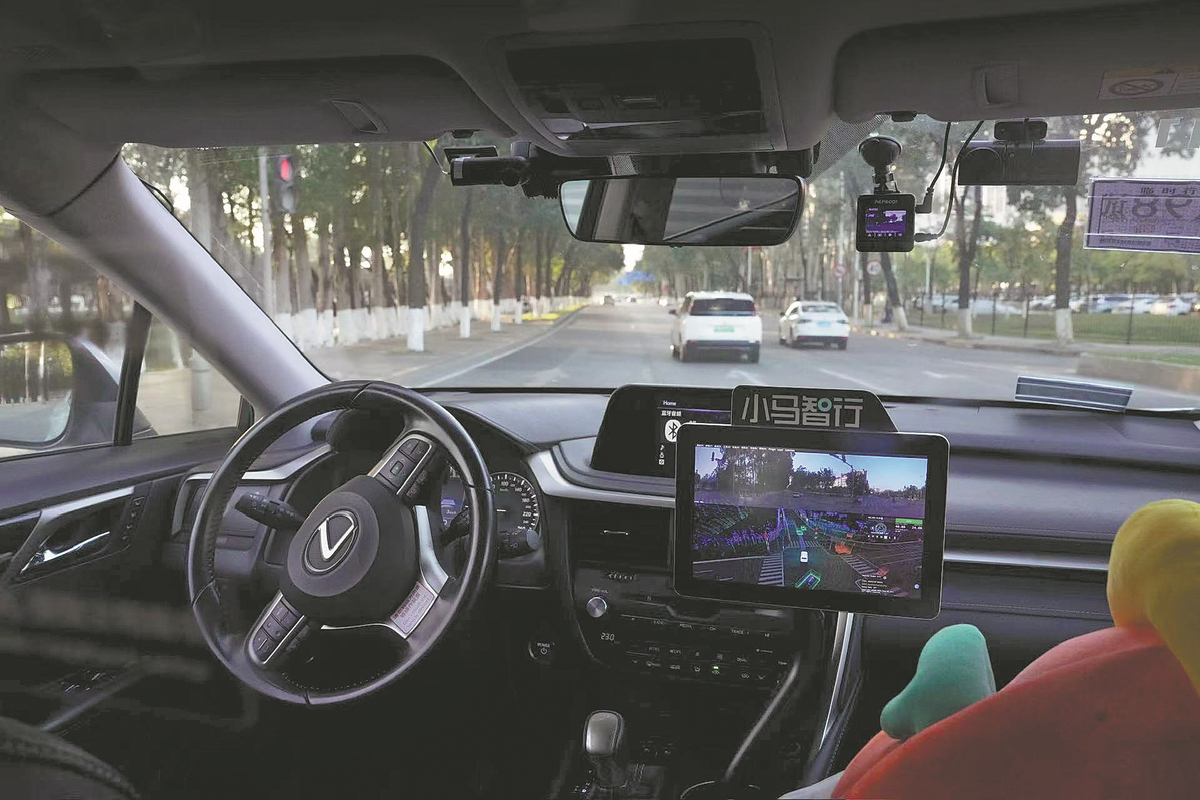
Chinese self-driving company Pony.ai will expand the number of its robotaxi fleet to about 1,000 this year from more than 200 currently, increase investment in research and development, and boost commercial operations as part of its broader push to bolster the popularization and application of autonomous driving technology.
Zhang Ning, vice-president of Pony.ai, said the company will be able to break even in operations when its robotaxi fleet exceeds 1,000 and begins to move toward large-scale commercialization this year.
"When we cross over that 1,000-level, the cost of running additional robotaxis will be reduced, while the gross profit margin will be higher," Zhang said.
The company said its fleet size of robotaxis is expected to reach 2,000 to 3,000 by the end of 2026, and the figure will be further expanded to more than 10,000 in the next three to five years due to the continuous decline of operational costs and policy support from authorities.
Zhang, who is in charge of Pony.ai's robotaxi business, said they have established joint ventures with Japanese carmaker Toyota and its Chinese JV, GAC Toyota, to promote the commercial operation of robotaxis, and inked strategic partnerships with Chinese automakers such as BAIC and GAC Aion to operate its seventh-generation robotaxi vehicles.
Pony.ai is stepping up efforts to advance mass production and deployment of Level 4 autonomous vehicles.
Autonomous driving is categorized from Level 0 to Level 5. The higher the level, the more advanced and intelligent the technology. Level 4 autonomy means vehicles can drive themselves in most conditions without a human backup driver.
Founded in 2016, Pony.ai has already obtained licenses for fully driverless robotaxi services in Beijing, Shanghai, and Guangdong province's Guangzhou and Shenzhen. It went public on the Nasdaq in November, which was the largest IPO in the autonomous driving sector in the US last year.
The company is also collaborating with ride-hailing platforms and taxi operators to integrate autonomous vehicles into urban mobility networks.
As for an overseas expansion plan, Mo Luyi, vice-president of Pony.ai and general manager of its Guangzhou branch, said its autonomous vehicles will begin road tests in South Korea soon. "We have also established a new R&D center in Luxembourg, and the vehicles will conduct road tests in Europe and then be put into operation," Mo said, adding they also plan to bolster the development of self-driving services in the Middle East.
Global consultancy McKinsey & Company expects China will become the world's largest market for self-driving vehicles, with revenue from such vehicles and mobility services exceeding $500 billion by 2030.
China has introduced a series of policies to promote the commercialization of self-driving vehicles. More than 50 cities nationwide have released autonomous driving pilot demonstration policies, and ramped up efforts to expand the application scenarios of self-driving technology.
Beijing recently approved new regulations on autonomous driving vehicles, marking significant progress in bolstering self-driving technology in the capital. The regulations, which are set to take effect on April 1, encourage and support policies and measures for technological innovation and industrial development of autonomous vehicles. They also provide a clear regulatory framework for autonomous vehicles equipped with Level 3 and higher systems.
The market scale of robotaxis in China is expected to exceed 1.18 trillion yuan ($161 billion) in 2025 and 2.93 trillion yuan in 2030, making it one of the largest application scenarios for autonomous driving technology, according to a report by Pacific Securities.
Lyu Jinghong, an analyst tracking intelligent mobility at research firm BloombergNEF, said continued tests on public roads, eased regulations as well as cost reductions in autonomous vehicle manufacturing will help accelerate the deployment and commercialization of self-driving vehicles.
"Ensuring the safety and stability of robotaxis remains a top priority," said Zhang Xiang, an auto sector researcher at North China University of Technology.
"More efforts are needed to continuously optimize algorithms, reduce the manufacturing costs of driverless vehicle components and facilitate the construction of intelligent transportation infrastructure."
- Chinese firm launches expressway unmanned truck platoon self-driving testing
- China's burgeoning autonomous driving industry fuels robotaxi use, development
- Nasdaq-listed Pony.ai sets sights on expansion, profitability
- China strengthens support for autonomous driving technology as Beijing passes new regulations
- Beijing passes regulations to support, govern autonomous driving technologies