Vegetables take root on 'Roof of the World'







LHASA-When Zhang Jiming came to Southwest China's Tibet autonomous region 20 years ago, many local villagers knew little about vegetables, or how to grow them and fed them to domestic animals.
"The villagers were taken aback when they saw tomatoes turn from green to red. They rushed to me and asked me what they should do," Zhang recalls. "I told them, 'just pick the tomatoes!'"
Zhang is a technician teaching local Tibetans how to grow vegetables, and he has witnessed how the vegetable industry has gone from barren to prosperous in the region.
Last year, Tibet reported a vegetable plantation area of 26,000 hectares, and vegetable production reached 970,000 metric tons, according to official figures. Tibet's major cities and towns can produce 85 percent of their vegetable requirements in summer and autumn, and about 65 percent in winter and spring.
Vegetables were once rarities in Tibet. In the feudal society of serfs, eating vegetables was the prerogative of a select few "noblemen".Only a few types of vegetables were cultivated in Lhasa and Xigaze.
As late as the 1990s, Tibet still suffered from a severe lack of vegetables. The lack of cultivated land was a stumbling block, and locals depended on vegetables transported from other areas in China. Many people from Tibet would pack vegetables in their suitcases when returning home from vacations outside the region.
Changes started to take place in 1998, when officials from East China's Shandong province decided to bring advanced vegetable plantation techniques when they were aiding development in the county of Bainang. Shandong is famous for its vegetable cultivation.
Two years later, Zhang joined a posse of vegetable technicians to aid Tibet, a place known as the "Roof of the World".
But it was no easy task. At first, Zhang suffered from altitude sickness. He felt dizzy and tired, and he lost his appetite.
"There was no electricity, and we couldn't speak the local language," Zhang says. "Local people did not identify with vegetable planting."
Zhang went door to door on his bicycle, trying to convince people to learn about vegetable seedling cultivation and plantation.
Zhang's efforts paid off, and the number of people planting vegetables grew day by day in Bainang.
In just 20 years, the local vegetable industry skyrocketed.
Currently, the county has established a national-level demonstration zone for vegetable cultivation, and is building an industrial garden of fruits and vegetables covering about 667 hectares.
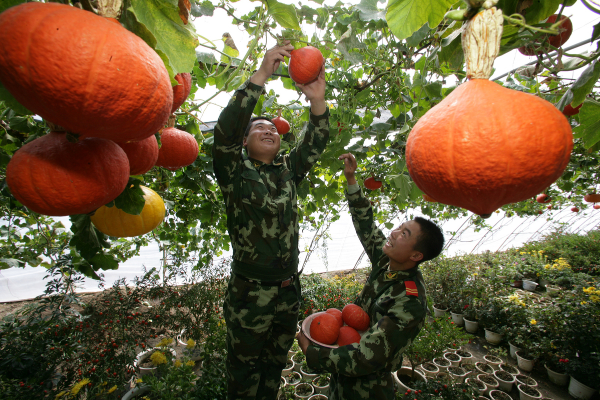
The vegetable industry also expanded to other remote areas in Tibet, such as Ngari and Nagqu. Some border control stations in Tibet have even built greenhouses, allowing soldiers to eat fresh vegetables instead of canned and dry food.
In the farmer's market on the bustling Keji Road in Xigaze, vendors tout their freshly picked vegetables to customers.
"It's fresh and cheap," one vendor says.
Prices for the vegetables range from 1 yuan (15 US cents) per kilo to 2 yuan per kilo. The rise of the vegetable industry has enriched the diets of local people in Tibet, whose main staple foods used to be beef, mutton and roasted barley flour.
"People are getting increasingly used to eating vegetables cooked in different ways," says Penpa Dondrup, 73, a former official of Pengcang village in Bainang. The village is where Bainang's first greenhouse was built.
Penpa Dondrup says vegetables diversified people's diet and contributed to better health in the village.
"We have more than 40 people aged 60 and above," he says. "One of them is over 90."
Statistics show that the average life expectancy in Tibet has risen from 35.5 to 70.6 at present.
The industry also helped people in Tibet cast off poverty.
In Bainang alone, more than 4,000 people have shaken off poverty by planting vegetables. The county has become an "innovation base" for plateau fruits and vegetables.
Meng Deli is the general manager of an agri-tech company specializing in modernizing Bainang's agriculture.
"Our technologies for vegetable cultivation are energy-efficient, controlled by computers and allow vegetables to grow in cold areas at high altitudes," Meng says.
"Here in Bainang, we have pure air, fine soil and great water resources," Meng says. "The high altitude and big temperature differences between day and night can be turned into advantages for vegetable cultivation with the help of technology."
Meng says he hopes to deliver high-quality fruits and vegetables from the "Roof of the World" to people across the country, and even around the globe.