


An ode to the fallen








Cast members of the musical Battle of Xiangjiang River stood by the eponymous waterway in South China's Guangxi Zhuang autonomous region, stared at the flowing river, and thought about the battle that happened there 86 years ago. They traced the footsteps of the Red Army, prayed for the soldiers who sacrificed their lives in the battle and read words inscribed on their tombs to learn their stories.
They paid several such visits to Guangxi's Xing'an, Quanzhou and Guanyang counties, where the battle took place, laying a basis for the creation of the musical, which was staged at the National Center for the Performing Arts in Beijing on Nov 10 and 11.
Organized by the publicity department of the regional government, the musical was created by Guangxi Art Performance Group to mark the 85th anniversary of the Xiangjiang battle last year, and premiered in Nanning. It was staged in Beijing this month as part of an exhibition of Guangxi's quality plays.
As the name suggests, it is wholly based on the historic battle, which happened in northern Guangxi during the Red Army's Long March. The musical tells the story of some Red Army soldiers who sacrificed their lives to ensure the central army and other soldiers were able to cross the river and continue on the journey.
According to Liu Kedong, visual director of the musical, "We want the audience to learn the story in an immersive way when they watch the musical, to take them to the cruel life-and-death battle, so that they gain a deep understanding of what happened and the importance of the soldiers' sacrifice."
When he visited a museum in Guangxi that marks the battle, he was impressed by the story of local people, who dismantled their doors and beds and used the planks to build the bridge that helped the Red Army soldiers cross the river. It inspired him to create the main stage set using several door planks.
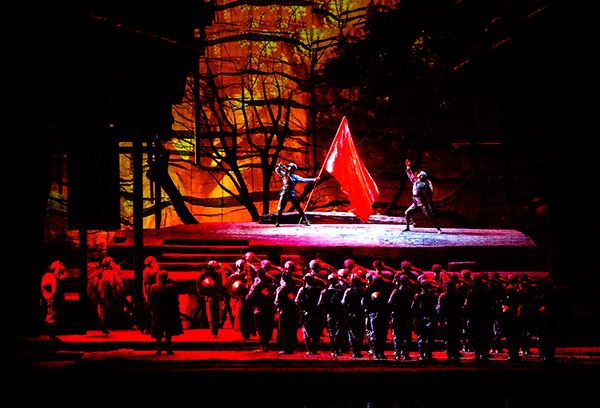
"The audience can see that the stage is full of moments about life and death. I designed the stage set to include trees. They seem luxuriant at first, but then they are burned to charcoal during the battle. The same is true with the people. Some people were still alive in the last second of the battle, but were dead before it was over," says Liu.
"The battle was hell, and only those who had faith in what they were doing could support themselves and make courageous choices. The play wants to show their faith," he adds.
Actor Gao Peng plays Chen Xiang, the hero of the musical. And the plot was adapted from the true story of Chen Shuxiang, a commander of the battalion that had the task of covering the other soldiers. He led the soldiers bravely in the fight before taking a bullet to the stomach, and he killed himself so that he would not be taken captive.
"You can say Chen is a hero or just an ordinary man doing his duty. No one is born to be a hero, but there are ordinary people who rise to meet emergent difficulties at important times. Chen is a very vivid character, and I try to stay true to the real person every time I stand on the stage," says Gao.
Most characters have their basis in reality, according to playwright Qian Xiaotian. "After visiting Guangxi, we decided to create the musical with the principle that historic events must be kept real, but we took artistic liberties with small details. Most characters are based on real people, more or less, and some of their names come from a monument to the battle which I saw in Guangxi.
"We find it difficult to show the battle in a comprehensive way, so we shaped some typical characters to show images of the Red Army, and thus pay tribute to all the soldiers in the battle," says Qian.
Director Chen Wei believes the musical is meaningful. She says the cast and crew of nearly 400 people treasure this opportunity to perform.
"We find it meaningful to use artistic means to show this group of soldiers and record their historic moment. I hope the musical suits young people's aesthetic taste, and helps them understand this part of history and remember these heroes," says Chen.