Global COVID-19 responses: 'Zero COVID-19 Case Policy' vs. 'Coexisting with COVID-19 Policy'







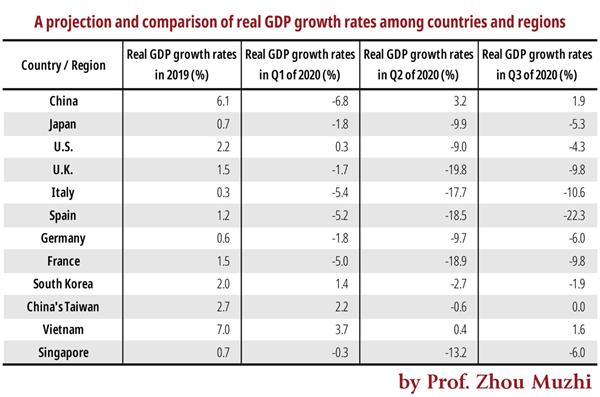
Sources: the National Bureau of Statistics of China, the Cabinet Office of Japan, the Bureau of Economic Analysis of the US Department of Commerce, the British Office for National Statistics, the Italian National Institute of Statistics, the Spanish National Statistics Institute, the Federal Statistics Office of Germany, the French National Institute of Statistics and Economic Studies, the Bank of Korea, the Directorate General of Budget, Accounting and Statistics of China's Taiwan, the Asian Development Bank and the International Monetary Fund.
The resurging virus in autumn and winter seasons posed daunting challenges to those countries that opted for the "Coexisting with COVID-19 Policy". Compared with them, China benefited from its "Zero COVID-19 Case Policy" as all localities across the country resumed economic activities and normal life based on their situations. After the postponed National People's Congress concluded on May 28, China basically resumed normal economic activities. During the National Day holiday, domestic tourists made 640 million trips. China's real GDP shrank by 6.8% in the first quarter from a year ago as the coronavirus outbreak seriously impacted its economy. China's real GDP grew by 3.2% in the second quarter, rebounding from the first quarter's contraction. The IMF projected that China's real GDP will grow by 1.9% in 2020.
The economy of Japan, European countries and the US, which adopted the "Coexisting with COVID-19 Policy", continued to shrink in the second quarter, widening their falls compared with the first quarter. Some countries even exhibited a negative double-digit growth. The IMF projected that those countries will all have a negative economic growth in 2020.
South Korea, Singapore, Vietnam, which experienced the test of the SARS outbreak like China, deployed the "Zero COVID-19 Case Policy". As shown in Chart 3, Vietnam and China's Taiwan have better economic performance. According to an IMF forecast, Vietnam's real GDP will grow by 1.6% in 2020, and the real GDP growth of Taiwan province of China will stand at zero. South Korea may see a 1.9% GDP contraction for 2020, which is a smaller drop compared with other Western countries. Singapore's economy, which is vulnerable to the world's economic fluctuations due to its heavy reliance on global trade, suffered a great slump in the second quarter.
According to the analysis above, compared with the "Zero COVID-19 Case Policy", the "Coexisting with COVID-19 Policy", which was intended to cushion the economic blow from a lockdown, turned out to be a failure that caused a long-term economic gloom.
By Nov. 8, there had been more than 50 million cases of infection globally. The winter outbreak would be worse, with the number of infections soaring. Europe and the US have become the epicenter of the outbreak. I suggest that all countries around the world should take the "Zero COVID-19 Case Policy" when wonder drugs and efficient vaccines are not available, to contain the spread of the virus.
(4) Japan: Swinging between economic growth and COVID-19 response
Japan reported the first confirmed COVID-19 case on Jan. 16, 2020. The first flight of the Japanese government taking 206 Japanese citizens took off in Wuhan and bound for Japan on Jan. 29. On Feb. 13, Japan reported the first COVID-19 death. On Feb. 28, Hokkaido released its announcement of emergency. On March 13, the Diet, or the Japanese Parliament, passed an amendment of a special law to combat COVID-19, including the virus to the list of infectious diseases suitable for the law. The special law stipulates that the government is granted enhanced authority to declare a state of emergency in condition that the COVID-19 epidemic may threaten people's lives and inflict great losses on society, laying a legal basis for the government to declare a state of emergency.
The Japanese government declared a state of emergency on April 7 with respect to the seven prefectures: Tokyo, Kanagawa, Saitama, Chiba, Osaka, Hyogo, and Fukuoka. On April 16, the state of emergency was expanded to the whole nation. That was a loose requirement aimed at reducing person-to-person contact by at least 70% to 80%, rather than a lockdown targeting at no new local cases. Even so, as shown in Chart 4, the daily new confirmed COVID-19 cases in Japan plumped immediately, and the declaration of a state of emergency achieved remarkable results in disease prevention and control. As the situation improved, the Japanese government lifted its nationwide state of emergency on May 25. Different from China, Japan reported 20 new cases on that day. The lifting was accompanied by new confirmed cases.
China required that a place must report no new COVID-19 cases for 14 consecutive days before it announced itself to be a low-risk area, but Japan lifted the state of emergency with new cases, which boded that the epidemic may come once again. It turned out that a week after lifting the state, Tokyo had to declare its state of emergency due to the rapid increase of infections, so as to raise the people's awareness of disease prevention and control amid severe COVID-19 epidemic.
Since July 22, Japan started to carry out the "Go to Travel" campaign to revive tourism and stimulate economy in places except Tokyo. On that day, the new confirmed COVID-19 cases in Japan amounted to 792, 10% more than the peak number in the state of emergency, proving the move to be a temerity regardless of anything. Ten days later, the daily new cases surged to 1,575, a 120% increase over the peak number during the state of emergency.
On Oct. 1, Tokyo was involved into the "Go to Travel" campaign. The number of Tokyo's new cases reached 284, a rising trend again.
As shown in Table 2, by the end of Oct.11, Japan's death toll from COVID-19 of every 100,000 people is only 1.3, lower than 66.3 of the US, 63 of UK, 59.8 of Italy, 50.1 of France and 11.6 from Germany. In terms of fatality rate, Japan is the lowest among developed countries. It can be said that Japan suffered least of the countries adopting the "coexisting with COVID-19 policy". However, the winter when influenza virus may rage is coming soon. The flu virus and the COVID-19 virus would pose more challenges to Japan. Meanwhile, Japan's economy under the long period of "coexisting with COVID-19 policy" has been fettered and sluggish. As shown in Table 3, IMF estimated that the real GDP of Japan may decrease 5.3% in 2020.
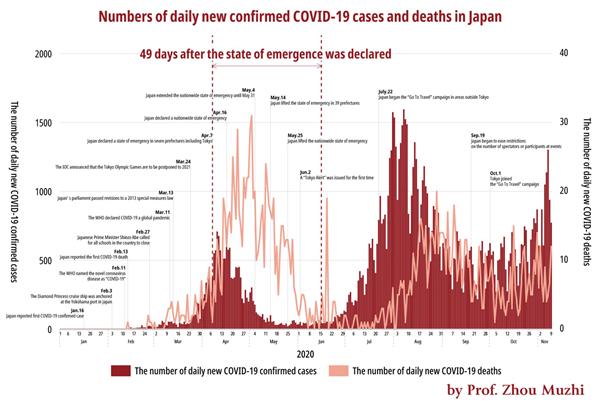
Sources: Database of positive cases of the Ministry of Health, Labor and Welfare of Japan, and NHK's special website for COVID-19 deaths in Japan.



- Exhibition highlighting the 'Two Airlines Incident' opens in Tianjin
- Average life expectancy in Beijing rises to 83.93 years
- Energy drink overdose sends delivery worker to hospital
- GBA and Hainan deepening cooperation to boost innovation and sustainable growth
- Beijing mulls including the costs of embryo freezing and preservation in medical insurance
- Rocket developed by private Chinese firm fails, loses three satellites