China's fintech innovation thrives in unusual year







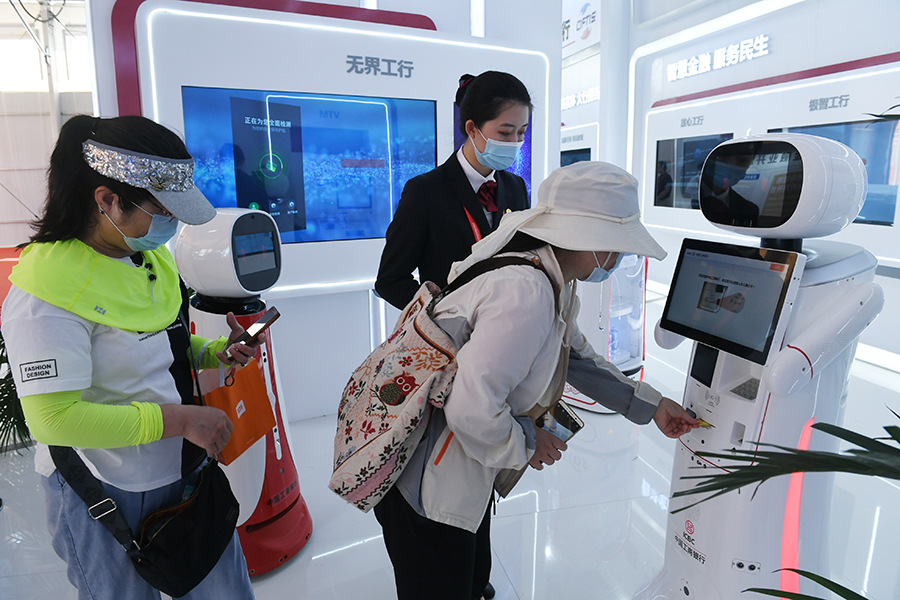
BEIJING -- The long queues at automatic teller machines (ATMs) have become a rare sight as people in China are already accustomed to going out with mobile phones instead of wallets, and many can't even remember when they withdrew cash the last time.
Rather than visiting brick-and-motor banks, people, especially the younger generation, turn to mobile phones and computers since the Internet and apps cover most banking services.
Official data showed that the number of ATMs dropped by 68,600 from the end of last year to September, while 2,790 more commercial bank outlets were shut down in the first 11 months, following the closure of more than 6,280 over the past two years.
The change at banks is just one example of the country's efforts to churn out financial technology (fintech) innovations and boost the digital economy, when demand for contactless service mounted and new business modes flourished in the stay-at-home market amid the COVID-19 pandemic.
Digital innovation
Despite disruptions due to COVID-19, the country's fintech innovations continued to provide better solutions for individuals, the real economy and social development, with the support of information technology including cloud computing, big data, artificial intelligence and mobile Internet.
"As digital payment, especially mobile payment, gets popular in the country, basic financial services are generally available in all urban and rural areas," Guo Shuqing, chairman of the China Banking and Insurance Regulatory Commission (CBIRC) said at the Singapore Fintech Festival.
"The accessibility and scale of China's mobile payment is world-leading, and real-time reception of deposits, withdrawals and remittances have been realized," he said.
The emergence of new business modes such as livestreaming has further boosted China's online consumption among stay-at-home customers in 2020, with retail sales over 8 trillion yuan ($1.22 trillion) in the first three quarters, up 9.7 percent year-on-year, according to the Ministry of Commerce (MOC).
New vitality has been injected into the country's real economy through fintech innovations. Digital credit has substantially increased the availability of inclusive financing by performing intelligent risk control with big data, which reduced reliance on collateral, said Guo.
Inclusive loans to small and micro companies surged 30.5 percent year-on-year to 14.8 trillion yuan at the end of September, while outstanding loans to private firms rose 5.4 trillion yuan from the beginning of the year, an increase of 1.6 trillion yuan from the same period last year, according to the CBIRC.
Digital transformation of the financial sector has also contributed to the country's sprint toward the goal of eradicating absolute poverty. In the first quarter, online sales of farm produce reached 93.68 billion yuan, a rise of 31 percent year-on-year, MOC data showed.
The pilot of digital renminbi (RMB), which realizes point-to-point payment between consumers and sellers, shows China's determination to eliminate information and financial risks in the digital economy.
The pilot, which has been launched in the cities of Shenzhen, Chengdu and Suzhou and the Xiongan New Area, is expected to expand to more areas including the Beijing-Tianjin-Hebei region, the Yangtze River Delta and the Guangdong-Hong Kong-Macao Greater Bay Area.
In October, 10 million yuan of digital RMB was issued in Shenzhen as a means of payment for local citizens. Digital RMB of 20 million, which can be spent both online and offline, was distributed among consumers in Suzhou.
To optimize the pilot, the People's Bank of China started cooperation with major e-commerce and fintech companies such as JD Digits and Didi Chuxing. By the end of August, over 6,700 pilot scenarios covering catering, transportation, shopping, household bill payment and civic services were established for digital RMB payment.
Prudent approach
Fintech innovations offered more opportunities for market players to access consumers. At the same time, new problems related to the stability of the financial sector, information safety and fair competition emerged.
To tackle the problems, the country has taken an innovative and prudent approach and introduced a raft of measures to curb debt risks, unfair competition and data leakage.
Online peer-to-peer (P2P) lending, where investors sidestep traditional lenders such as banks to lend directly to borrowers, exited the innovation arena this year as a result of the country's ongoing efforts to crack down on risky forms of financing.
By mid-November, the number of Chinese P2P lenders had fallen to zero from a peak of about 5,000.
As data privacy becomes a growing public concern amid the rapid expansion of online transactions, the country's top legislature has drafted a law on the protection of personal information.
In his speech, Guo also stressed the need for fairer market competition as tech giants can use data monopoly advantages to hinder fair competition and obtain excess returns.
"More attention needs to be given to large companies to prevent them from obstructing the entry of new organizations, collecting data in unusual ways and refusing to share information that should be disclosed," he said.
As for the risks from some market players that are "too big to fail," Guo said the regulators need to keep a close eye on those tech giants that have branched into financial business.
"We must monitor the complexity and spill-out effect of their business risks, defuse risks timely and forestall new, hidden troubles brewing systemic risks," he said.
China's financial industry has embraced a new generation of information technologies and its spending on information technology is expected to reach 220.8 billion yuan by the end of 2020, global market intelligence firm International Data Corporation predicted.
To go in line with the development trends of fintech innovation, supervising technologies and regulations need to be developed, said Lu Shuchun, secretary-general of the National Internet Finance Association of China.