E-commerce helps lift struggling regions







For 72-year-old Li Shenglan, working as a weaver at a government-funded e-commerce facility is a good decision that not only turned her favorite hobby into a profitable undertaking, but also is a great way to help lift her family out of poverty.
"I like weaving fabrics. It was far easier work than toiling on the farm. Besides, I can chat with people of my age while working, which is a great comfort and joy," Li said.
Li was formerly a farmer from Dongzhang village, Quting township, Linfen, Shanxi province. Her family, registered as impoverished in government records, used to rely on planting wheat and corn on the 0.4-hectare family-owned plot for a living.
"We could barely make ends meet by working on the farm. Sometimes we helped our fellow villagers for extra income," she said.
Now Li earns an extra of 25 yuan ($3.82) per day just from weaving. "I weave about 5 meters of cloth per day on average and earn 5 yuan for each meter. That may sound like a small amount to many people, but that helps provide basic needs. I can also make more money if I become more skilled at operating machines to produce more," Li said.
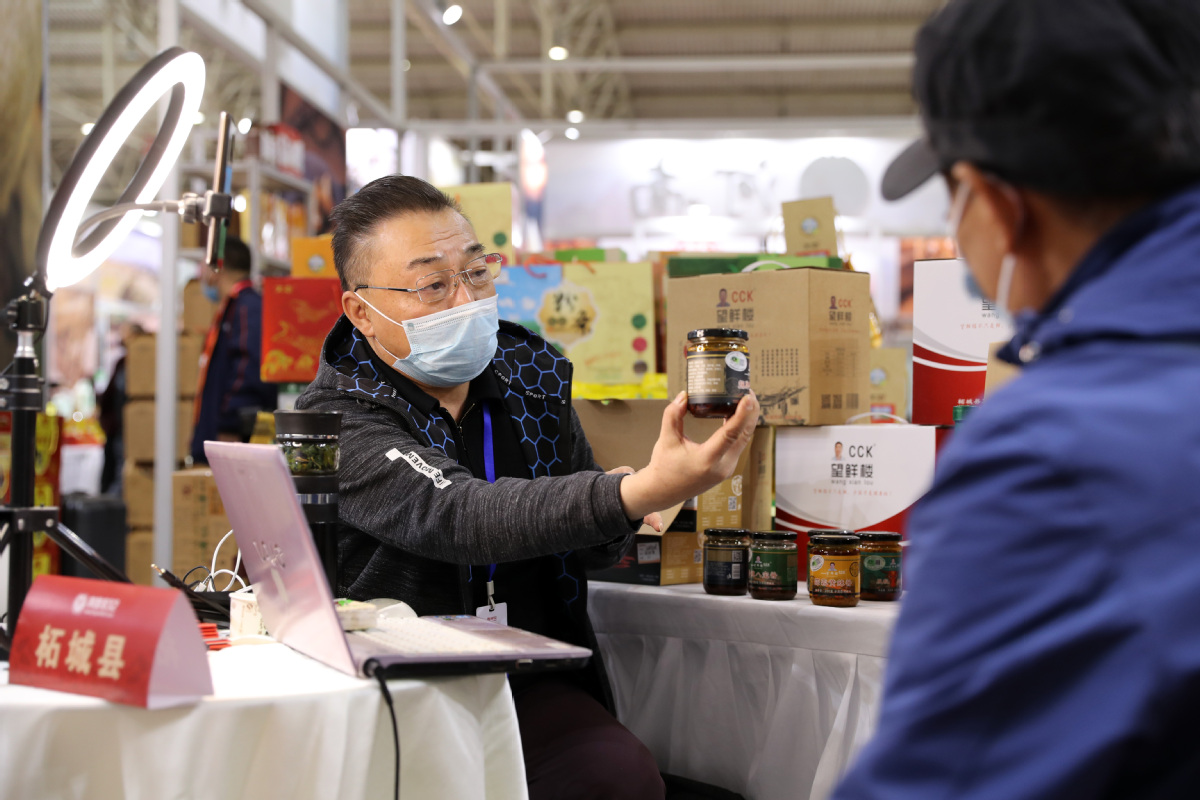
In November 2019, the e-commerce facility where Li currently works was founded with government support. Aiming at boosting the local economy, the facility has multiple functions including poverty alleviation, talent incubation, e-commerce store operations, logistics work and warehouse functionality. The station cooperates with seven supermarkets, nine companies and 18 associations and sells 230 kinds of agricultural products and related goods across the country via e-commerce platforms.
In June 2020, the e-commerce station registered a bedding brand called Kuang Yi Bo Bei, whose products are made of textiles woven by workers in the station's weaving department. In the same year, government officials from Quting provided 80 looms to seven villages under their jurisdiction, which attracted 40 people from registered impoverished families to work.
According to the local government, each registered impoverished family can earn about 12,000 yuan to 18,000 yuan per year by working in the e-commerce station's weaving department.
Yue Jinchuan, Party secretary of Dongzhang village in Quting, said the e-commerce station also offers training and related services. It set up a village-level e-commerce service center and provides financial and delivery services to those in need.
As of July, the e-commerce station had helped more than 500 villagers sell over 20 metric tons of agricultural products with sales revenue exceeding 120,000 yuan, the local government said.
"E-commerce plays an important role in combating poverty, especially amid COVID-19 challenges. It also provides successful experience in poverty alleviation to the global community," said Zhou Minliang, a senior researcher at the Institute of Industrial Economics of the Chinese Academy of Social Sciences.
The Ministry of Commerce said that in 2019, online retail sales in poverty-stricken counties nationwide reached 239.2 billion yuan, a year-on-year increase of 33 percent, which led to rising employment rates and income increases for about 5 million farmers across the country.
The increasingly important role of e-commerce in poverty alleviation is closely related to the improvement of infrastructure and related services in impoverished areas. As of June 2020, 100 percent of villages and townships capable of building asphalt roads had completed such construction. Impoverished villages' access to optical fibers, the infrastructure behind modern telecommunications, rose to 98 percent from less than 70 percent in 2017. About 96.6 percent of villages and townships have set up delivery service stations, and 832 country-level poverty-stricken counties have set up e-commerce service stations, Zhang Wenguang, dean of the School of Government and director of the Research Center for Rural Governance at Beijing Normal University, wrote in a recent article.
Zhang said underdeveloped areas should step up efforts to leverage geographical strengths to develop agricultural products, and meanwhile set up standards for food quality and safety checks, as well as packaging and cold chain logistics.
Zhang said government officials in underdeveloped areas should also make efforts to encourage people, especially seniors, to use e-commerce to broaden sales channels and encourage banks to launch supportive measures in terms of micro-loans.
Yang Xiaoyu contributed to this story.