Space ambitions needed now more than ever







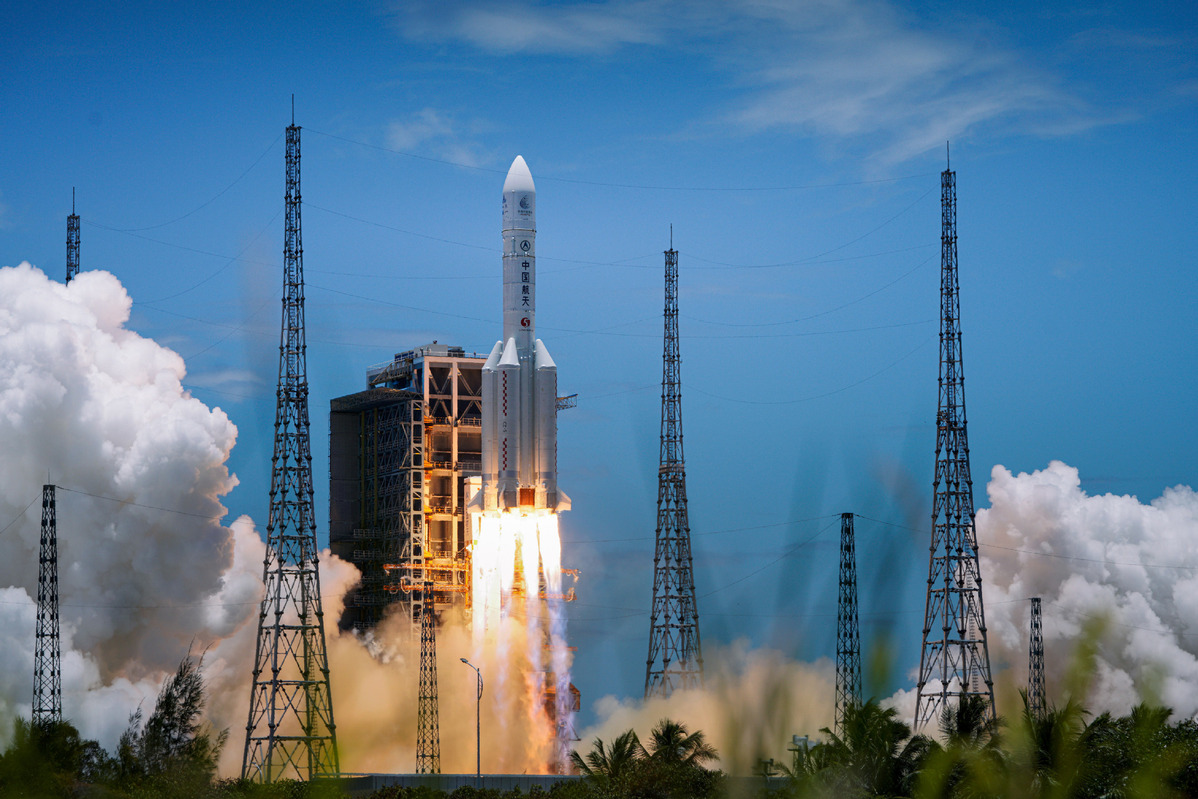
One human endeavor that defied the challenges that 2020 threw at us was space exploration, and 2021 is set to be an equally exciting year in increasing our understanding of the final frontier.
Space missions are years in the making and sometimes have narrow launch windows. Faced with the disruption of the pandemic that affected nearly every activity, the space sector forged ahead with a timetable of long planned projects.
Last year, state agencies and private companies undertook more than 100 orbital rocket launches. These included no less than three launches to Mars, including China's July launch of Tianwen 1-a groundbreaking, combined orbiter, lander and rover mission.
That came just days after the United Arab Emirates launched its Hope orbiter toward Mars, and in the same month that US space agency NASA launched the rover Perseverance to continue the search for life on the red planet.
The three missions are all scheduled to reach their distant destination in February after traveling millions of kilometers into space.
The following month, Boeing will undertake a further attempt to launch its Starliner space capsule toward the international space station after an aborted attempt in late 2019 in which the capsule was stranded in the wrong orbit. No one ever claimed space projects were easy.
Although 2021 will mark a bumper year for the advancement of science into space, the top headline might still go to US actor Tom Cruise when he arrives at the international space station to film a new movie.
"We need popular media to inspire a new generation of engineers and scientists to make NASA's ambitious plans a reality," NASA Administrator Jim Bridenstine wrote in a tweet.
On a grander scale, the first of 11 launches to build a Chinese space station by 2023 will happen this year. The 66-metric-ton orbiting space station will be home to three astronauts on six-month rotations and focus on experiments in astronomy, space medicine, life science and biotechnology.
Earthbound skeptics may question why major countries and businesses are expending so much on space exploration at a time when challenges on our planet have been mounting-not just in terms of the pandemic, but also in the face of the economic constraints that have accompanied it.
But that would be to ignore the practical benefits of space exploration that the COVID-19 crisis did much to highlight.
As early as April last year, the European Space Agency put out an appeal for fresh ideas on how space resources could be used to boost the fight against the pandemic.
The ESA was one of a number of international agencies that went on to develop a dashboard that used satellite-based observations to track changes in air and water quality, climate change, economic activity and agriculture, and to measure how regional lockdowns and social distancing measures affected the Earth's air, land and water.
Post-pandemic, it is hoped that space-derived data can be harnessed for a green economic recovery. For instance, cities may use satellite information to dynamically map traffic systems and ease the shift toward zero carbon public transportation systems.
According to the ESA, satellite applications can be used to help plan, monitor, predict and improve renewable energy production, while green construction can make use of space-based data and internet of things sensors to put new buildings in ecologically safe zones and conserve energy.
These days, everyone understands the benefits of satellite technology, not least in the fields of distance learning and working that were so vital in 2020.
But missions to Mars and beyond still might strike some as somewhat esoteric-not to say costly-when humanity faces so many challenges back home on Earth.
It is worth recalling, then, how many of the modern world's scientific innovations have sprung from the exploration of space. Medical diagnostic tools, wireless technology and camera phones are just some of the practical benefits that have emerged.
To get to Mars, scientists have had to remotely drill for rock samples to look for ancient signs of life, use high-resolution film, develop low-gravity flying machines, and send accurate information back to Earth.
Apart from the additional commercial attractions of space tourism and mining, space exploration will continue to provide answers to scientific questions that have thus far remained unanswered.
Despite these current and potential advantages, space budgets could well come under pressure as the world recovers from a difficult year.
The 37-member Organization for Economic Cooperation and Development warned in August last year of growing concerns about the medium-and long-term effects of the COVID-19 crisis on government budgets and the prospect of significant funding cuts for future space projects.
Noting that more than 80 countries now have a space program, the OECD described the post-crisis sector in terms of a societal necessity rather than as an economic burden.
Or, as one contributor to The Space Review put it: "In the long term, this pandemic may provide the impetus to further our expansion into the rest of the solar system."
Harvey Morris is a senior media consultant for China Daily UK.The views do not necessarily reflect those of China Daily.