Women on front line of virus testing battle







Authorities in Shijiazhuang, Hebei's provincial capital, have rolled out a series of citywide nucleic acid testing campaigns following a spike in COVID-19 cases this month.
Many more are still to come at district or county levels, creating huge numbers of samples.
Turbocharging the effort are tens of thousands of lab technicians from across the nation-an army of mostly female medical college graduates who have worked grueling hours on night shifts to get the job done.
Yang Hongke, a head technician at a clinical testing laboratory in Shijiazhuang, her home city, is one of them.
The city, which has a population of 11 million, spotted a novel coronavirus infection in a sprawling rural neighborhood on Jan 2. Soon afterward, large numbers of throat swab samples began streaming into labs, usually as night fell.
That's because the mass sample collection missions were conducted during the day at residential communities or the workplaces of those who had to keep working despite a sweeping stay-at-home order.
That meant testing personnel had to work on what Yang, 28, called "American schedules", referring to the time difference between China and the United States.
"The faster we do the testing, the sooner people will get the results," she said, explaining that positive results are central to deciding to place people under isolation for treatment or further medical observation.
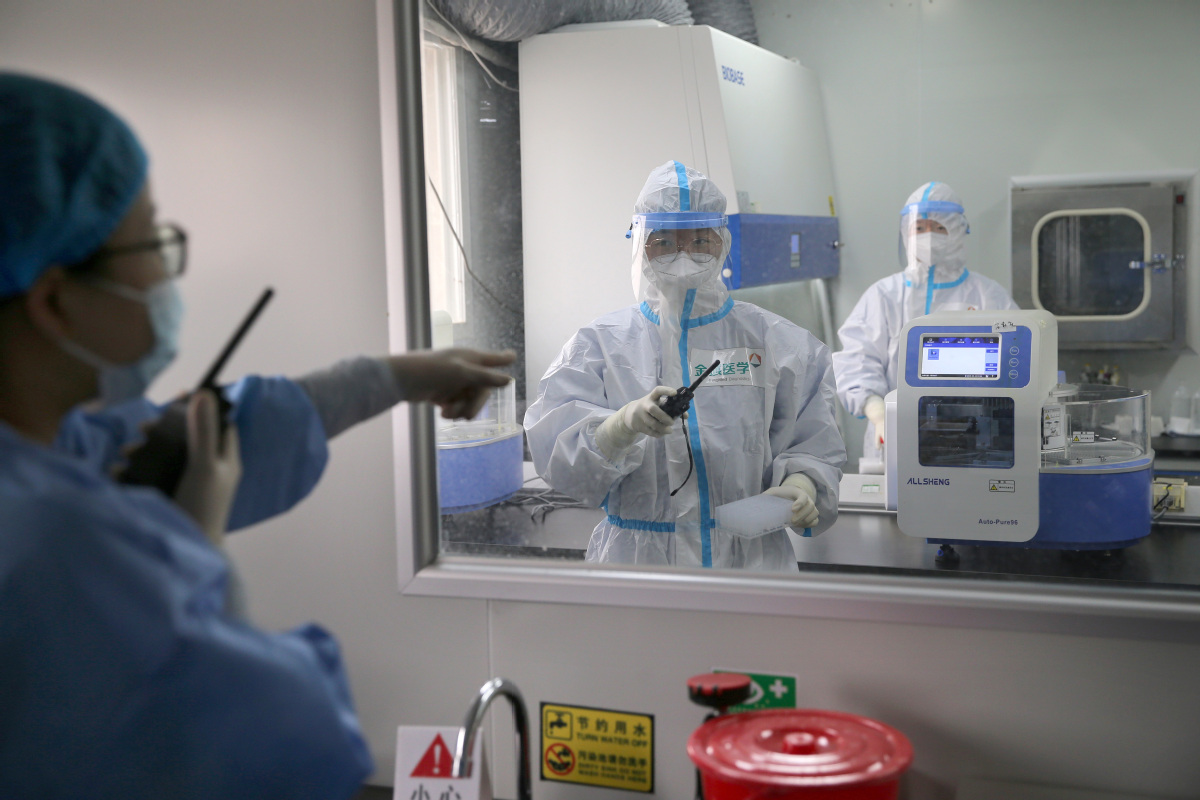
Yang is among 60 technicians at a lab owned by KingMed Diagnostics who have been working on shifts from midnight to 8 am for weeks.
Wearing hazmat suits and face shields, they are determined to report test results on schedule, even against their own interests.
Though the supply of protective equipment is sufficient, many offered not to drink water or use bathrooms throughout their shifts, as front-line health workers did in Wuhan, Hubei province, earlier last year due to a shortage of essential supplies.
The aim is to speed up a process that involves extracting and condensing nucleic acids for testing-which typically takes up to several hours and demands strict adherence to complex safety protocols due to infection concerns-and writing test reports.
At the height of the testing campaigns, Yang could only rest for a few hours before another shift began to ensure samples did not pile up.
"We would stop eating or drinking two hours ahead of our shifts and solve all of the personal matters," she said.
Yang joined the lab in 2017 after graduating from a medical school in Beijing.
When COVID-19 infections began spreading nationwide early last year, Yang was among many KingMed employees sent for training at the company's headquarters in Guangzhou, Guangdong province, to meet the surge in demand for testing.
Since then, her schedule has been tuned to fulfill the needs of the nation.
She was deployed to Beijing and then Wuhan early last year as part of a task force to aid testing drives.
When she returned to Shijiazhuang in May after outbreaks on the Chinese mainland had largely been stamped out, Yang joined testing missions aimed at ensuring students' safe return to campuses.
She said she was thankful to her boyfriend, a salesman, for being supportive of her job, which usually requires business travel and an unconventional work schedule.
Yang and her colleagues have helped test 220,000 tubes of samples since Jan 5. Each tube includes one, five or 10 swab samples, and they are tested all at once-a practice known as pool testing. When samples from 10 people are tested in one go and test positive, authorities contact each person and get them retested individually.
Among the 60 technicians working long nights, more than 80 percent are women and 90 percent are below the age of 30, lab management said.
He Haiyu works under Yang's supervision at the Shijiazhuang lab. The 25-year-old from Gansu province was deployed twice to the Xinjiang Uygur autonomous region last year to help in mass testing drives.
She was often soaked in sweat in her hazmat suit, which she could wear for up to 10 hours.
"Hazmat suits are our armor," she said. "I feel a sense of obligation in them."


- Defense spokesman: PLA drills around Taiwan justified
- Chinese fantasy animation hits Vietnamese theaters amid holiday surge
- BBC documentary reveals Guangdong's wild side
- Hangzhou 'Bunny Officer' goes viral for gentle traffic management
- From lab to life: humanoid robots' 'coming-of-age' year
- Video of PLA's drills around Taiwan Island released