Museum sheds light on giant pandas







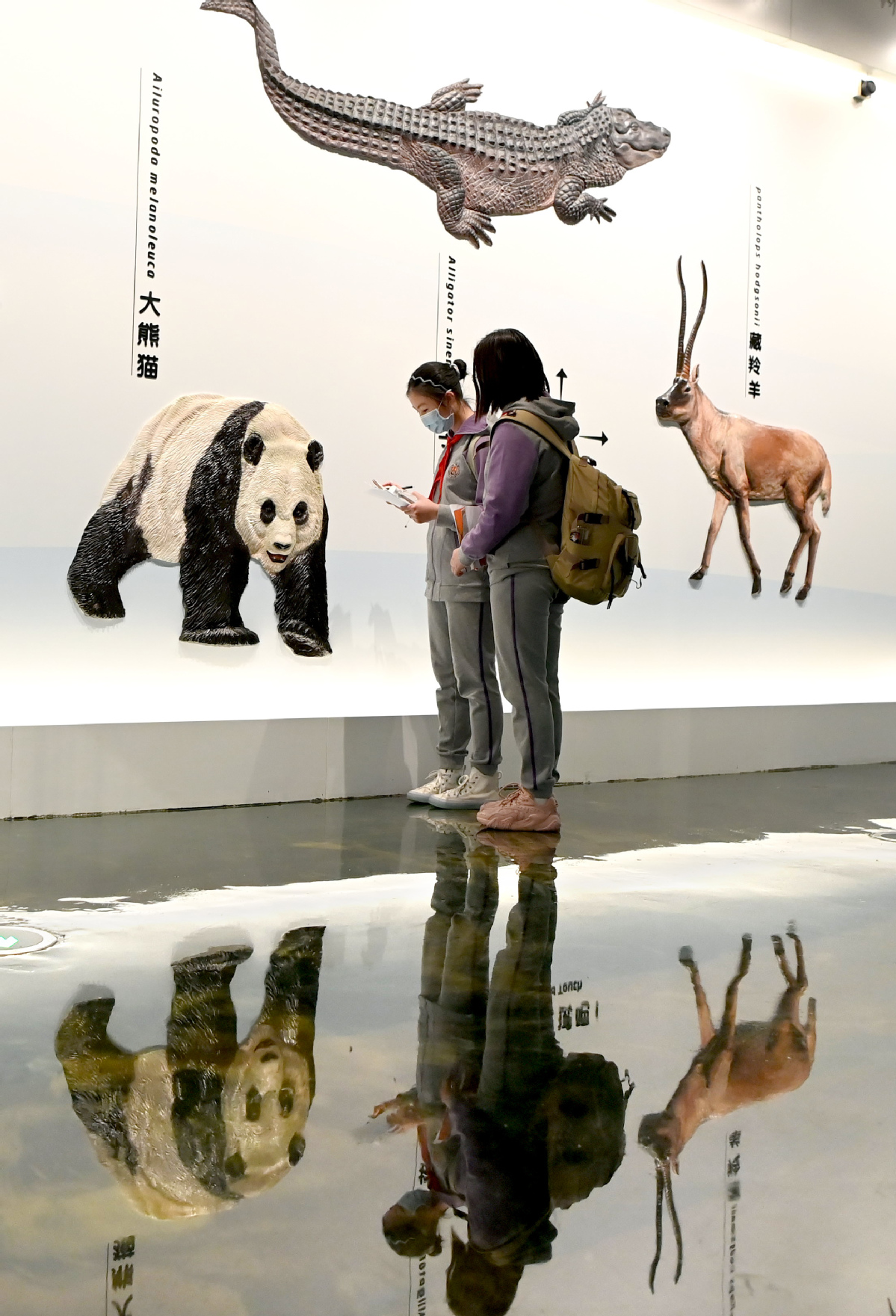
Do you love giant pandas but wonder why they have a sixth thumb, what it's called and why they are herbivores?
The answers are readily available at the Chengdu Giant Panda Museum, which opened at the Chengdu Research Base of Giant Panda Breeding in Chengdu, Sichuan's provincial capital, on Wednesday.
Zhang Zhihe, deputy director of the Chengdu management bureau of the Giant Panda National Park, said that with a built area of 7,179 square meters and a display area of 4,342 sq m, it is believed to be the world's first interactive-experience museum with a giant panda theme.
Zhang was head of the Chengdu panda base when arrangements for the museum's exhibits started to be made in August 2019.
The museum has exhibits about the history, habits and plight of the giant panda and efforts to rescue the species from extinction.
Visitors to the museum will learn that Jean Pierre Armand David, a French priest and naturalist, was the first Western explorer to discover and document giant pandas in 1869.
During the 12 years he lived in China, he named and introduced 68 new bird species to the West, as well as over 100 insects and other mammals, including milu, also known as Pere David's deer, and the golden snub-nosed monkey.
He sent a giant panda specimen back to Henri Milne Edwards at the Museum National d'Histoire Naturelle in Paris, who, in 1870, published a paper declaring the giant panda a new species that eventually came to be called Ailuropoda melanoleuca, Zhang said.
In the past, giant pandas were most likely carnivores and later became specialist bamboo-eaters.
"A major reason giant pandas focus their dietary efforts on the laborious task of consuming bamboo is simply that there has always been an abundant supply," Zhang said.
With their very particular diet, pandas have, over time, developed special physical features that help them process and consume bamboo.
One of the most noticeable and helpful adaptions is an elongated wrist bone. Called the radial sesamoid, it acts as a sort of sixth thumb that allows pandas to grab and hold objects, Zhang said.
"Pandas use this elongated bone, or pseudo-thumb, primarily to grasp, break off and process bamboo, but they can also use this handy 'thumb' to hold other items that might interest them," he said.
During the Pleistocene Epoch, which began about 1.6 million years ago, pandas enjoyed a wide distribution from northern Myanmar to eastern China, and even as far north as the region around Beijing.
Today, pandas survive in just six mountain ranges in the provinces of Sichuan, Shaanxi and Gansu, with their habitat totaling about 23,050 square kilometers.
"The six mountain ranges are the Qinling, Minshan, Qionglai, Daxiangling, Xiaoxiangling and Liangshan mountains," Zhang said.
The largest single area still remaining for wild giant pandas is the Minshan Mountain range, which covers an area of 9,603 sq km.
The six areas are highly fragmented due to human habitation and activities. With most valleys inhabited by humans, many panda populations are isolated in narrow belts of bamboo no more than 1,000 to 1,200 meters wide.
"Therefore, their actual geographical range is much smaller than generally depicted on maps," Zhang said.






- Beijing explores robots to support aging population
- Aid cadre decides to stay permanently in Xizang
- Inner Mongolia's two ports named national smart port models
- Ministry lodges stern representations with US over $11b arms sales plan to Taiwan
- Unlocking life in Gansu: an Egyptian professor's journey with the Five-Star Card
- NE China's Heilongjiang issues highest-level blizzard warning