


New rules to protect, preserve unique areas







Updated regulations on the protection of Beijing's historical and cultural areas came into effect last week, highlighting the capital's determination to preserve its areas of historical interest.
As a world-famous city and an embodiment of Chinese civilization, Beijing was approved as one of the first national historical and cultural cities in 1982, said Zhang Qing, deputy director of the Standing Committee of the Beijing People's Congress.
To continually update the local regulations, which have been in force for 16 years, will help to transform the ideas and requirements for the protection of historical and cultural cities into institutional rules, in a bid to further improve the protection of Beijing's character, Zhang added.
The new regulations make it clear that the scope of protection for Beijing's historical and cultural areas covers all the administrative districts.
By strictly ensuring no more time-honored areas are demolished, the new regulations aim to preserve the overall pattern of these areas, which highlight gentle, open and magnificent spaces, according to local officials.
At the beginning of 2021, two streets, both with more than 700 years of history in downtown Beijing, opened with a revitalized character after renovations.
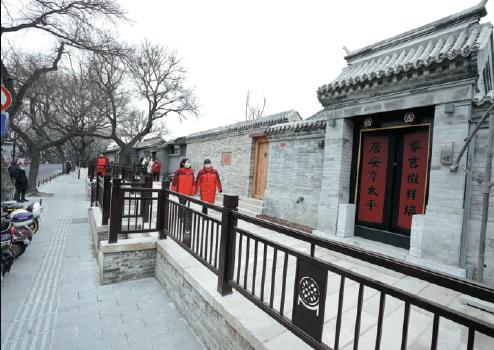
One of them is Gulou Xidajie, or Drum Tower West Street, in Beijing's Xicheng district.
He Xiangdong, a 75-year-old local resident, said: "Three years ago, it wasn't like this. There were cars everywhere. What a mess!"
Having lived in the area for most of his life, He witnessed the process of the street's transformation from chaos to order.
Gulou Xidajie has kept the breadth it had more than 700 years ago. But as illegal buildings and car parking grew, the street became congested and noisy.
To improve the situation, Xicheng district launched a three-year action plan to tidy up and revive the street in June 2017.
The plan covered multiple aspects that ranged from demolishing illegal buildings, blocking off hole-in-the-wall shops and stopping vehicles from parking illegally.
In the past three years, 308 illegal buildings in the street, covering about 13,900 square meters, have been demolished. Also, 214 illegal advertising boards and 212 unapproved hole-in-the-wall shops were dealt with.
"More than a decade ago, Gulou Xidajie was a street where vehicles were not allowed to stop, but the rule could not be enforced at all. Illegal parking became more and more serious (in the past few years)," said Liu Weiyan, a senior officer involved in the three-year action plan.
There are a large number of residents living in hutong, or alleyways, who bought cars but had no place to park. So they had to park vehicles on the sidewalk of Gulou Xidajie.
More than 600 vehicles were illegally parked along the 1.7-kilometer-long street at peak time, forcing pedestrians to risk walking on the road.
After investigations and studies, Xicheng district mobilized neighboring enterprises and public institutions to share some of their parking places with residents in immediate need. This has helped to solve the congestion in the street.
"Promoting people-centered new-type urbanization and implementing urban renewal action are important national strategies during the 14th Five-Year Plan (2021-25)," said Yang Jun, deputy director of the Beijing Commission of Planning and Natural Resources.
Urban renewal is not only a matter of physical and spatial demolition and repair. It is also a systematic project to promote sustainable and high-quality development, and high-level governance of a city, Yang added.
"We need to base ourselves on Beijing's realities, continue to explore, enrich and improve our policies and measures, which requires the concerted efforts of the government, market, society and the public."