Hezhai: Birthplace of self-governance in China







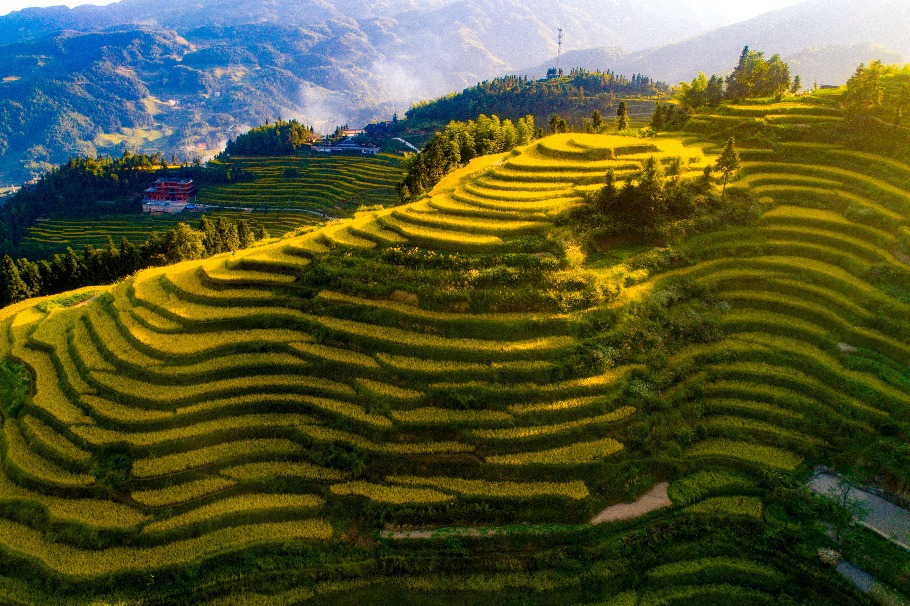
In 1978, 18 farmers in Xiaogang village in Anhui province made a secret pact to break from the country's rigid agricultural system. Two years later, around 200 farmers voted spontaneously to form China's first self-governance committee at the village level in Hezhai, a mountainous area in the Guangxi Zhuang autonomous region.
Both innovations are regarded today as epoch-making achievements in the country's rural reform.
Wei Huanneng, then 38, was the head of a production team in Hezhai village, where the per capita income was 57.83 yuan ($8.8).
"With the advent of the household responsibility contract system, the former production teams gradually lost their power over village affairs, and residents suffered from disorder — gambling, theft, superstition and indecent behavior," Wei recalled.
In this situation, the village assembly discussed setting up their own organization to curb the chaos. But who would lead the organization? The residents decided to conduct an anonymous vote under a camphor tree, and Wei and five others were elected as members of the village committee on Feb 5, 1980. Wei was appointed as head.
"At that time, the members of the Communist Party of China were pioneers in the management of village affairs and much trusted by the people," said Wei, who joined the CPC in 1976.
Once established, the committee confronted a series of challenges, including exploitative logging by local farmers.
"We spent five months working on a draft of village regulations and agreements that everyone promised to follow," Wei said.
Under the agreement, damaging forests to reclaim land for farming was banned.
"In fact the agreement worked very well. We saw much less social disorder. Once a thief was caught stealing a cattle from our village, and he got a fine of 150 yuan," Wei said.
More and more magical changes have taken place ever since the committee was formed.
"We had no access to electricity until the committee raised money to light up the village. We also paved dirt roads and built bridges," Wei said.
During Wei's 20 years in office, he managed to settle numerous economic disputes and neighborhood arguments through negotiation.
"I earned nearly nothing from the job, but as long as harmony was improved, all the effort was worthwhile," he said.
The success of Hezhai soon extended to all of Yizhou district of Hechi. As of 1982, 598 of its 2,000 villages had set up similar committees.
After the Standing Committee of the National People's Congress conducted research on the innovation, self-governance committees at village level were written into the Constitution, a revision that took place in December 1982.
The once-backward village thus became the birthplace of grassroots self-governance in China.
Nowadays, Wei, now 79, is relieved to see young Party members in the village shouldering more responsibility to improve people's livelihoods.
Zhou Zhenhong, 36, was determined to develop rural tourism and has run a guest house in Hezhai since 2016. His business was hurt by the COVID-19 pandemic, so he found an alternative: He launched a lobster breeding project with the help of the village committee and invited members of 20 impoverished households to be part-time employees.
"It's hard to develop any industry in Hezhai. Our CPC members should do their part to help seek a better life," Zhou said.
With an annual production of 10,000 kilograms, each impoverished family can earn 2,500 yuan per year.
"I still have confidence in this place, since whenever there is a problem there will be a solution figured out by the Party members," Zhou said.
According to the local government, Hezhai's per capita income rose sharply to 13,630 yuan in 2019.



- 'Treasure Island' song highlights PLA resolve
- Party at backstage of float parade in Shanghai
- Hainan holds foreign-focused symposium to optimize its international portal
- Shanghai Tourism Festival dazzles with grand float parade
- Election of Macao's 8th Legislative Assembly commences
- International Universities Rowing Open kicks off in East China