Prosperity promoter








The Belt and Road Initiative offers countries a practical way to overcome the pressing challenge of poverty
Unlike in the past when people and their governments in developing countries were at their wits' end about what policies they should pursue or not to overcome poverty, today the situation is completely different.
Not only are the conditions fundamentally different, so are the prospects and the enormous potential for lifting people out of poverty. The challenge is to find innovative and creative ways, as well as an appropriate economic model that can serve to bring about sustained people-centered development. China's Belt and Road Initiative, fashioned to suit local conditions, is one good example.
Inequality and poverty continue to be recurring themes at the international and regional levels.
An untold number of international declarations have been made and plans of action have been adopted by governments expressing their commitment to reduce and eliminate poverty at the global and national levels. Yet poverty persists.
As a result people are growing tired of empty promises and meaningless rhetoric that do not provide jobs, do not put money in their pockets and food on the table, nor offer a livelihood that would lift them out of poverty and open up a pathway to prosperity. The problem is much deeper than it appears on the surface.
Compounding the problem is the novel coronavirus outbreak that is having a severe impact on economies, particularly those of many developing countries. As though that was not enough, the challenges of grinding poverty in developing countries are the high costs for adaptation and resilience building measures to combat climate change.
Despite the advances in science and technology, millions of people in developing countries continue to scrounge through garbage for food in order to survive. The living conditions of millions of people in Asia, Africa, Latin America and the Caribbean continue to deteriorate as the gap between the haves and have-nots grows wider and wider.
The problems of poverty and backwardness are linked to a number of related problems. These include: foreign ownership and control, particularly by multinational corporations; lopsided industrialization; emphasis on production for exports and not for local consumption; inequality in international trade, elimination of trade preferences, the rise of protectionism and the manipulation of commodity prices; the crushing debt burden, the high cost of technological transfers; archaic land tenure systems; burdensome taxation measures; bureaucratic-administrative and military police elitist structures; corruption, extravagance and nepotism.
The bureaucratic elites in many poverty-ridden developing countries have opted to live limousine-style in donkey-cart economies while the poor, underprivileged and marginalized workers and farmers continue to live in abject poverty.
In the circumstances, finding a solution to the problem of poverty at the national and global levels has become even more urgent. Despite some positive strides, however, poverty and inequality continue to grow.
Reduction and eventual elimination of poverty can happen by formulating people-centered development strategies. Experience shows that the "trickle-down "approach has failed to deliver the desired goods for tackling unemployment, inequality in income distribution and retarded rural development.
A major challenge is to find ways of keeping young people from getting ensnared in drug trafficking, criminal and other forms of anti-social behavior. Our times demand clear thinking to diagnose the ills of the world, to ascertain the root cause of society's growing problems and to formulate what must be done. A development strategy for the eradication of poverty must be global and positive, it must be based on interdependence, cooperation and partnership.
Through the struggles waged by the Chinese people to eliminate poverty and pursue the social and economic development, historical experience has been accumulated by China, and there are important lessons, which can be learned by other countries.
Naturally, in the battle to overcome poverty there can be no one-size-fits-all formula. Nor can the Chinese experience be slavishly replicated in other countries, since the local conditions and peculiarities will be completely different.
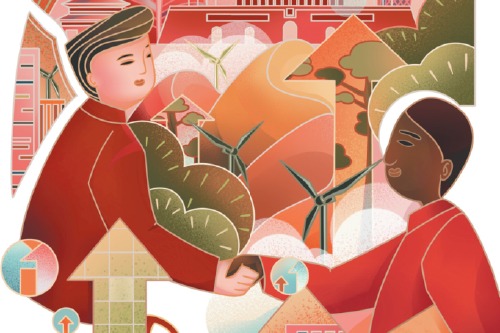
China has provided assistance to developing countries and international organizations participating in the Belt and Road Initiative for projects to improve people's lives. Funds from the Chinese government for poverty-alleviation housing, public health and rehabilitation projects via the Belt and Road should also be welcomed by governments in developing countries as means to help them alleviate poverty.
In 2015, China provided support to over 600 developmental projects in other developing countries, along with the establishment of a South-South Cooperation Assistance Fund and the China-UN Peace and Development Fund.
China offers one of the ways out of poverty. The money for the poverty-alleviation housing, public health and rehabilitation projects along the Belt and Road route should be welcomed by governments in developing countries. If utilized effectively by them, all these can go a long way in alleviating poverty.
The author is former foreign minister of Guyana. The author contributed this article to China Watch, a think tank powered by China Daily.
The views do not necessarily reflect those of China Daily.