Some resist intl energy agency's call for halting exploration







The influential International Energy Agency has called for a halt to all new oil, gas and coal exploration in a bid to secure the future of the planet by reducing carbon emissions to net zero by midcentury.
In a report released on May 18, the IEA also said that investment in green technology would have to double to $5 trillion over the next 10 years to meet the 2050 net zero target.
The recommendations come six months ahead of the 26th United Nations Climate Change Conference of the Parties, or COP26, in Glasgow in November, when world leaders will meet to discuss progress on curbing global warming and consider future action.
But what are the prospects that the talks on enhancing the 2015 Paris accord on climate change will look to the IEA proposals as a blueprint for an action plan? And is its call for zero exploration feasible?
The Paris-based agency was set up in 1974 by major industrialized countries to respond to an oil embargo imposed by members of the Organization of Arab Petroleum Exporting Countries and linked to the Arab-Israeli War of the previous year.
The so-called first oil shock saw crude prices quadruple and signaled a shift in power from consumers to predominantly developing country producers.
More recently, the IEA has evolved from an organization that was set up to ensure secure oil supplies into one that has embraced global efforts to enhance the switch to clean energy in a bid to tackle climate change.
Launching the agency's latest report, IEA Executive Director Fatih Birol said the gap between rhetoric and action on climate change was widening. Although more countries were signing up to net zero emissions targets, global emissions were still on course to surge by 1.5 billion metric tons this year, he warned.
Although governments accept the need for a switch from carbon-based production to green energy, there has already been resistance to the IEA's call for an embargo on further exploration.
Some have expressed the view that curbing oil and gas, without adequate clean resources to replace them, will only lead to energy insecurity. Japan and Australia have both expressed reservations about the IEA plan, with the latter's resources minister, Keith Pitt, saying: "Coal, oil and gas will continue to be a big part of Australia's energy mix."
Meanwhile, Akihisa Matsuda, deputy director of international affairs at Japan's Ministry of Economy, Trade and Industry, said his government had no plans to freeze its oil, gas and coal investments. "The (IEA) report provides one suggestion as to how the world can reduce greenhouse gas emissions to net zero by 2050, but it is not necessarily in line with the Japanese government's policy," he said.
"Japan needs to protect its energy security, including a stable supply of electricity, so we will balance this with our goal of becoming carbon neutral by 2050."
It is a debate in which no side contests the need for a fundamental shift in energy production in the coming decades. But differences remain about how to get there, particularly at a time when governments are under pressure to revive their economies as they recover from the COVID-19 pandemic.
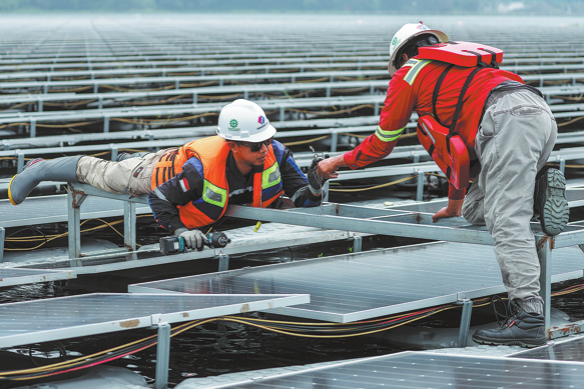
The IEA itself acknowledged that, despite the impact of the pandemic, the world's renewable energy capacity had jumped 45 percent in 2020, spearheaded by a 90 percent rise in wind power capacity.
It noted that a record amount of renewable power had come on stream in the fourth quarter of last year, with China alone adding more than triple the capacity it added in the fourth quarter of 2019.
Despite China's massive investment in green energy, coal-fired plants remain the main source of energy supplies during the transition. Similarly, the United States relies on coal for one-fifth of its energy capacity.
There has been much political rhetoric about "building back green" as part of pandemic recovery programs as governments face mounting pressure from increasingly climate-aware populations to take action.
In Europe, Finland and Spain lead the pack, allocating 42 percent and 31 percent, respectively, of recovery funds to green spending, according to recent statistics.
Ministers of the G7 group of mainly Western industrialized countries have meanwhile agreed to end direct funding of coal-fired power stations in poorer nations by the end of this year. That falls somewhat short of the IEA's call for a halt on such projects but is a step in the direction of the agency's war on coal.
Its recommendations are unlikely to be followed to the letter, but they will provide part of the backdrop to COP26. Governments may continue to debate the route to a cleaner planet, but there is no argument about the urgent need to reach the destination.
The author is a senior media consultant for China Daily UK.