Tree-planting campaigns bear fruit across globe







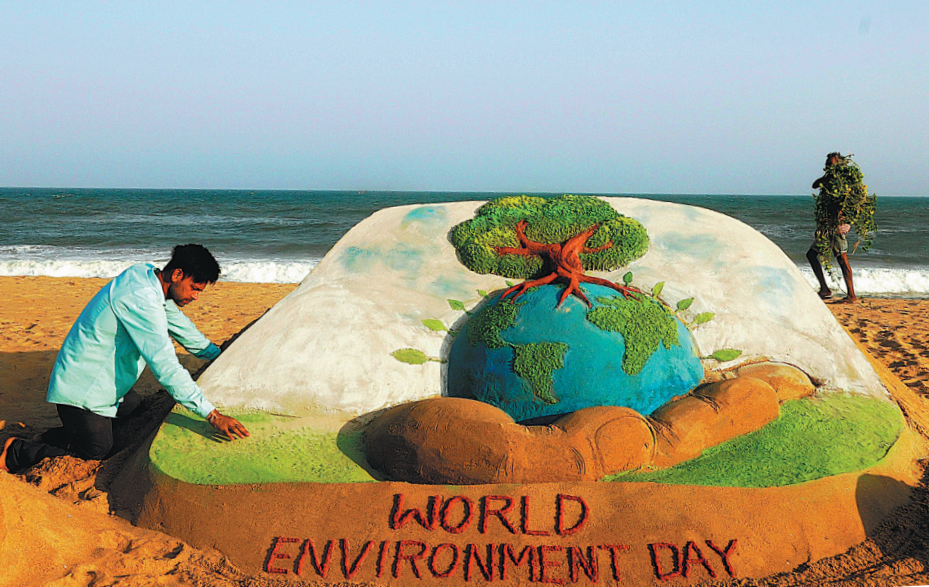
This year's World Environment Day, which was observed on Saturday, was a good reminder of the increasing cloud of climate change. With a gigantic tree-planting project in full bloom, Pakistan had sound ground for being the global host country in helping to launch the United Nations Decade on Ecosystem Restoration.
Thanks to Pakistan's nationwide Ten Billion Tree Tsunami project, officially launched in 2018, the country is celebrating a milestone not only in completing the planting of a billion trees by this month as part of the drive, but also in meeting the targets of the UN's Sustainable Development Goals.
Much like China, Pakistan over the years has aroused the public's interest and participation in implementing huge tree-planting projects, which are politically popular and media-friendly, and often feature stunning numbers.
The Ten Billion Tree Tsunami project is an expansion of a tree-planting campaign launched in 2014 after the model of China's "Great Green Wall" forestation effort. The program aims to revive forest and wildlife resources in Pakistan, improve the overall conservation of protected areas, and encourage ecotourism, community engagement and job creation through conservation.
Phase One of the project, lasting from 2019 to 2023, is being implemented across Pakistan by the Ministry of Climate Change along with provincial and territorial forest and wildlife departments. Through this program, the greening target of nearly 860 million plants on 381,374 hectares of land had been achieved by the end of April. The program also features the country's first "green bond "and decisions on protecting marine areas.
Benefits from tree planting are well understood by the public in Pakistan nowadays, as increases in vegetation coverage prevent land degradation, improve aquifers and invite wildlife back, all of which are effective measures to restore our burdened ecological system.
Likewise effective is China's Three-North Shelterbelt Forest Program, the official name of the Great Green Wall project, which was initiated in 1978 across 13 provinces, municipalities and autonomous regions in the country's vast northeast, north and northwest regions. Extending for 4,500 kilometers, the Great Green Wall, possibly the largest ecological project in history, calls for planting more than 3.6 million hectares of forest.
To build this "wall", Beijing has launched a two-pronged plan: use aerial seeding to cover wide swaths of land where the soil is less arid, and pay farmers to plant trees and shrubs in areas that require closer attention. A$1.2 billion oversight system, consisting of mapping and land-surveillance databases, has also been implemented.
The results of the Great Green Wall are evident from the fact that the project has already yielded a decrease in the frequency and scale of sandstorms, stabilized the amount of desert land, and even increased precipitation.
Moreover, man-made forestation has provided financial stability to many previously impoverished communities in the respective regions. Government investment in related infrastructure has also aided overall regional development.
Similarly, Pakistan's Ten Billion Tree Tsunami project has provided more than 100,000 jobs through World Bank assistance. During the COVID-19 pandemic, the forest and wildlife departments have provided green jobs through green stimulus to about 85,000 daily wage earners under the tree-planting program.
It is high time for us to realize that the global challenge of climate change requires collective efforts and cooperation to limit its effects. One nation cannot control climate change alone, because the problem does not respect borders. That helps to explain why, across Asia, more countries are joining in tree planting projects, including India, Sri Lanka and Indonesia.
After facing extreme weather and the COVID-19 pandemic in 2020, consumers made one thing clear: They want a more sustainable world.
While, greenhouse-gas emissions and overexploitation of natural resources result in a rise in temperature that brings floods, droughts, a rise in sea level, and other destructive events, tree planting and reduced tree cutting can reverse such destruction and help check disasters, apart from making our homelands more beautiful.
It is encouraging that a recent report to the United Nations from China said the efforts will "terminate expansion of new desertification caused by human factors "within a decade. By 2050, much of the arid land can be restored to a productive and sustainable state, the report said.
Yet states often make climate promises but leave the promises in the air and eventually ignore climate change.
Hopefully the launch of the UN Decade on Ecosystem Restoration will pool resources from all governments, international organizations and private businesses to prevent, halt and reverse the degradation of ecosystems worldwide.
Just as President Xi Jinping remarked in his congratulatory letter to this year's World Environment Day events in Islamabad, the world is a community with a shared future where everyone is in the same boat. So the ecosystem can only be successfully restored and preserved when everyone plays a part.
A good start is for each of us to plant one more tree or help to have one more tree cultivated.
The author is a social scientist, research scholar and public policy analyst based in Islamabad, Pakistan. The views do not necessarily reflect those of China Daily.