Scientist's innovation transforms rural lives







Researcher's relocation, farming plans lead villagers out of entrenched poverty
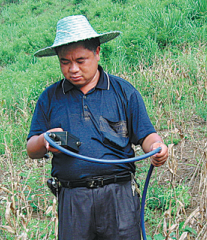
It is often a bit difficult to find Zeng Fuping by phone.
The 57-year-old spends half his time conducting agriculture studies and farm work deep in rural mountainous areas where reception can be poor.
Over the years, Zeng has doubled up as deputy chief of Huanjiang Maonan autonomous county in Hechi in the Guangxi Zhuang autonomous region, and as a researcher at the Institute of Subtropical Agriculture of the Chinese Academy of Sciences.
He is affectionately nicknamed the "real poverty alleviator", a homonym for his name in Mandarin.
Zeng was assigned to improve Huanjiang county conditions by the CAS in 1994, and says he was shocked by the abject poverty he saw upon his arrival.
"The villagers lived in leaky, thatched cottages and drank yellow-green water," he says, adding that some children didn't even have clothes, and everything a typical household owned added up to a few hundred yuan.
He wasted no time developing an understanding of the agricultural structure in the area, with a mind to changing living conditions.
Huanjiang is surrounded by mountains on all sides, and with the exception of Kenfu, an area with relatively open farmland, most villagers lived in rocky, mountainous areas that weren't really suited to farming.
Ever practical, they sometimes cut corners to save trouble. Some planted millet after burning the ground, continuing the slash-and-burn technique developed thousands of years ago to improve soil fertility. Others planted corn kernels in the cracks between the stones. But few were able to make ends meet.
One of Zeng's goals was to relocate mountain residents to neighboring sites with more arable land, and help them with new farming endeavors.
After studying the situation, Zeng decided to introduce more efficient crop varieties to Kenfu, and offer villagers training in agricultural skills.
He settled on rice, fruits and potatoes as the best replacement crops but soon discovered that it was difficult to persuade the villagers to try something they had never done before.
Zeng found it difficult to get to know the villagers at first, so to blend in better, he began to spend time with them, chatting and drinking.
Once he had endeared himself, he explained his proposal for introducing alternate planting, which mixed short-term vegetable and long-term sugar cane cultivation.
He figured that one hectare of vegetables would bring in about 30,000 yuan ($3,570 at the time) a year, while sugar cane could sell for 300 yuan a ton, and he convinced villagers that the method would greatly increase their incomes.
"It would bring in considerably more, even after deducting costs, because every household had about one-third of a hectare," Zeng says, adding that the method would also allow residents to take other work when things were not busy, and increase their incomes further.
His efforts paid off, Zeng gained the villagers' trust and they agreed to his plans. In September 1996, he took a group of 500 to Kenfu, which was no more than wilderness at the time. They spent the first month building houses, and getting the land ready for farming.
Zeng proposed mixing scientific studies with farming, and each household was assigned a specific project. The farmers would take out loans to invest in training and agricultural equipment, while the CAS would be responsible for overseeing the scientific aspect of the development of fruit, vegetables, livestock and poultry in Kenfu.
In this way, a complete agricultural chain would be created, from land reclamation to seedling supply and product sales, Zeng says.
He also asked the CAS for help setting up a field site to study the karst ecology of the region, and as a result, he and his colleagues have published around 30 papers on the agricultural potential of karst landscapes over the years.
Zeng's approach began to change lives, and he says that basic problems, like the lack clothing and food, were solved in 1997.
Liu Shengyou is one of the beneficiaries of Zeng's work.
The 75-year-old is content with life today. He and his family live in a three-story house in Kenfu, an area that is now abundant in fruit like the Shatang mandarin and the pomelo.
He used to lived in Chaoge, a village in a high, cold mountainous area that is cut off from the outside. The land there was poor and Liu and his family only had a few cattle.
"The whole year's produce was barely enough to sustain us for three to five months," he says.
Since he moved to Kenfu in 1996, Liu says he has seen Zeng on a daily basis and has learned how to plant trees and keep them free of pests.
Encouraged by free technical support and funding provided by the local government in 1998, Liu and other villagers purchased fruit seedlings, and began to scale up production.
By 2002, every household could afford to build spacious brick-and-mortar houses and in 2017, per capita income reached 9,664 yuan ($1,500).
Zeng was named "Pioneer of the Year" by the CAS in 2019 for devising a new system of cooperation between technical departments, companies, and farming households in the alleviation of poverty.
The mechanism was dubbed the Kenfu Model by UNESCO for its success in eradicating rural poverty last year. According to national standards, Maonan county was declared to have been lifted from poverty in May last year.
As local incomes increased, Zeng turned his attention to the issues of waste treatment, both domestic sewage and waste from previously existing aquaculture projects, which was seeping into water supplies.
He introduced the villagers to myriophylla, a type of fern that can be grown in ponds. The plant is able to grow in water high in nitrogen and phosphorus, both present in agricultural runoff, and is effective at filtering out organic matter, while providing a habitat for beneficial water organisms. It can also be harvested afterward, for use as high-quality animal feed and green fertilizer.
"Land and water resources here are more precious, and recycling needs to be considered," Zeng said.
For Zeng, Huanjiang has become his second home and he has become familiar with every corner of the county. Residents now view him as a fellow Maonan, which he considers to be the greatest recognition of his work.