Automobile industry grows along with expressways







Zhang Kuihong, 79, remembers the day China's first expressway opened to traffic more than three decades ago.
"The weather was very good. Sitting in a helicopter, I saw the road reflecting the sunlight, like a golden dragon crouching on the land," said Zhang, who was deputy chief engineer of the Shanghai-Jiading Expressway.
"Back then, cars could only run as fast as 80 kilometers per hour, and China's automotive industry was underdeveloped," he said. "Some experts felt building an expressway with a 120 km/h speed limit was pointless. So the Shanghai-Jiading Expressway was launched as a pilot program."
In 1988, the 15.9-km road linking Shanghai with the satellite city of Jiading was completed, marking a milestone in China's expressway development.
Three decades later, the country's expressway network stretches for 160,000 km, ranking first in the world.
As the expressways have grown, the development of the auto industry in China has also been switched to an express track.
Back in the 1980s, China was still widely regarded as a "kingdom of bicycles". But now it's becoming a "kingdom on four wheels". It has been the world's largest auto producer since 2009, and by last year it had 281 million automobiles in use and 418 million licensed drivers, according to the Ministry of Public Security.
The pilot expressway that started from Shanghai in 1988 now extends 1,960 km westward to Chengdu, Sichuan province.
Known as the G42 Shanghai-Chengdu Expressway, it runs parallel to the Yangtze River and serves as a transportation artery for industrial chains along the Yangtze River Economic Belt.
Cheng Changchun, dean of the Jiangsu Yangtze River Economic Research Institute, said the G42 Expressway links three economic engines-the Chengdu-Chongqing city cluster on the upper reaches of the Yangtze River, the cluster of cities around Wuhan, Hubei province, on its middle reaches, and the Yangtze River Delta.
"The fast expressway coupled with cheap river shipping has boosted the integration of industrial chains," he said. "Convenient transportation between cities along the Yangtze plays a vital role in their economic development."
Every day, thousands of metric tons of steel sheet for cars are produced in the plants of Wuhan Iron and Steel Corp in Wuhan and then transported by trucks, trains and ships to different car manufacturers around the country.
Yang Rui, chief engineer of the company's cold-rolled steel plant, said the boom in the domestic auto industry in the early 2000s spurred the company to produce high-quality steel sheet, and the plant was built in 2005.
"In the past 15 years, we have made continuous progress and now our steel is used to make more than 3 million cars every year," Yang said. "The location of Wuhan, the transportation nexus of waterway, highway and railway, has greatly facilitated the selling of our steel across the country."
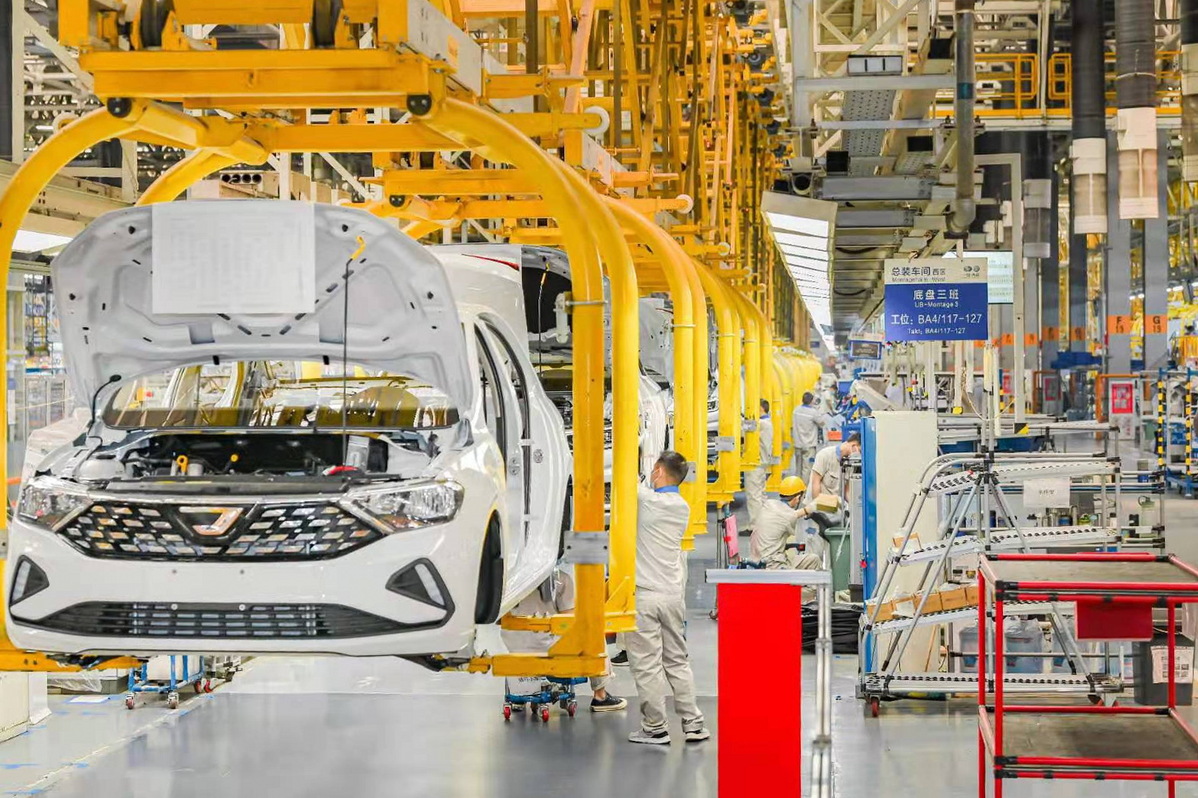
Some of the steel is transported to the assembly line at the FAW-Volkswagen Automotive factory in Chengdu, where a newly assembled Jetta car comes down the line every 58 seconds.
Gabriel Gonzalez, senior production manager at FAW-Volkswagen Automotive, has spent more than 24 years in the auto industry in Mexico, Europe and the United States and now oversees production at the Jetta factory in Chengdu.
"I have had to learn a lot of things from Chinese people," said Gonzalez, who arrived in China two and a half years ago. "Everything is in the mobile phone. Everything is digital here in China… Right now, China is in a very good position in the auto industry."
Riding the wave of autonomous driving and the electrification of cars, China has become not only a manufacturer and consumer of cars, but also a designer and an exporter.
Li Jirong, deputy director of the statistics office at Shanghai Customs, said car exports from Shanghai ports increased from 54,000 units in 2016 to 205,000 units last year, and many were electric cars from domestic brands.
"Last year, cars manufactured in China were exported to 128 countries and regions," Li said. "They were not only sold to developing countries, with many exported to developed economies such as the European Union, Australia and the US."
"The numbers speak volumes. I feel proud to have witnessed the growth of China's auto industry, and I hope that in the near future there will be more made-in-China cars running on roads around the world."
Cang Wei contributed to this story.

- China launches new communication technology test satellite
- Portuguese-speaking media visit Mixue headquarters in Zhengzhou
- Duo fined for damaging grassland at Xinjiang landmark
- Chinese biotech firms unveil advanced human-centric genomic model
- China delivers 1st dual-fuel luxury Ro-Ro vessel GNV·VIRGO
- Nyingchi's breathtaking autumn charm