Sustainable success







Idealism and equality
The CPC's people-oriented priorities and policies are behind its unprecedented move toward sustainable development, Ragnar says.
"In the '70s, not only China, but the whole world, had not realized the concept of sustainable development; everyone was very busy at just developing their own countries, the economies, becoming strong. A large part of the world was very poor. While the Western world was quite rich, the developing countries, including China, wanted to build their own industry. Therefore, they didn't think too much about geothermal energy or sustainable resources like solar, wind and hydropower," he says.
"But because the focus was on improving the lives of the people, China gradually started emphasizing sustainable and clean development when there was the realization that pollution was very dangerous to the people.
"China's realization came about 15, 20 years ago. In this sense, when China entered this century, it started looking at the possibilities of utilizing renewable energy.
"So, this project between Iceland and China was actually one of the first steps in accordance with this new policy of sustainable energy."
This concept of sustainable energy was not recognized by anyone in the world at that time, Ragnar says.
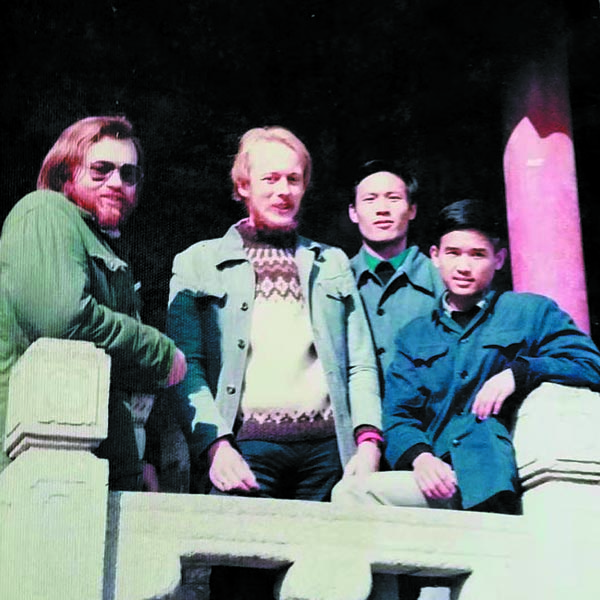
"But for me, it's not really surprising. Because when I came to China in the '70s, the reason why I came was that I'm a third-generation Esperantist," says Ragnar, referring to those who practice the Esperanto international auxiliary language.
"Both my parents and my grandfather were Esperantists. We are idealists. We think that everyone should be equal in international relations and people should be speaking a neutral language which makes them equal in the relationship," he says.
"So, this idea of fairness or equality was very strong with me. I was a strong idealist and when I came to China, I came to realize that Chinese people were very idealistic and there was a very strong feeling of fairness, of equality, in the whole of society."
His time at Peking University has been seminal in his understanding of those ideals, Ragnar says.
"When I went to Peking University studying philosophy, the history of China and the history of the university, I realized that at the time when the CPC was established 100 years ago during the formative years of the Chinese revolutionary movement, the school played a very strong role," he says.
"Some of the original leaders of the Party, like Chen Duxiu and Li Dazhao, were very idealistic. Their aim was to modernize China and they wanted to live in a fair world. Equality was very important for them," says Ragnar, whose time at the elite educational institution has been recorded under a major oral history project involving other prominent alumni.
"After World War I, China had reacted very strongly to the Western denial or unwillingness to change its relations with the country and base it on an equal footing; then you have the May Fourth Movement and Peking University played a leading role," says Ragnar, referring to the historic anti-imperialist movement.
"The Chinese intelligentsia moved toward communism and that can be traced to those years at the time of its foundation."
Development drive
The country's practical developmental approach also helped fuel its achievements, Ragnar says.
"The central theme was modernization. For China and the CPC leadership, if it's not fair and it doesn't serve the country's modernization, then they change or adjust the policies.
"One of the biggest differences between the Western countries and China is that, while we change our governments very frequently, we don't change our economic system-our economies are basically along the same policies," he says.
"China has kept its political leadership but changed its policies, the economic basis, in order to modernize.
"So, there's been the policy of reform and opening-up, and economic innovation. Very rapidly China developed, but there was a lot of pollution. There was a lot of environmental problems. It was about three decades (ago).
"Then around that time, the world woke up to the realities of pollution and the necessity of sustainable, long-term development," Ragnar says.
"And in a remarkably short time, China actually took up this policy, and in this century, about 15 years ago, just about the time when we established our geothermal cooperation, China changes its priorities to rapid sustainable development, from just rapid economic development."
Building on trust
"One hundred years after the establishment of the Communist Party of China, there's a lot of reflection of what are the main components of Chinese Marxism, or socialism, (with) Chinese characteristics," he says.
"I really do think these characteristics, of social fairness, equality and of focusing on modernization, of understanding that modernization has changed, from just being simple modernization or learning from the West into being focused on sustainable development, and innovation, have become a major component.
"There's the idealism: that development and modernization and economic progress is not just for itself or for its own sake. It is for the people.
"The fundamental slogan of the CPC, to 'serve the people', is still the main theme of the Party.
"These all go very long back into Chinese history because the Confucianists said that within a country, it is the people that are most precious. This is linked to the Chinese characteristics, of Chinese socialism. This has been a theme of Chinese socialism from its very establishment," Ragnar says.
"So, the CPC is very focused on the people and on having their trust. And it can only continue to do that through sustainable development, which benefits the lives of the people. That is also why you have poverty alleviation forming the main efforts of the last few years; now it's to continue and revitalize the rural areas and communities. It's because of this focus on the people.
"And it can only be done through sustainable development. Which is why Iceland has a very bright future in continuing to work with China."