Tour of history







The site of the first Party congress in Shanghai has seen a surge in visitor numbers, Yang Feiyue reports.
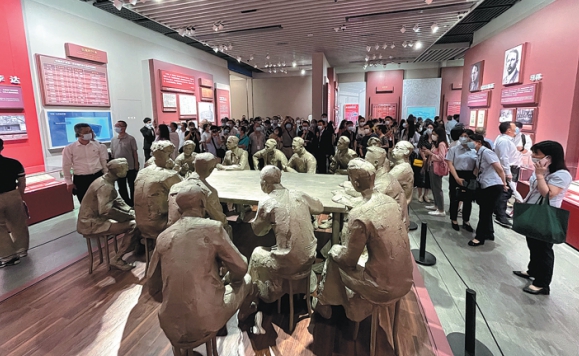
It was raining in Shanghai on June 17, yet it didn't stop visitors from lining up before the Memorial of the Site of the First National Congress of the Communist Party of China in the city's Huangpu district. The group included reporters from overseas media such as Kyodo News and The New York Times, among others. They walked down the history of the founding of the Party through more than 1,000 historical items, photos and diagrams. The visit was organized by the Information Office of the State Council, China's Cabinet, to enable a better understanding of the 100-year history of the CPC.
"Globally speaking, we actually did more to truthfully reflect what a political party has gone through since its establishment in such a big country," says Ruan Jun, deputy curator of the exhibition. "I believe much of the content can evoke empathy… and has universal value."
Construction of the new exhibition hall started in 2019, close to the original site where the Party was born. The old shikumen site was developed into a commemorative museum in 1952 and attracted visitors, especially since President Xi Jinping visited in October 2017.
Visitors can see the typical Shanghai house with a courtyard and stone-framed gates, all of which retains the past look. The venue had between 500,000 and 550,000 visitors a year before 2017, but arrivals rose sharply to 1.46 million in 2019.
"The old museum is a smaller space with a relatively simple presentation approach," says Ruan, adding that it is difficult to display enough to show the history there.
The new hall spans 3,700 square meters, more than threefold in size from the previous site. It shows revolutionary relics that were found nationwide to present a vivid picture of the epoch-making beginnings of the founding of the CPC, including items from Party members' former residences and memorials.
Visitors can appreciate valuable first editions of the Communist Manifesto written by the founders of Communism, Karl Marx and Friedrich Engels, in Chinese. In China, the manifesto was first republished in August 1920.
People can also take a close look at medals commemorating the 1911 Revolution, which ended the last imperial dynasty in China, fliers from the May Fourth Movement of 1919, and a toolkit used by a martyr, Li Bai, who died at age 39 in 1949 during the fight to liberate the country. In addition, documents in Russian, Japanese and English relating to the founding of the CPC have been collected from overseas in recent years and are displayed at the new site.
Some exhibits have been donated by the public. Among them is a logbook recording the duties of the Chinese military before Shanghai's liberation in May 1949, and relevant policies after the liberation. All exhibits were picked from about 124,000 historical items that are in the site's collection.
"We will adjust the arrangement (of historical items) under different circumstances and themes in the future," Ruan says.
The exhibition is an unprecedented display of cultural relics from the Party's founding period and enables visitors to gain an understanding of the Party's beginnings and have more insight into past events, such as why it was established in Shanghai, according to the exhibition management.
Li Qiang, Party secretary of Shanghai, said at the memorial's reopening ceremony on June 3 after an expansion project, that this area witnessed the groundbreaking event of the Party's founding, which marked the great start of the Chinese revolution, carried the great dream of the Party, and inherited the great spirit of Party members. It's the eternal glory of the city to be the birthplace of the Party, Li said.
Immersive experiences have also been developed, and visitors can see the restoration of past scenes and better take in the twists and turns of major events. The process of the CPC's first national congress in 1921 is displayed in a 300-square-meter space in the hall, through holographic projections and "nakedeye" 3D technology. Another display highlight is a 3-meter-long and 7-meter-high oil painting depicting the first group of 58 Party members striding forward.