Commercial lenders eyeing greater digital transition







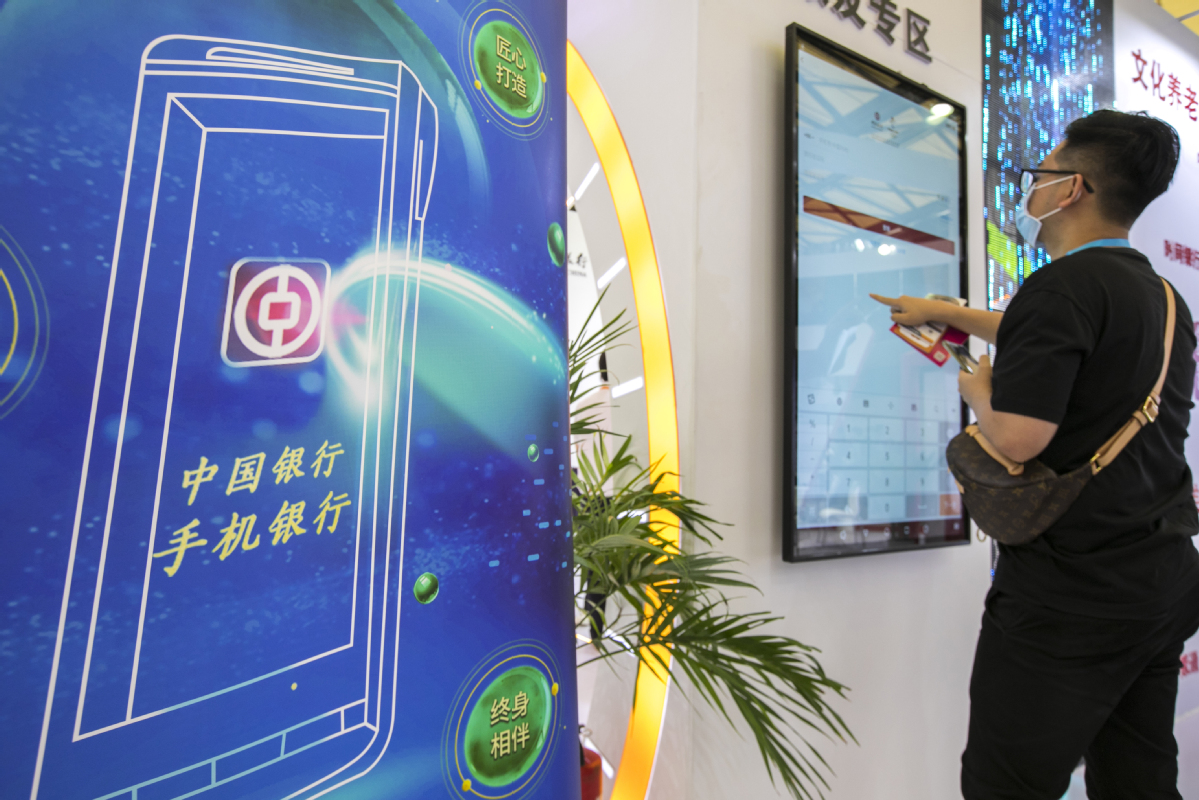
The accelerated infiltration of internet and fintech companies into the traditional banking sector is reshaping the market structure, thus prompting commercial banks to explore digital transitions, Bank of China Ltd said in a white paper released on Monday.
"In recent years, the new generation of information technologies-including 5G, big data, cloud computing and blockchain-deeply integrated with various aspects of Chinese society, profoundly changed models of industrial development and consumer behavior and continuously sped up the reshaping of the format of financial services," said Liu Jin, president of BOC, a large State-owned commercial lender.
"The financial industry's efforts to build a financial scenario ecology and promote digital transitions against the backdrop of serving China's high-quality development showed its willingness to shoulder the responsibility of deepening supply-side structural reform of the sector. The efforts are also an inevitable choice of financial institutions to seek change and break through bottlenecks," Liu said.
Financial scenarios, which refer to those that embed financial services into relevant nonfinancial services to satisfy customer needs with high efficiency, are now fully embedded in many aspects of the daily lives of Chinese residents, including sectors such as clothing, food, housing, transportation and entertainment, thanks to the rapid development of technologies and mobile networks.
As of the end of 2020, the population of internet users in China hit 989 million. There were 981 million instant messaging service users, 782 million online shoppers and 854 million online payment service users in the country, according to the China Internet Network Information Center.
The development of the internet and mobile networks has greatly changed the habits of Chinese residents, especially millennials, who are used to integrating their needs into various everyday life scenarios to have access to comprehensive services, with expectations for customized solutions, said the white paper.
Bank of China has been creating strategic financial scenarios for cross-border finance, education, sports and silver-haired economy since 2020, in addition to major financial scenarios for government affairs, healthcare, transport, culture and tourism, to continuously innovate service models and improve capability to access and serve customers.
The construction of financial scenarios will be based on national strategies of economic development and will hold onto the principle of sustainable operations by targeting customer groups that have huge market space and great potential for growth, said Xu Haibo, deputy general manager of Bank of China's personal digital banking department.
The core competence of financial scenario construction lies in the customer experience offered by financial products, and the main goal of financial scenario construction is to achieve a win-win situation in the integration of non-financial services with a bank's financial products, Xu said.
Financial scenario ecological construction will put great emphasis on digital technologies and digital operations. The growth of financial scenarios will bring new impetus for the digital transition of the banking sector, said Gao Feng, chief information officer of the China Banking Association, who advised the banking sector to create standards for financial scenario ecology and improve the classification of scenarios.
Xue Zhenghua, associate chair of the Institute for Fintech Research at Tsinghua University, said the rapid development of China's industrial digitization in recent years will create new development opportunities for financial scenario construction.
Last year, the scale of China's digital economy reached 39.2 trillion yuan ($6.1 trillion), accounting for 38.6 percent of the country's GDP, said a report issued by the China Academy of Information and Communications Technology.