


Together in chorus
Grand Song tradition gains popularity and continues to unite communities








Editor's note: From arts and crafts to knowledge and skills, China's intangible cultural heritage is invaluably embedded in its ethnic communities. This series looks at the latest efforts to preserve and promote the country's inherited traditions and living expressions.
When Wu Jinyan, a singer of the Dong ethnic group, stepped off the stage from one of her first overseas concerts, she found it hard to mingle at the post-performance party.
"We couldn't speak the language and didn't really know what was going on. But people soon gathered around. They wanted to know more about us and our singing. We became closer through song."
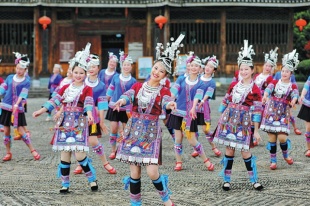
The experience two years ago in a multistop United States tour became a highlight for Wu and fellow practitioners of the Dong ethnic group's traditional "Grand Song", marking its increasing popularity at home and abroad.
"The growing interest is very appropriate, because our songs have always been about the community; the more the merrier," she said.
Wu, 37, is a lead singer in Yandong, Liping county, in southwestern China's Guizhou province.
Her ethnic group is famous for its Grand Song, the folk music-described as polyphonic and a capella-of its members, with UNESCO recognizing the practice as an intangible cultural heritage. The millennia-old tradition is said to derive from the sounds of nature and singers' lives in their natural surroundings, such as the rush of rivers and the call of birds, with each group having as many as 1,000 singers.
Ethnomusicologist and music curator Mu Qian has studied the Dong songs closely and helped promote them worldwide. Mu traveled to the US with Wu's six-member team, taking on the role of emcee to introduce the cultural backgrounds and meaning of the songs of the Dong people, also known as Kam, combining ethnomusicological theory with his experience.
"The sounds of nature have a special meaning to the Kam people and are reflected in many Kam songs," Mu wrote in Folklife, the online magazine of the Smithsonian Center for Folklife and Cultural Heritage.
"For example, the chirping of cicadas is a constant backdrop in the Kam area, and the imitation of cicadas can be found in many songs. In During Daytime, I Go up the Mountain, a young woman hears the sound of cicadas; to her ears, it sounds like weeping. She sighs at the memory of an old lover," according to Mu, an editor at the nonprofit organization Repertoire International de Litterature Musicale in New York.
During their stop at the University of Michigan, "the group performed a full concert, but we also held workshops. We did this wherever conditions allowed, as workshops seemed the best way to introduce the natural and human environment of the Kam region and to teach the audience to sing," he said.
"By working close up, we could give people a deeper understanding of this musical culture so different from their own."
Wu Jinyan said "the face-to-face interaction and cultural exchange proved to be very important. These are all very valuable experiences for me, helping to increase understanding of treasured aspects of our traditions".