A helping hand to the South
China is sharing its experience and providing practical assistance to help developing countries shake off poverty








Poverty, a chronic affliction of human society, is a challenge for the whole world. Home to nearly one-fifth of the world's population, China completely eradicated extreme poverty-the first target of the UN 2030 Agenda for Sustainable Development-10 years ahead of schedule.
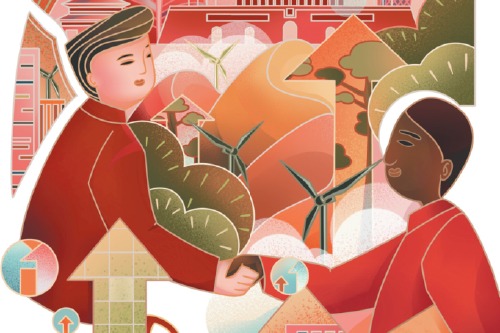
That is a milestone in the history of the Chinese nation and the history of humankind, making an important contribution to the cause of global poverty alleviation. As a responsible major power, China has also carried out South-South cooperation in various ways to support and assist developing countries, especially the least developed countries, so that they can rely on themselves and strive to build their homelands.
China's achievement is an inseparable part of the global poverty alleviation effort. For instance, the country has built agricultural technology demonstration centers and organized training to cultivate personnel in developing countries in Africa to help the continent shake off poverty.
By the end of 2019, China's assistance for Africa's poverty reduction had benefited 500,000 people. It also works on the synergy between the Belt and Road Initiative and the UN 2030 Agenda for Sustainable Development. These cooperation projects embody China's experience at the global level.
First, international cooperation on poverty eradication initiated by China combines aid and investment. That form is similar to its domestic model that integrates fiscal transfer and development-driven poverty alleviation through multiple channels. Fiscal transfer means establishing a social welfare and assistance system financed by the government, including the minimum living allowance, support for people living in dire poverty and relief for people affected by disasters. The latter focuses on the capacity building of poor groups, who, discovering and releasing their potential comparative advantages in the market, can shake off poverty through their own efforts. Entering the 21st century, China's aid and investment in developing countries are displaying a simultaneous growth trend.
Second, China's poverty reduction cooperation with other countries includes infrastructure and education projects based on its experience of poverty alleviation. Infrastructure, a priority in poverty alleviation, starts with building roads and projects for water conservancy and supply and power generation and supply, and expands into communications, housing and other fields. It also plays a significant role in China's foreign aid and has achieved remarkable results. Compared with resources, energy, commerce and finance, food and other aid projects related to infrastructure, science, education and humanities show better poverty reduction results. For instance, the roads built in the impoverished delta of Mauritania inject strong impetus into the development of local agriculture and livestock.
Last, when providing foreign assistance, China adheres to the principles of not imposing any additional political strings and not interfering in the internal affairs of the recipient countries. Also, China does not require recipients to reform their domestic political, economic and social systems in exchange for poverty eradication funds.
The Chinese government and State-owned enterprises have played an important role in foreign aid. From 2004 to 2014, SOEs accounted for nearly 70 percent of those providing assistance. Over 30 percent of the projects are led by the government and SOEs, including those carried out by recipient countries or in cooperation with China.
In January, the State Council Information Office released a white paper, China's International Development Cooperation in the New Era, which states that from 2013 to 2018, China allocated 270.2 billion yuan ($41.7 billion) in foreign assistance under three categories-grants, interest-free loans and concessional loans.
Grants worth 127.8 billion yuan, accounting for 47.3 percent of the total, mainly went toward helping developing countries build small and medium-sized social welfare projects and to fund projects for cooperation in human resources development, technical cooperation, material assistance and emergency humanitarian assistance, as well as projects under the South-South Cooperation Assistance Fund.
The white paper says China has introduced some domestically effective measures in recipient countries, launching demonstration projects and optimizing the local living and business environments to increase residents' incomes.
For instance, during the assistance to Svay Ampear, a village in Cambodia, Chinese experts conducted research to understand the local conditions before establishing a register of poverty-stricken households. The project team then began building toilets, installing stoves and facilities supplying power to improve villagers' lives. The project also included training residents with the skills necessary to start their own businesses. Besides, information on Chinese enterprises is available for local people, who can also get recommendations for employment.

The author is a member of the academic committee of the Pangoal Institution and deputy director of the Institute of World Economics and Politics at the Chinese Academy of Social Sciences. The author contributed this article to China Watch, a think tank powered by China Daily.