Isolationism should not be option for Washington







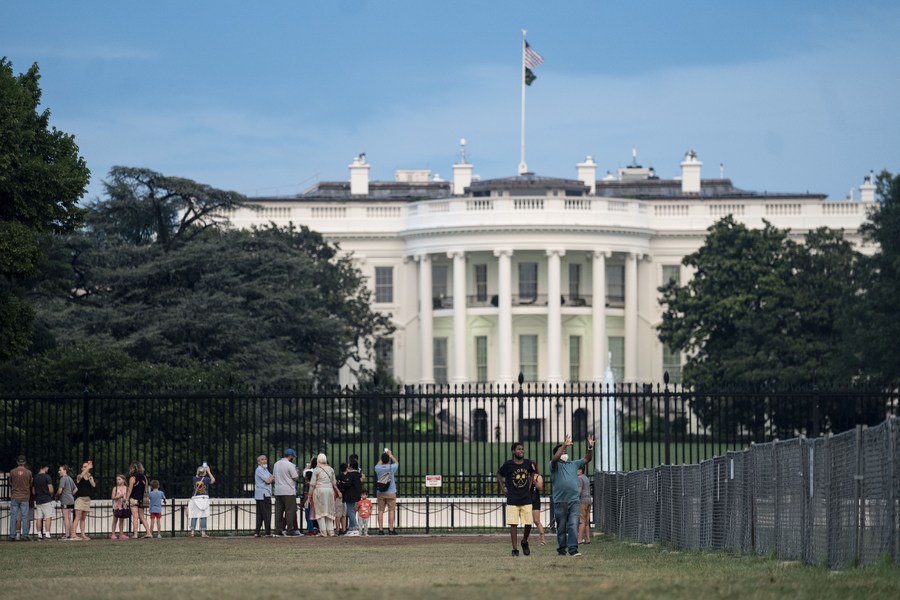
The day after the frantic US departure from Afghanistan on August 31, President Joe Biden announced a shift of Washington's foreign policy away from foreign wars.
"This decision about Afghanistan is not just about Afghanistan," he said. "It's about ending an era of major military operations to remake other countries."
After the debacles of US intervention in both Afghanistan and Iraq, Biden's initiative will strike many at home and abroad as long overdue. It will be seen as a belated recognition that US arrogance in seeking to remake the world in its own image was always doomed to failure.
With Biden yet to spell out in any detail the next chapter in US foreign policy, there is the risk of a retreat into the kind of isolationism that has marked much of the country's two-and-a-half-century history.
From the time of its founding fathers, there was always a temptation to look inward as the new nation sought to establish itself in a world then dominated by Old World empires and dynasties.
In his 1801 presidential inauguration address, Thomas Jefferson pledged "peace, commerce, and honest friendship with all nations, entangling alliances with none".
It was a doctrine under which the US thrived economically but sought only limited engagement on the world stage.
That is an option that may have been appropriate to the first half of the 19th century, but it is barely tenable in the 21st. As the world's leading economic power, the US has a central role to play in addressing the threats that face humanity, from climate change to pandemics to poverty in the developing world.
Biden's challenge is to develop a more positive foreign policy, one based on greater international cooperation in facing up to shared global problems and that avoids the temptation to lapse into a new era of isolationism.
The negative aspects of US isolationism are linked, at least in the minds of the country's liberal internationalists, with the period of the 1930s. In that decade, the experience of the Great Depression and memories of US losses in World War I led the public to support noninvolvement in European and Asian conflicts and international politics.
That led Washington to initially adopt a hands-off policy when it came to imperial Japan's invasion of China and the aggressive policies of Nazi Germany.
However, its later decisive entry into World War II contributed to the establishment of US hegemony, which was to dominate for the remainder of the 20th century.
A revival of US isolationism was already apparent in the election victory of Biden's predecessor Donald Trump, who appealed to an America First mentality. His single four-year term saw Washington retreat from its commitments on climate change and abandon a historic international agreement on Iran's nuclear program.
Trump may have gone, but a number of voters and their increasingly vociferous political spokesmen continue to promote negative isolationist views on climate, race and immigration.
Biden is not a natural isolationist, although he has yet to clarify the role he wants the US to play in the post-Afghanistan world. However, Trump or one of his ideological successors could well emerge as the front-runner in the next election in three years.
Perhaps by that time Biden or his ideological successor will have evolved a strategy for positive US engagement with the rest of the world that will depend more on global dialogue and less on unilateral military muscle.
Among the challenges is the persistence of fundamentalist terrorist groups of the kind whose attack on the US in 2001 led to the ill-considered intervention in Afghanistan.
The day after the September 11 attacks that year, the United Nations Security Council declared that international terrorism was a threat to international peace and security and pledged a determination to combat it by all means. Perhaps subsequent events were an example of the US belief that it could go it alone.
If a humbled US has now indeed turned a new page, then Biden's first test may well come at the 26th UN Climate Change Conference, or COP26, which will be held in Glasgow in November, when world leaders will gather to confront the most existential threat we all share-climate change.
It is a challenge that, by definition, has to be resolved globally. Greenhouse gases do not respect international borders.
National self-interest may best be served by acknowledging the problems faced by other global partners in an increasingly globalized world. It is an area in which isolationism simply will not work.
Harvey Morris is a senior media consultant for China Daily UK.