China launches first solar observation satellite







After landing probes on the lunar and Martian surfaces, China has begun to set its sights on the core of our solar system.
In a landmark step, the country launched its first solar observation satellite on Thursday, aiming to help scientists deepen their knowledge about the star.
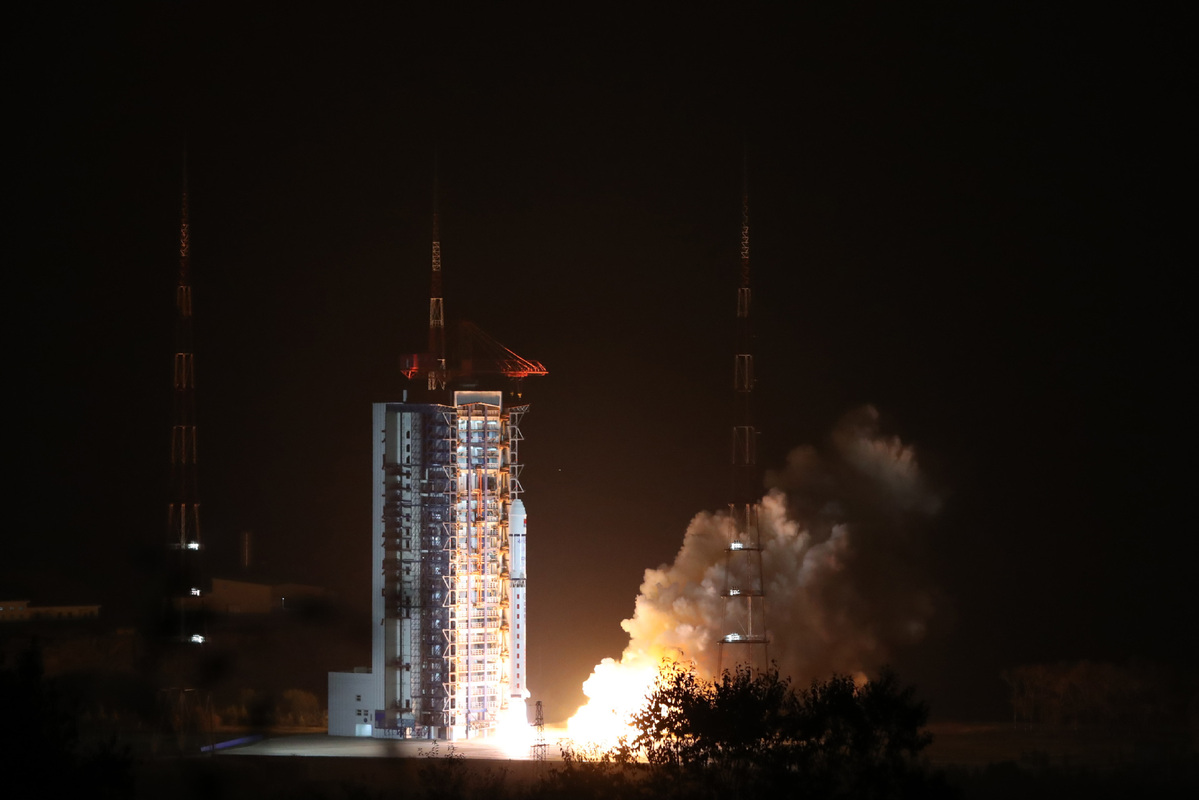
The 508-kilogram satellite, the Chinese H-Alpha Solar Explorer, was launched by a Long March 2D carrier rocket that blasted off at 6:51 pm at the Taiyuan Satellite Launch Center in Shanxi province and entered a sun-synchronous orbit about 517 kilometers above Earth, according to a statement from the China National Space Administration.
The administration said the mission is expected to provide scientists the first high-quality observation data of the source area of a solar eruption and will improve China's research capability on solar physics, adding it is exceptionally important to the nation's space exploration and satellite technology.
The administration noted after rounds of public solicitation and expert review that Xihe, the name of the sun goddess in ancient Chinese mythology, has been selected out of more than 10,000 proposals as the spacecraft's codename. The name symbolizes the nation's aspirations for solar exploration, it explained.
Wang Wei, deputy director of the Shanghai Institute of Satellite Engineering at the Shanghai Academy of Spaceflight Technology and project manager of the satellite, said the spacecraft is China's first space-based solar telescope and is designed to work for at least three years.
"Its scientific payload is an H-alpha imaging spectrograph — developed by the Chinese Academy of Sciences' Changchun Institute of Optics, Fine Mechanics and Physics — that can, for the first time, acquire full-disk spectroscopic solar observations in the H-alpha wave band," the researcher said. "Scientifically speaking, the instrument is able to observe and record changes in the sun's physical elements like its temperature and speed, facilitating scientists' studies about the dynamics and physics of a solar eruption."
Several Chinese satellites, such as the Fengyun 3E meteorological satellite, have carried equipment that can collect solar data, but Xihe is the first dedicated to solar observation.
Zhao Jian, a senior official at the China National Space Administration in charge of the satellite program, said it is important for mankind to study the sun because solar activities have many effects on Earth.
"Therefore, obtaining more knowledge about the sun helps to avoid solar activities' adverse effects, especially its disruption of the Earth's communications and navigation service and to better protect spacecraft and astronauts," Zhao said.
Studying the sun also allows scientists to deepen their research on the origin and evolution of celestial magnetic fields, the acceleration and distribution of energetic particles and other physical phenomena, he added.
The official said the United States, Europe, Russia and Japan have launched more than 70 spacecraft dedicated to solar observation, such as NASA's Parker Solar Probe and Solar Terrestrial Relations Observatory.
"Our country now ranks No 2 in the world in terms of published research papers on solar observation, but all the satellite-generated data used by our scientists was from foreign spacecraft. Xihe will put an end to dependence on foreign satellites and we will share its products with researchers around the world," he said.
Zhao noted Xihe features high directional accuracy and flying stability, and marks the first time magnetic suspension technology will be used on any spacecraft.
Currently, Chinese scientists and spacecraft designers are working on another solar research satellite — the Advanced Space-Based Solar Observatory, which will be used for solar physics studies.
That satellite, which is still under development, aims to explore connections among the solar magnetic field, solar flares and coronal mass ejections. It is scheduled to be launched in 2022 to a sun-synchronous orbit, Zhao said.
In another development, Thursday's launch also marked the deployment of the first two satellites owned by the Asia-Pacific Space Cooperation Organization – Student Small Satellites 1 and 2 – tasked with carrying out technological verification.
The Student Small Satellite Project aims to promote capacity-building on space science and technology among faculty members and students from APSCO member states, the organization said.



- Mainland slams Taiwan leader Lai's speech
- Migratory birds flock to Jilin's wetland haven
- Former Chinese bank official sentenced to death with reprieve
- China's 'Flying Police' gyrocopter unit soars over Gobi Desert
- Woman jailed and fined for selling celebrities personal information
- China publishes draft law on private sector promotion to solicit public opinion