


Clues from an intriguing past







Discoveries suggest ancient civilizations had common features.
This year marks the centennial of the discovery of the Yangshao Culture by Johan Gunnar Andersson (1874-1960). The Swedish geologist was the first to take up a spade and break ground in Yangshao, a small village in Central China's Henan province, in 1921, after which the well-known culture is named.
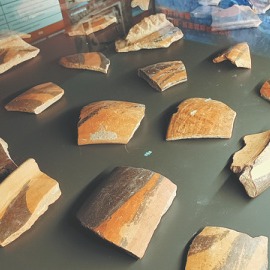
Andersson was fascinated by the Yangshao shards, broken pieces of ceramic material with black painting on them. Oracle bones and bronze ritual vessels looted by antiquity collectors from Yinxu-the ruins of the last capital city of the Shang Dynasty (c.16th century-11th century BC)-in 1899 were the only available clues pointing to the date of the shards known to Andersson.
Therefore, he had to refer to similar examples found in Eastern Europe by German and Ukrainian archaeologists in the early 1900s. These were the Tripolye and Cucuteni cultures, named after the first places where these painted pottery shards were unearthed.
Building upon comparative methodology, archaeology, to some degree, is a discipline of analogy. Comparisons must be made with other findings. The practitioners first observe objects, and then develop their hypothesis to explain why some are similar while others are not.
Based on his knowledge of archaeological discoveries in Europe and Central Asia, Andersson insightfully claimed that the pottery shards found in Yangshao were much earlier than the bronzes found in Yinxu. This was crucial, as it represented the earliest discovered Chinese culture, taking into consideration the time scale of the European counterparts.
After solving the question of when, the question of how naturally surfaced in his mind. The similarities in painted elements and their composition led Andersson to uncritically propose a fanciful theory that the similarities shared by Tripolye and Yangshao painted pottery resulted from the transcontinental transmission from the former to the latter.
Excavations by US geologist Raphael Pumpelly (1837-1923) in Anau (an archaeological site in present-day Turkmenistan) in the early 1900s, along with a large number of painted pottery with analogous motifs, gave Andersson more confidence to assert the cultural connection between Tripolye and Yangshao via Anau.
Chinese civilization is unique and deeply rooted in local cultural contexts. Painting techniques on pottery are not exclusive to any one civilization, but a shared artistic representation among agricultural groups worldwide.
Although Andersson's theory has long been thrown into the trash can, it is still quite tantalizing to explore the similarity in material cultures among two distantly separated regions.