World Bank downgrades 2022 global growth forecast to 4.1 pct







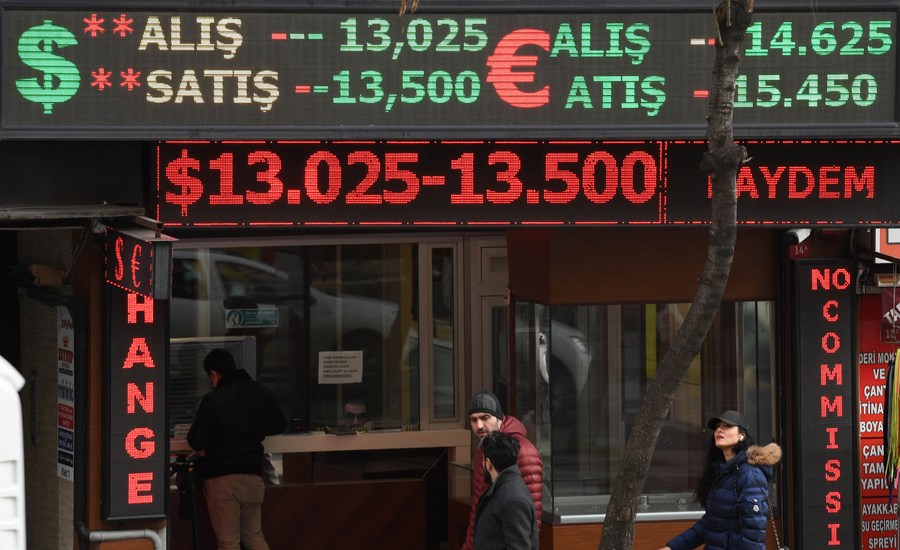
WASHINGTON - The global economy is on track to grow by downwardly revised 4.1 percent this year amid new waves of the pandemic, rising inflation and continued supply chain bottlenecks, the World Bank Group said in its latest Global Economic Prospects released on Tuesday.
The global outlook is "clouded by various downside risks", including renewed COVID-19 outbreaks due to new virus variants, the possibility of unanchored inflation expectations, and financial stress in a context of record-high debt levels, according to the semiannual report.
After rebounding to an estimated 5.5 percent in 2021, global growth is expected to decelerate markedly to 4.1 percent in 2022, the report noted. The latest projection for 2021 and 2022 is 0.2 percentage point lower than the June forecast, respectively.
The US economy is estimated to grow by 5.6 percent in 2021, and moderates to 3.7 percent this year. The Chinese economy is estimated to grow 8.0 percent in 2021, and slow to 5.1 percent this year.
The report highlighted that the COVID-19 pandemic has raised global income inequality, partly reversing the decline that was achieved over the previous two decades.
By 2023, annual output is expected to remain below the pre-pandemic trend in all emerging market and developing economy (EMDE) regions, in contrast to advanced economies, where the gap is projected to close.
In emerging market and developing economies - particularly in small states and fragile and conflict-afflicted countries - output and investment will remain markedly below pre-pandemic trends, "owing to lower vaccination rates, tighter fiscal and monetary policies, and more persistent scarring from the pandemic," the report noted.
The Washington-based development organization called for a rapid global rollout of vaccination and redoubled productivity-enhancing reforms, which can help lower between-country inequality.
Preliminary evidence suggests that the pandemic has also caused within-country income inequality to rise somewhat in EMDEs because of particularly severe job and income losses among lower-income population groups, according to the report.
Aside from growing income inequality across and within countries, the report outlined two other "daunting challenges" for many developing countries: macroeconomic imbalances have reached "unprecedented" proportions; the world is undergoing a phase of "exceptional uncertainty".
Spending in developing countries surged to support economic activity during the crisis, but many countries are now facing record levels of external and domestic debt, the report noted.
"Adding to these debt-related risks is the potential for higher interest rates: it is difficult to predict how rapidly interest rates will rise as advanced economies slow down their expansion in monetary policies," said World Bank Group President David Malpass.
"With fiscal and monetary policy in uncharted territory, the implications for exchange rates, inflation, debt sustainability, and economic growth are unlikely to be favorable for developing countries," Malpass continued.
The report noted that the near-term outlook for global inflation is notably higher than previously envisioned, owing to pandemic resurgence, higher food and energy prices, and more "pernicious" supply disruptions.
Noting that rising inequality and security challenges are "particularly harmful" for developing countries, the World Bank chief said putting more countries on a favorable growth path requires concerted international action and a comprehensive set of national policy responses.
"In light of the projected slowdown in output and investment growth, limited policy space, and substantial risks clouding the outlook, emerging and developing economies will need to carefully calibrate fiscal and monetary policies," said Ayhan Kose, Chief Economist and Director of the Prospects Group in the Equitable Growth, Finance, and Institutions (EFI) Practice Group of the World Bank.
Kose noted that EMDEs also need to undertake reforms to erase the scars of the pandemic. "These reforms should be designed to improve investment and human capital, reverse income and gender inequality, and cope with challenges of climate change," he added.