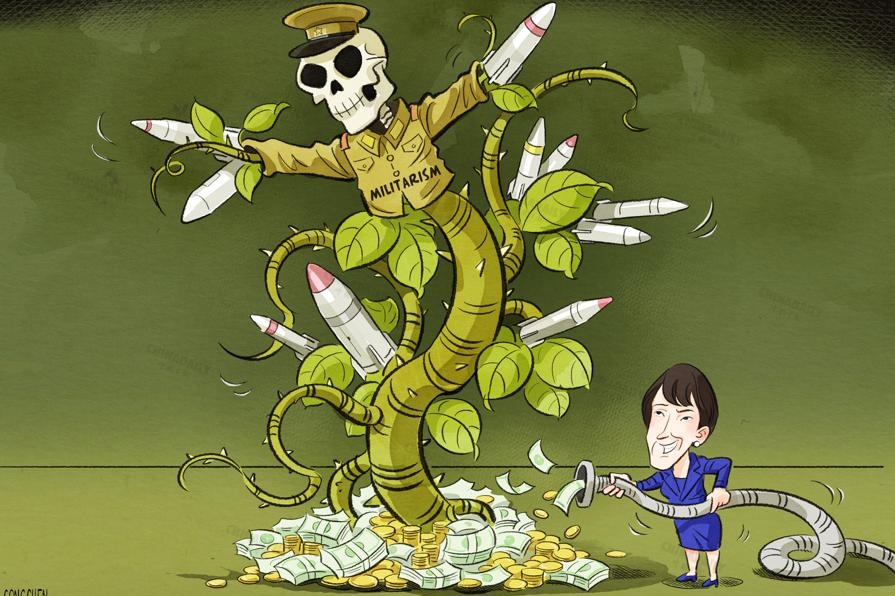
Accentuate the positive
China and the US can escape the Thucydides Trap, but both need to demonstrate the will to do so








When former US president Richard Nixon visited China 50 years ago, China was an impoverished nation. The Chinese GDP was $153.9 billion, around 8.5 percent of the US GDP of $1.873 trillion. At that time, US engagement of China was a way for the United States to strengthen its containment of the Soviet Union, the main US rival during the Cold War.
The political-economic landscape looks very different today. In 2021, the Chinese GDP was $18.08 trillion, 78.6 percent of the US GDP of $22.99 trillion. Instead of being a component of a US strategy to rival other large powers, China is now the world's second-largest economy and the US' main competitor.
This historical change has led many US and Chinese policymakers to worry that the rise of China and the erosion of US political-economy hegemony will lead to war. These concerns are warranted by the recent rise in political tensions over an increasing number of issues between the two countries, including climate, trade and security.
It is a high-stakes example of what political observers refer to as the Thucydides Trap: the purported tendency for existing powers and rising powers to go to war over political primacy. In the case of the US-China rivalry, war would constitute an international calamity. Innocent people would suffer, and the costs would most certainly spread far beyond Chinese and US borders.
Policymakers must then look for ways to avoid the Thucydides Trap.
There are two sources of comfort. The first is simply that this theory is highly controversial. Although Thucydides was writing of a war that did occur-the Peloponnesian War between Athens and Sparta in ancient Greece-the theory is still a matter of debate within the scholarly community. And unlike other theories, it has been difficult to validate with data.
The second is the belief that China and the US can avoid the trap by focusing on common goals. An underlying assumption of the Thucydides Trap argument is that powers such as the US and China are engaged in a zero-sum game. Zero-sum battles for economic and political power have complicated the potential for other shared interests between the US and China.
To avoid the Thucydides Trap, China and the US need to identify positive-sum goals-objectives that make both countries better off. The best example is climate change. Global warming is bad for both countries. Pollution in China will affect the climate of the US and vice versa. The global endeavor to reduce climate change will also be more effective if both countries exert effort. Combating climate change in China will not hinder the US' efforts. It is the opposite: China's efforts will help the US' efforts.
Another positive-sum objective is the economic recovery from the COVID-19 pandemic and promoting economic growth through trade more generally. China is the US' largest importer and its third-largest export market; the US is China's third-largest importer and largest export market. The two countries are the world's two largest importers and exporters, and together constitute roughly 20 percent of world's trade volume. This means that the Chinese recovery will aid the US recovery and vice versa, and both countries' recoveries are critical to the world economy.
Both the battle against climate change and pandemic recovery have the additional advantage that they will benefit other nations, too. Thus, it's not only that these common ends can improve US-China relations; they can also improve relations between the two large powers and the rest of the international community.
US-China relations have reached a historical fork in the road. They can follow history and focus on zero-sum objectives, which may very well lead to war. Alternatively, they can create a new model of major power interaction by focusing on positive-sum common objectives such as climate change and economic recovery. Both countries, and the rest of the world, will be better off along the second path.
Since positive-sum common objectives exist, the only other critical ingredient for success is a mutual desire for peace.
So, there is reason to be optimistic. Peace can be achieved as long as both the US and China want it.
The author is James J. O'Connor professor of Managerial Economics& Decision Sciences at Northwestern University. The author contributed this article to China Watch, a think tank powered by China Daily. The views do not necessarily reflect those of China Daily.
Contact the editor at editor@chinawatch.cn