Foreigner hails whole-process people's democracy







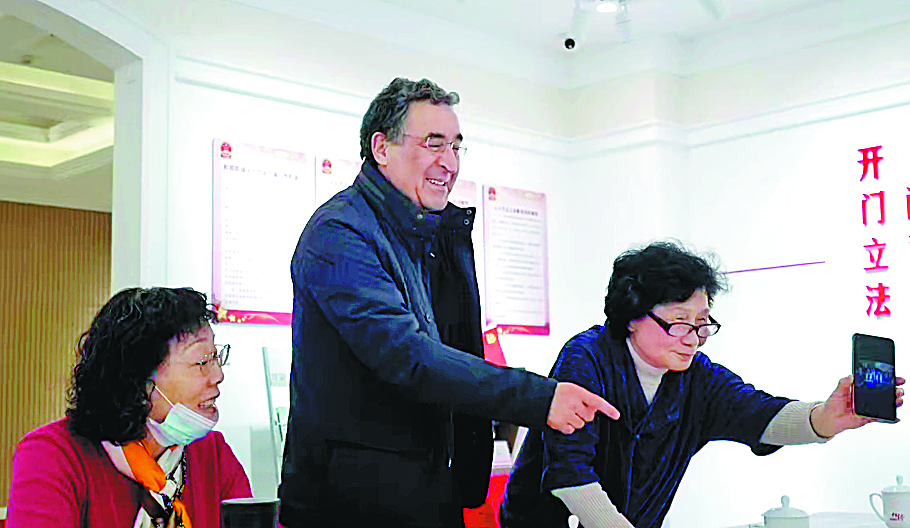
Noyan Rona, a Turkish national who has resided in Shanghai for more than two decades, said that his expectation for this year's two sessions is for China to exercise its whole-process people's democracy in the formulation of social policies and the country's governance.
Whole-process people's democracy refers to China's model of democracy. Rona is a resident of Hongqiao subdistrict in Shanghai's Changning district, where President Xi Jinping first put forward the concept of whole-process people's democracy during a visit to the city in 2019.
"Since my relocation to Shanghai in the mid-1990s, I've always been giving my opinions and suggestions about community and city development. Shanghai is a highly open metropolis. The officials and residents here are very open-minded and receptive to new, better and more advanced practices," said Rona, 66, the chief representative of Turkish Garanti Bank's Shanghai office.
He said the concept of whole-process people's democracy can be easily accepted by residents of the Ronghua neighborhood community where he lives, as this concept has been utilized in community governance since the 1990s.
"For example, a meeting was held here at the Gubei Civic Center just a few days ago to discuss matters like transportation, trash sorting and the management of pets," said Rona, adding that many residents in the neighborhood participated and gave their opinions and suggestions.
The Gubei Civic Center is more than a community activity center. It is a place where grassroots officials and residents have gathered regularly since July 2015 to share advice and suggestions on the development of the community and the city.
It was the city's first and one of the country's first four stations for this purpose. Opinions solicited from such institutions are conveyed to the country's top legislature on the revision of the country's laws. Shanghai now has 25 such institutions across the city.
Rona said the interconnection between the neighborhood committees, subdistrict offices and all residents is a perfect reflection of whole-process people's democracy.
"When the average resident reports something to the officials, they seriously listen to your problem, solve the problems in a very serious manner, and give you serious feedback," he said.
Since 2016, Rona has also offered advice and suggestions at an annual meeting where the city's political advisory body listens to foreigners' opinions. He has put forward viewpoints regarding the payment of personal income tax by expats, the keeping of pets and barrier-free facilities.
He said such a process showed that the city's governance was becoming more transparent and the residents were more passionate about contributing ideas to the city's better future.
"When government departments and the public exchange their viewpoints and reach consensus, it's also a process of building mutual trust," said Rona.
Last year, the standing committee of the Shanghai Municipal People's Congress revised its rules of procedure, and whole-process people's democracy became part of the work of the legislative body.
Throughout last year, the city's 25 institutions responsible for soliciting public advice and providing suggestions on law revision put forward more than 3,100 suggestions, and 354 were adopted.
Zhu Guoping, a deputy to the National People's Congress and a former long-standing community official, said that such institutions at the grassroots level have become a means to express and gather opinions from the public and are a vivid example of whole-process people's democracy.
"Some residents used to feel that making laws was far away from them and only happened at the Great Hall of the People in Beijing. But now it can happen near their homes," said Zhu.
She said that every decision about the neighborhood, such as adding elevators to the old residential buildings, providing care for the elderly or the face-lift of the neighborhood, is now made in the framework of whole-process people's democracy.
"The residents are very enthusiastic about the making and revision of laws, as that makes them feel they're the masters of the country," she said.
"Also, when one individual participates in law revision, 10 around him or her will be encouraged to pay attention to laws. It's an excellent way of popularizing legal knowledge," she said.



- 'Artificial sun' experiment finds way to break plasma density limit
- China reports 20% rise in inter-regional trips on first day of holiday
- China welcomes New Year in style
- Shanghai park holds ceremony for newly-arrived African penguin chick
- Yearender: Xi leads China through a pivotal 2025
- Tianjin University unveils initiative aimed at developing innovative leaders