Sunresin sees sunny prospects for lithium







Editor's note: China aims to nurture 10,000 "little giants" from 2021 to 2025 amid an ambitious plan to trigger the vitality of small and medium-sized enterprises in its sprawling industrial economy. "Little giants" typically specialize in niche sectors, command high market shares and boast strong innovative capacity. To be termed a "little giant", a Chinese firm must see a minimum 5 percent year-on-year average growth rate of its main business income or net profit in the past two years. More importantly, it must have two valid invention patents or other similar proof of its innovation capabilities, and at least 3 percent of its top line must be dedicated to R&D, among other financial and operational criteria. China Daily explores how they help the world's second largest economy stabilize its industrial and supply chains, navigate headwinds from the COVID-19 pandemic and achieve breakthroughs in technology bottlenecks.
Chemical element key component in batteries utilized within new energy vehicle industry
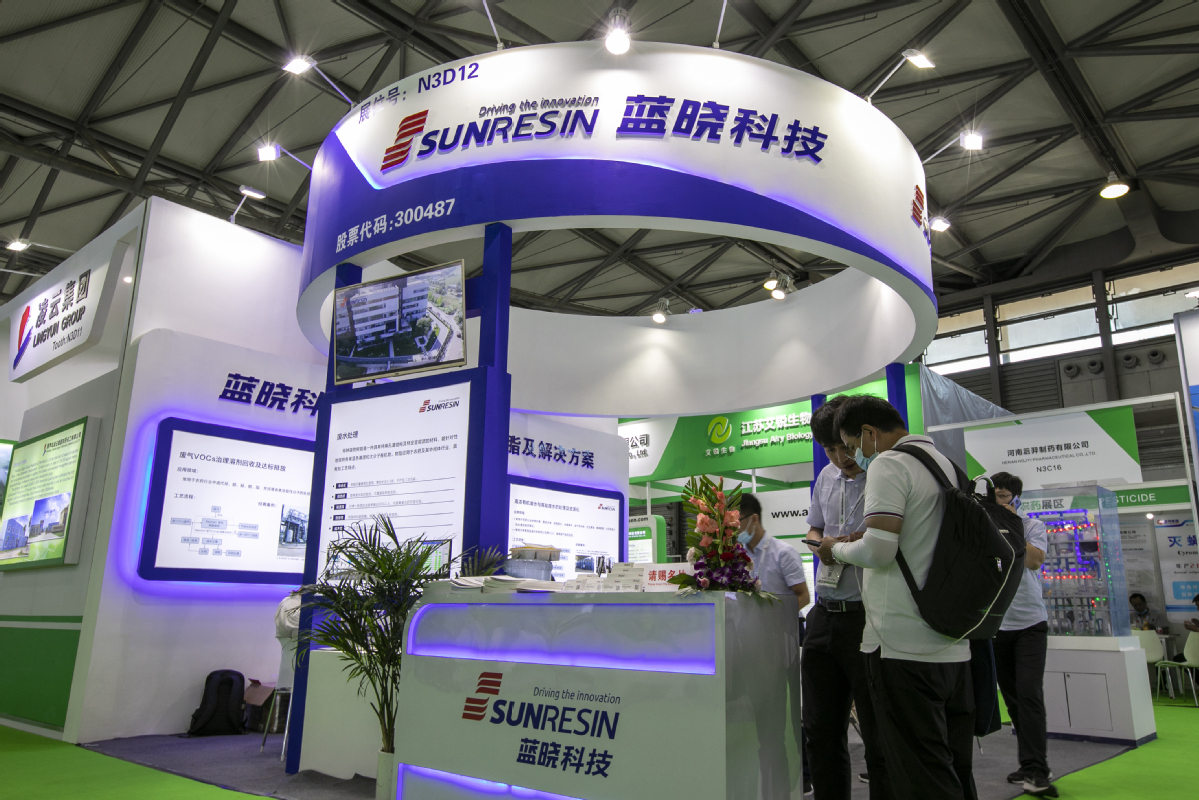
Sunresin New Materials Co Ltd, a leading special resin manufacturer based in Xi'an, Shaanxi province, is accelerating efforts to scale up lithium extraction capacity, expand its footprint in overseas markets and contribute to the nation's carbon peak and neutrality goals, said Gao Yuejing, its founder and chairman.
"As a high-tech enterprise, Sunresin has leveraged adsorptive separation technology to extract lithium carbonate-a raw material used to make lithium batteries-from salt lakes, which is environmentally friendly and economical, and can greatly alleviate imbalances between supply and demand for lithium resources," Gao said.
With over 10 years of experience in lithium extraction, Sunresin has expanded its presence in salt lakes in Qinghai province, the Tibet autonomous region, North America, Europe and South America, she added.
Lithium mainly comes from lithium ores and salt lakes, and about 76 percent of global lithium resources are concentrated in such bodies of water. Gao explained that in China, about 85 percent of lithium resources exist in salt lakes that have lower concentrations of lithium, but instead are rich with boron, magnesium and other impurities, thus making lithium extraction much more difficult.
The adsorption and separation of polymer materials can be used to obtain, separate and purify resources from nature, as well as control carbon emissions and curb environmental pollution in industrial processes, Gao said.
Founded in 2001, Sunresin is mainly engaged in manufacturing ion exchange resins and adsorptive separation resins, with production capacity reaching 50,000 cubic meters annually. Its technology and products are widely applied in various industries like wastewater treatment, biotech, pharmaceuticals, plant chemical extraction and food processing.
China's new energy vehicle industry saw rapid year-on-year growth in February, with total sales surging 184.3 percent on a yearly basis to about 334,000 units, according to the China Association of Automobile Manufacturers. NEVs include electric vehicles, plug-in hybrids and hydrogen fuel-cell energy vehicles.
With the explosive growth of the NEV industry in China in recent years, there is surging demand for batteries. Meanwhile, lithium, cobalt, nickel and other upstream raw materials, which are used to make EV batteries, have witnessed soaring prices since last year.
As lithium salts have topped 500,000 yuan ($78,500) per metric ton recently, Gao said the shortage of lithium has seriously affected the robust development of the NEV industry.
A research report from CITIC Securities said domestic lithium carbonate demand for NEVs and energy storage will reach 600,000 tons by 2025, with investment in production lines for lithium extraction from salt lakes expected to reach 10 billion yuan.
With the country's carbon neutrality efforts steadily gaining momentum, and the global NEV market rapidly expanding, Sunresin has entered a phase of rapid growth.
According to Sunresin, nine production lines related to lithium extraction from salt lakes have been completed or are under construction so far, with a total capacity of 73,000 tons of lithium carbonate and lithium hydroxide and a contractual value of more than 2.5 billion yuan. The two forms of lithium can be used in electric vehicles and lithium-ion batteries.
In January, Sunresin signed an agreement with Tibet Mineral Development Co Ltd to extract lithium hydroxide at Jese Tsakha Salt Lake in the Tibet autonomous region.
Under the contract, Sunresin will build the first phase of lithium hydroxide production lines, with a designed annual output of 10,000 tons, and provide operational management services for 15 years, contributing a total of 150,000 tons of lithium hydroxide to the market.
The company also intends to provide services for the construction and operational management of the second and third-phase lithium hydroxide production lines, with an annual output of 20,000 tons.
The launch of this project marks a milestone for the industrialization of Sunresin's lithium extraction technology applied in high-altitude areas, the company said.
Data from the China Automotive Battery Innovation Alliance show that the output of power batteries jumped 236.2 percent year-on-year to 31.8 gigawatt-hours in February.
During the period, the country produced 20.1 GWh of lithium iron phosphate batteries, surging 364.1 percent year-on-year. Meanwhile, the output of ternary lithium batteries stood at 11.6 GWh, an increase of 127.2 percent. This type of battery uses metal oxides of nickel, cobalt and manganese and packs more punch for its weight than other batteries.
China has pledged to have carbon dioxide emissions peak by 2030 and achieve carbon neutrality by 2060, making the world's biggest cut in carbon emission intensity in the shortest time frame in history.
Gao said achieving the two goals is conducive to bolstering the transformation and optimization of the energy structure, while highlighting that adsorptive separation technology is playing a vital part in promoting green, sustainable and high-quality development and improving the quality of people's lives.
The technology could also serve downstream industries such as photovoltaic, nuclear power and NEVs, and help transform and upgrade the industrial economic structure, she added.
Carbon capture, utilization and storage (CCUS) is also an important method to reduce carbon emissions, and Sunresin has collaborated with large chemical companies in Europe to provide adsorption materials for carbon capture.
"Sunresin's adsorptive separation technology has diversified application scenarios and is expected to play an important role in advancing carbon neutrality in China and across the world," said Wang Zhe, chief energy and chemical analyst from CITIC Securities.
Wang said that with the continued increase of new production capacity and growing penetration in downstream markets, Sunresin offers high growth potential over the long term.
In addition, the company is accelerating its globalization push, with overseas sales revenue rising 32.69 percent year-on-year to 163 million yuan in 2020. Its businesses now cover Europe, Asia, South America, North America and Africa, Gao said.
Cui Dongshu, secretary-general of the China Passenger Car Association, said the accelerated exploitation of lithium resources will gradually alleviate the lithium shortage. "In 2022, the price of lithium will witness a slight increase, and the price is expected to gradually drop to a reasonable range in 2023," Cui said.
Apart from lithium, the company has mastered techniques to extract other metals. A cobalt extraction project undertaken by Sunresin was officially put into operation in December 2021 in the Democratic Republic of Congo, with the first batch of cobalt products produced. The project is expected to help increase the supply of cobalt, thus contributing to the sustainable development of the NEV industry.