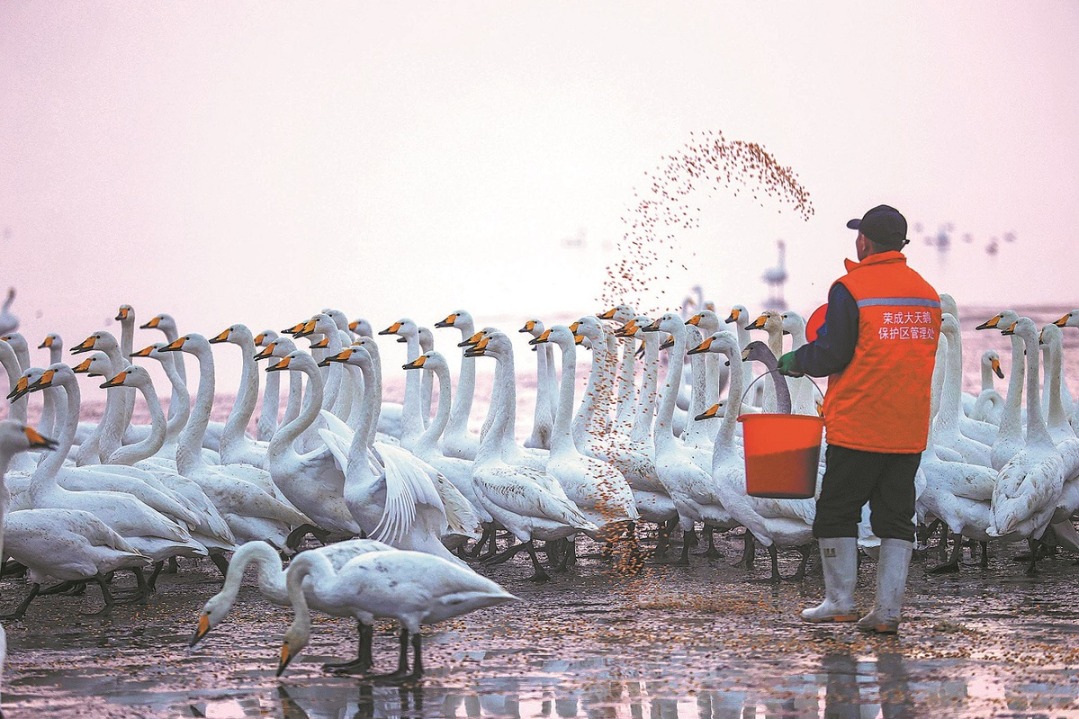
China's ecology sees historic turning point: official








BEIJING -- China's ecological environment has witnessed a historic turning point over the past decade, an official said Thursday.
"We have seen fewer hazy days and black and smelly water bodies, and have enjoyed bluer skies and more lucid waters and lush mountains," Han Wenxiu, a senior official with the Central Committee for Financial and Economic Affairs, said at a press conference.
China's afforested land has accounted for about a quarter of the world's total, and its CO2 emissions per unit of GDP have dropped about 34 percent, Han said.
The country has also topped the globe in installed capacity of wind and photovoltaic power and other green energy, and in the production and sales of new energy vehicles, Han said.
As a faithful advocate of the Paris Agreement, China has announced targets of peaking CO2 emissions before 2030 and achieving carbon neutrality before 2060, Han said.
Concrete efforts
Ecological protection has been high on the policy agenda of the world's second-largest economy over the past decade as solid actions have been taken to advance ecological development and push the country toward a green future.
Accountability has been ensured as lists of responsibilities have been drawn up by central and local authorities and environmental inspections have been launched and deepened, Ye Min, vice minister of ecology and environment, said at the press conference.
China has enacted or revised 13 laws and 17 administrative regulations covering the prevention and control of air, water and soil pollution, accompanied by meticulous efforts to guarantee the laws are strictly enforced.
The national carbon market has started trading and the national green development fund has been set up. At the end of 2021, outstanding green credit amounted to 15.9 trillion yuan (about $2.36 trillion).
To encourage the green shift of businesses, China has incorporated more than 3.3 million fixed pollution sources into sewage management and has issued catalogs on products that pose high environmental risks or are crucial to environmental protection.
China has also vigorously improved public awareness of environmental protection and promoted green lifestyles.
To build a beautiful China, Ye said continued efforts have to be made in cutting carbon emissions, fighting pollution and improving environmental governance. He also stressed the importance of local accountability, business participation, public oversight and market-oriented mechanisms.
Low-carbon transition
As China's ecological advance has entered a critical period focusing on carbon reduction, enormous progress has been made in its transformation to green and low-carbon development.
Speaking at the press conference, Hu Zucai, deputy director of the National Development and Reform Commission, listed a series of major achievements from the widespread use of clean power to more efficient energy consumption.
The installed capacity of renewable energy in China has exceeded 1 billion kilowatts, with that of hydropower, wind power, solar power and biomass power all ranking first in the world. The share of clean energy has risen from 14.5 percent to 25.5 percent in the country's energy consumption mix.
Ultra-low emission coal-fired power generation has exceeded 1 billion kilowatts, leading the world in efficiency and emission reduction.
Progress has also been noticeable in energy conservation. China's average annual economic growth of 6.5 percent over the past years was powered by a mere 3 percent annual increase in energy consumption. The energy consumption intensity has dropped 26.2 percent, which is equivalent to saving 1.4 billion tonnes of standard coal or an emission cut of 2.94 billion tonnes of CO2.
Looking forward, Hu stressed that China's carbon reduction push is a profound, systemic reform that cannot be achieved easily or swiftly. "The phasing out of traditional energy must be based on the safe and reliable replacement by new energy sources."
China will step up efforts to develop new energy, Hu said, adding that 450 million kilowatts of hydropower, wind power and solar power generation capacity will be built in deserts, with the first projects totaling 85 million kilowatts having broken ground.
The task of peaking CO2 emissions and achieving carbon neutrality will be advanced in an orderly, forceful and effective manner, and new progress will be made continuously, he said.




- Shanghai Disney Resort unveils flexible ticket refund policy
- China launches?the 11th Kinetica 1 carrier rocket, sending 9 satellites into orbit
- Recessive genes result in Caucasian appearance for Jiangsu girl
- China has amassed 5 million invention patents, emphasizing quality over quantity
- National body urges trade unions to help migrant workers get their wage arrears
- Blue alerts issued as China braces for widespread winter snow