US-ASEAN 2022 looks to many like White House PR exercise







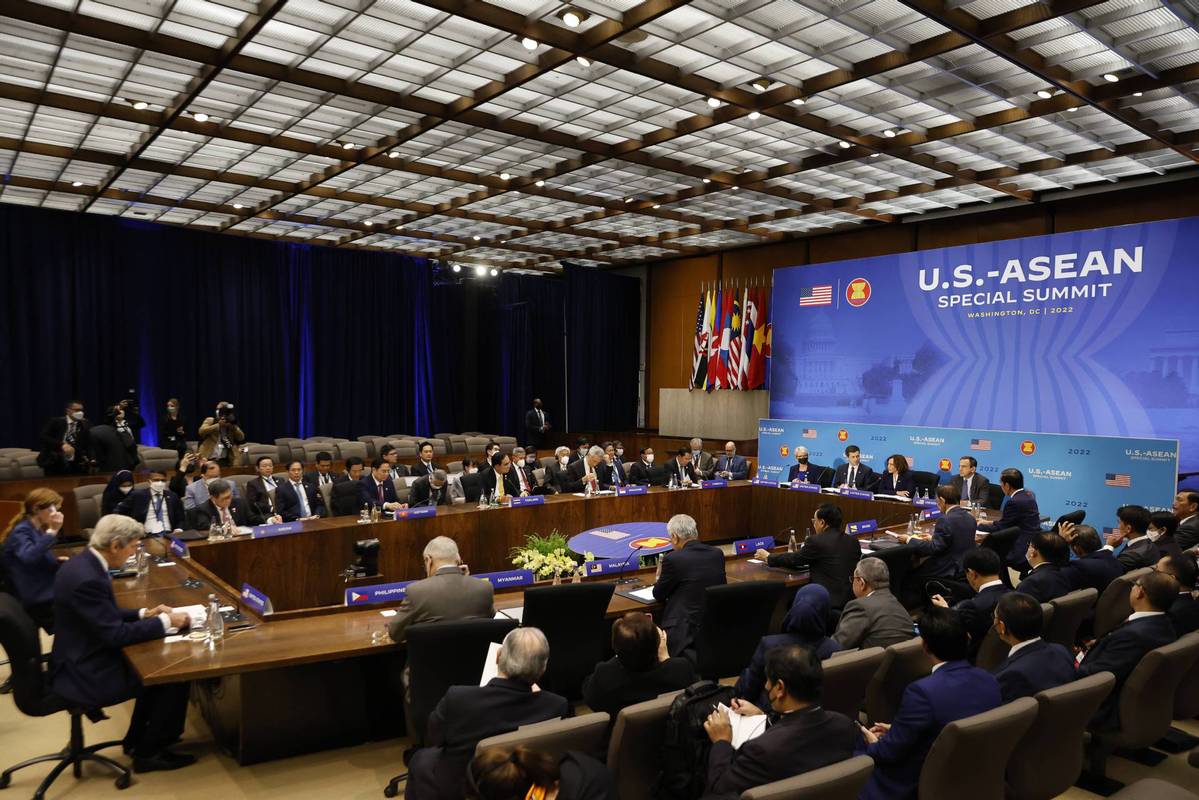
Hailed as a historic event in a press statement released by the US State Department, the US-ASEAN Special Summit 2022 on Thursday and Friday was the first such meeting held in Washington DC and at the White House since the US started its dialogue relationship with ASEAN 45 years ago.
Eight out of the 10 ASEAN heads of state attended the two-day summit, the second in-person meeting by a US president with the Southeast Asian regional bloc. The last one was by Barack Obama in 2016. Myanmar's leader was not invited to the summit, and the Philippines was represented by its foreign affairs secretary, as the country was in transition after an election.
The summit was officially convened to celebrate 45 years of US-ASEAN diplomatic engagement. However, more importantly, the Special Summit was held "to re-affirm the United States' enduring commitment to Southeast Asia and underscore the importance of US-ASEAN cooperation in ensuring security, prosperity, and respect for human rights", amid China's increasing influence over its Southeast Asian neighbors.
In fact, despite the lack of engagement of former US president Donald Trump's administration with the region, ASEAN has always been of vital strategic importance to the US' geopolitical interests, particularly to counterbalance and contain China. Since Obama's "Pivot to Asia", the South China Sea, in which Vietnam, the Philippines and Malaysia have overlapping territorial claims with China, has become the battleground of big power strategic competition.
At the meeting on Friday, Biden told the ASEAN leaders that the US-ASEAN partnership is "critical "and the Special Summit marked the launch of a "new era" in US-ASEAN relations. "A great deal of the history of our world in the next 50 years is going to be written in the ASEAN countries, and our relationship with you is the future, in the coming years and decades", he said.
Earlier, in her meeting with the regional group, US Vice-President Kamala Harris stressed that the Biden administration recognizes the vital strategic importance of ASEAN, "a role that will only grow with time". She emphasized the need to maintain freedom of the seas, and asserted that "the United States and ASEAN have shared a vision for this region, and together we will guard against threats to international rules and norms".
Neither Biden nor Harris mentioned China by name. However, the insinuation of their speeches is obvious: It is all about China!
In the Joint Vision Statement issued at the conclusion of the event, both sides declared, inter alia, their dedication to promoting maritime cooperation in the region by "ensuring maritime security and safety, as well as freedom of navigation and overflight and other lawful uses of the seas as described in the 1982 UNCLOS."
That narrative, however, is nothing new, but instead a regurgitation of America's rhetoric on the South China Sea. In fact, the US lacks legitimacy in arguing that the competing claimants in South China Sea should abide by the UN Convention on the Law of the Sea as the US itself has not acceded to UNCLOS.
ASEAN is China's largest trading partner. The bloc's total trade with China is double that of its trade with the US. Notwithstanding the South China Sea dispute, ASEAN countries generally maintain good relations with China and do not want to take sides amid the intensified China-US rivalry in the region. Centrality has been ASEAN's unwavering stance as the world has increasingly turned bipolar.
A case in point was when Malaysia, one of the three ASEAN countries invited to the Democracy Summit that Biden hosted in December, declined to attend.
On the Russia-Ukraine conflict, the summit merely reaffirmed "respect for sovereignty, political independence, and territorial integrity", without condemning Russia by name. In fact, except for Singapore, no ASEAN country has joined the US sanctions on Russia.
ASEAN leaders are actually more interested in the economic agenda of the summit. They want expanded market access to the US without having had to comply to the stringent labor and environmental standards. However, it appears unlikely that Washington will relent on such standards anytime soon, in view of the Biden administration's strong stance on human rights.
Biden announced a $150 million development and security package for the 10-member ASEAN bloc at the summit, a pittance when compared with the billions in US military aid provided to Ukraine. It paled vis-a-vis the $1.5 billion development assistance China pledged to the ASEAN countries in November 2021 to fight COVID-19 and fuel economic recovery.
And despite a lot of hoo-ha on the Indo-Pacific Economic Framework proposed by Biden, and successive visits by top US officials to ASEAN early this year selling the idea, there was no mention of it in the Joint Vision Statement. The 28-point Joint Vision Statement appears to be more of a statement of "diplomatic niceties" that is lacking in substantive action plans. It is just a symbolic step by both sides to raise their relationships.
To many, the US-ASEAN Special Summit is yet another White House grand PR exercise, just like the Democracy Summit. In the eyes of Washington political elites, ASEAN countries are but friends in need. The US' interests in ASEAN are basically geopolitical.
The author is the president of Centre for New Inclusive Asia based in Kuala Lumpur, Malaysia.