Blind candidates offered equal opportunity in gaokao







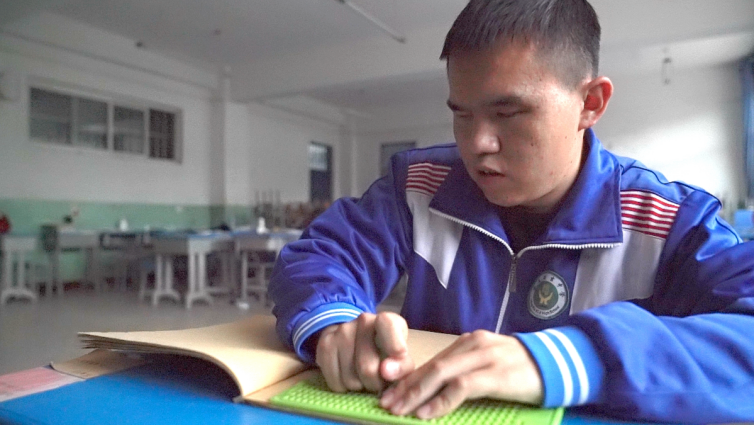
On Tuesday morning, Yang Wenju walked into the testing center in Xiji Middle School along with other students to take gaokao, the annual national college entrance examination. What distinguished Yang from other candidates was that he had the privilege of sitting the test in a room exclusively for him.
Yang, 21, is a blind student from Xiji county in Northwest China's Ningxia Hui autonomous region. Having lost his eyesight at the age of 10, Yang never gave up his pursuit for knowledge.
Yang's goal is to enter a medical university and become a physician specializing in massage and acupuncture after graduation.
This year, eight blind students signed up for the gaokao across China.
The test for blind students is the same as sighted candidates except that the papers are printed in Braille. Compared with sighted students, blind students have 50 percent more time to finish the test as it is more time-consuming for them to read Braille.
The smallest unit of Braille is composed of six dots, whose positions are arranged to represent letters. Usually it takes several such units to spell out the pronunciation of a Chinese character. And tactile graphics are designed to convey non-textual information.
In addition to blind students, special arrangements were also made for visually impaired students who sat the gaokao, such as large-print test papers, extension of test time by 30 percent, and permission to use magnifying glass and table lamps.
China has 20 million visually-impaired people. For a long time, they were unable to take the nation's most important exam.
The country first introduced Braille gaokao tests in 2014. That year, Li Jinsheng, a 46-year-old blind masseur from Shandong province, sat for the test, making him the country's first blind candidate to take the gaokao.
To enable Li to take the test like other candidates, the Education Ministry transported the tailor-made Braille test papers from Beijing to Henan province, where the test was to be held, the day before the gaokao.
Despite his poor score, Li's participation in the exam brought hope to many visually-impaired people who aspired to enter mainstream universities.
For visually-impaired students, there are two choices to get the opportunity to receive higher education: one is to take the entrance exam designed for schools for students with disabilities, and the other is sit the gaokao alongside able-bodied students, which remains a daunting task, as visually-impaired candidates don't enjoy extra points in the exam and have to compete with able-bodied students on a level playing field.
Since 2014, only a few blind candidates have taken the test annually, with some realizing their dream of studying at university.
For example, Ang Ziyu, a blind student from Anhui province, secured 635, a high score, in the grueling gaokao test in 2020, and was admitted to the information and computing science at Minzu University of China.
In 2015, Zheng Rongquan, a blind student from Zhejiang province, scored 570, and was enrolled by Wenzhou University.
But overall, most blind students still choose to attend schools for people with disabilities as most mainstream universities don't recruit blind students due to the lack of Braille teaching materials and staff with experience in education of visually-impaired students.
As one of the few blind students courageous enough to sit the gaokao, Yang Wenju said he wanted to experience the life of normal schools and study and live with able-bodied students.
Last year, Yang Wenju received an offer from a college dedicated to disabled people in Changchun, Jilin province. But he rejected the offer, believing he could earn a position in a mainstream university through taking the gaokao.
"I think college life is free, and I can learn anything I want to learn and do anything I want to do," he said.




- Fire relief allowance doubled to HK$100,000 for affected families in Hong Kong
- HK may ban smoking at building sites
- Academicians pledge to advance scientific innovation
- New records substantiate truths of war
- Flu activity in China rising, cases likely to peak soon
- Conceptual design of nuclear-powered icebreaker unveiled