Building age-ready cities
China needs to tackle four priorities to prepare itself better for a more urban future as it embraces for an aging society







China needs to tackle three priorities to prepare itself better for a more urban future as it embraces for an aging society
Two dramatic demographic trends are transforming the world today-population aging and urbanization. By 2050, two-thirds of the world's population will be living in cities and towns, an increase of more than 10 percentage points from 2018. In 1990, older persons comprised 6 percent of the global population; by 2050 they will make up 16 percent. That means one in six people in the world will be 65 or over, and 20 percent of them will be over 80.
Aging has a gender dimension, too. Since women live longer than men do, the future is not just older: it is also more female. This has implications for property and other resources that women can secure over their lifetime and are left with if their husbands die, especially, if the women do not have independent sources of income. Aging has gendered connotations in another way as well: caregivers of older persons tend to be overwhelmingly women.
These trends are global but apply to China with particular urgency. Over 12 percent of China's population was 65 or older in 2019, but this will double by 2050. At the same time, China is urbanizing rapidly, with almost 60 percent of its population living in cities and towns in 2018. By 2050, a staggering 80 percent of its population will be urban.
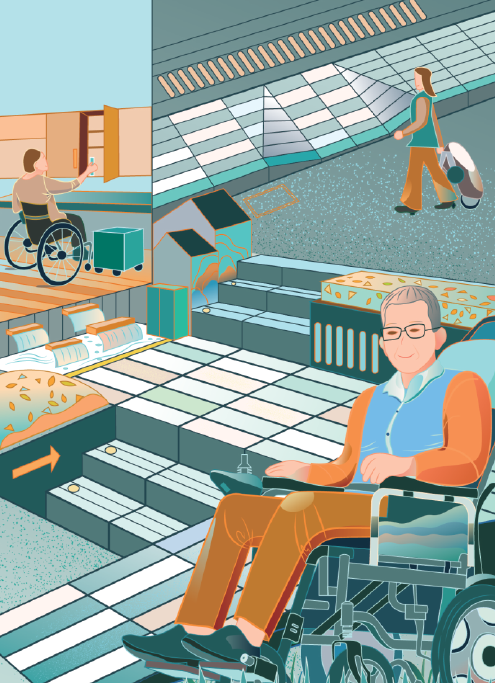
While simultaneous aging and urbanization are seen by many as a challenge, with the right policies the two trends can be turned into an opportunity. The key to this is to make cities ready for an aging population. As a recent World Bank report "Silver Hues: Building Age-Ready Cities" argues, age-readiness is not just good for older persons, but benefits the whole society. For example, when cities construct accessible sidewalks, they also benefit persons in wheelchairs, parents with strollers, and manual workers carrying heavy loads.
An age-ready city is also conducive to persons with disabilities. While aging cannot be conflated with disability, it is estimated 46 percent of persons aged 60 and older-are living with disabilities. In fact, most of us will have a brush with disability at some point in our lives-either temporarily or permanently-or as caregivers and proxies of older persons and persons with disabilities.
The benefits of designing cities for older persons are reason enough to make the requisite investments. But age-readiness also has direct benefits for the economy as well. Older persons constitute a large and growing market for goods and services. They are important consumers of healthcare, transport, technology, housing and entertainment. They often have a lifetime of savings that they can tap to live their senior years in comfort. The private sector has much to gain from this expanding market, as reflected in rising investments in the "silver "economy.
China foresaw its aging economy and society decades ago. "Smart elder care"-using technology wisely to meet the diverse and increasing demand of older persons, is scaling up at a rapid pace, with some of China's largest companies entering the market, often in partnership with local governments. Shandong province, for example, has an online hospital that provides a variety of services, including consultations with doctors, diagnosis, prescriptions, disease management and other follow-up services. This has been particularly useful during the COVID-19 pandemic, as the service saves patients from in-person hospital visits and reduces pressure on the healthcare system.
In pursuit of universal accessibility, China also established the Code for the Design of Residential Buildings for the Aged in 1999 as the design standard to meet the needs of aging adults. This is applicable to both new and renovated buildings. China's richer coastal cities offer many examples of improved accessibility and boast a growing commercial market for elderly care.
While China has been an "early mover" in harnessing the gains of its aging population, based on the analysis in the World Bank report, three priorities stand out for China to prepare itself better for an older and more urban future.
First, China's accessibility standards in urban design need to be better enforced. Universal accessibility of the built environment requires training urban planners, architects, construction engineers and other professionals. Such capacity building is critical if accessibility is not to remain an add-on or an afterthought.
Second, building new infrastructure or repurposing the old needs financing. While it is more cost-effective to build in accessibility features during construction, many old buildings will need to be refurbished toward age-readiness. Public private partnerships can be harnessed to mobilize the requisite commercial funding.
Third, given the additional costs of making cities age-ready, China will need to pay special attention to cities and towns, as well as individuals and households with fewer resources. Innovative solutions will need to be encouraged, from low-cost medical technologies to new forms of community-based care, particularly in rural areas where outward migration has undermined the traditional model of family-based care.
These priorities should ideally be central to China's growth agenda. Successful cities of the future will be those where older persons can contribute to their fullest potential and be partners in the country's growth and development.
Maitreyi Bordia Das is practice manager in the Global Practice for Urban, Resilience and Land at the World Bank. Yuko Arai is urban specialist in the East Asia and Pacific Region of the World Bank. Yoonhee Kim is the World Bank's sector leader for Sustainable Development in China. The authors contributed this article to China Watch, a think tank powered by China Daily. The views do not necessarily reflect those of China Daily.
Contact the editor at editor@chinawatch.cn.