Jidu Auto steps up to roll out mass-produced robocars







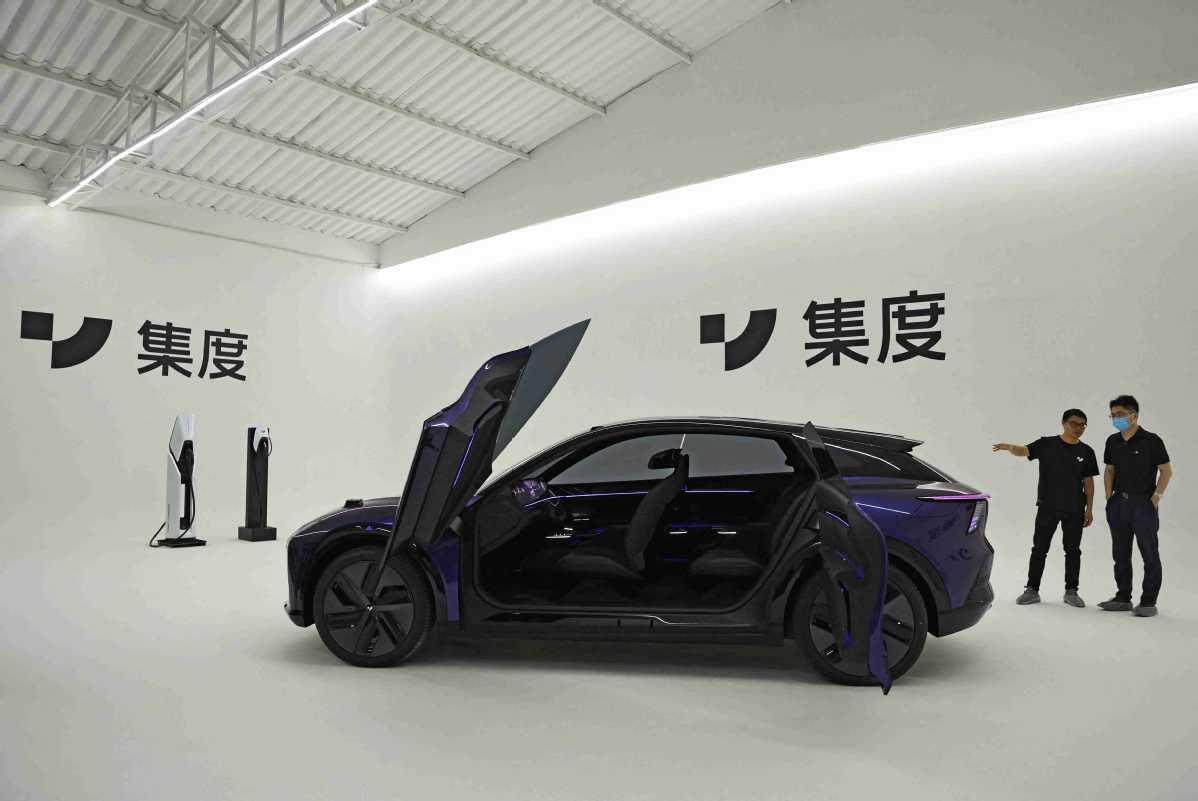
Smart electric vehicle company Jidu Auto, a joint venture established by Chinese tech giant Baidu Inc and carmaker Geely Holding Group, plans to launch its first mass-produced robocar model in the coming autumn and open the first self-owned store in the fourth quarter of this year.
The mass-produced version, which will be 90 percent similar to its concept car, will possess level 4 autonomous driving capability that needs no human intervention, said Xia Yiping, CEO of Jidu.
"We will build our own sales, delivery and after-sale service system," Xia said while adding the EVs will be manufactured in Ningbo, Zhejiang province, where Geely has several plants.
The company has unveiled its first concept robocar named Robo-01.The concept car features a futuristic design, including a U-shaped folding steering wheel, a 3D borderless one-piece screen, 3D human-machine co-driving map, a full-scene voice inside and outside the car, millisecond voice response and offline intelligent voice assistant.
Equipped with the autonomous driving software technology powered by Baidu and lidar sensors, the robocar owns high-level voice interaction abilities, and is capable of self-learning and self-improvement based on user behavior, Xia added.
"The Jidu robocar aims to meet user needs for intelligent travel, in-car intelligent assistance and an intelligent cabin in the new era," said Xia, adding "the ultimate goal is to realize a fully driverless transportation experience".
Xia said the company will also unveil the design of its second mass-produced model at this year's Guangzhou Auto Show.
The first model will target the family car market and will be priced above 200,000 yuan ($30,000), said Robin Li, co-founder and CEO of Baidu, during a conference call last month.
The automaker will start receiving orders for the robocar from the second half of the year, with deliveries expected to begin in 2023, Li added.
Founded in March last year, Jidu Auto completed a $400 million Series-A financing in January. With the completion of the financing, Jidu is set to continue accelerating progress in R&D and mass production.
Baidu will leverage its advantage in software and artificial intelligence capabilities, while Geely will contribute its expertise in automobile design and manufacturing, Xia added.
Zhang Xiang, a researcher at the Automobile Industry Innovation Research Center, which is part of North China University of Technology in Beijing, said Baidu has accumulated abundant data and experience in operating the autonomous driving vehicles in several cities across the nation, which could be applied into the mass-produced model of the robocar.
Baidu's move to venture into the burgeoning electric vehicle segment will help the company diversify its business and explore more revenue streams, Zhang said.
"There are some highlights and innovations in the newly launched concept car, such as the highly autonomous driving system, intelligent cabin and retractable steering wheel, which is seldom seen in the country's EV market," he added.
China is the world's largest market for electric cars and plug-in hybrids, attracting startups and established carmakers to explore the lucrative segment.
Industry experts said that controlling the manufacturing cost is an urgent problem to be dealt with, given the price hikes in lithium batteries and other upstream raw materials as well as the chip shortage.
Last year, more than 3.5 million such vehicles were sold in China, up 157 percent year-on-year, accounting for 13.4 percent of total vehicle sales, according to the China Association of Automobile Manufacturers. The association expects the figure to reach 5 million this year as demand continues to rise.
According to the latest development plan for the NEV industry from 2021 to 2035 approved by the State Council, the nation's NEV sales are expected to account for 20 percent of all new vehicle sales by 2025, and vehicles used in public transportation will be completely electrified by 2035.